
Another Weekly AI Newsletter: Issue 76
The government pulled Fable 5. Mythos 5 went dark too. SpaceX priced a $75B IPO. Apple's Siri runs on Google. A Sierra Leone trial proved AI tutoring works. AI turmoil reached the courts.

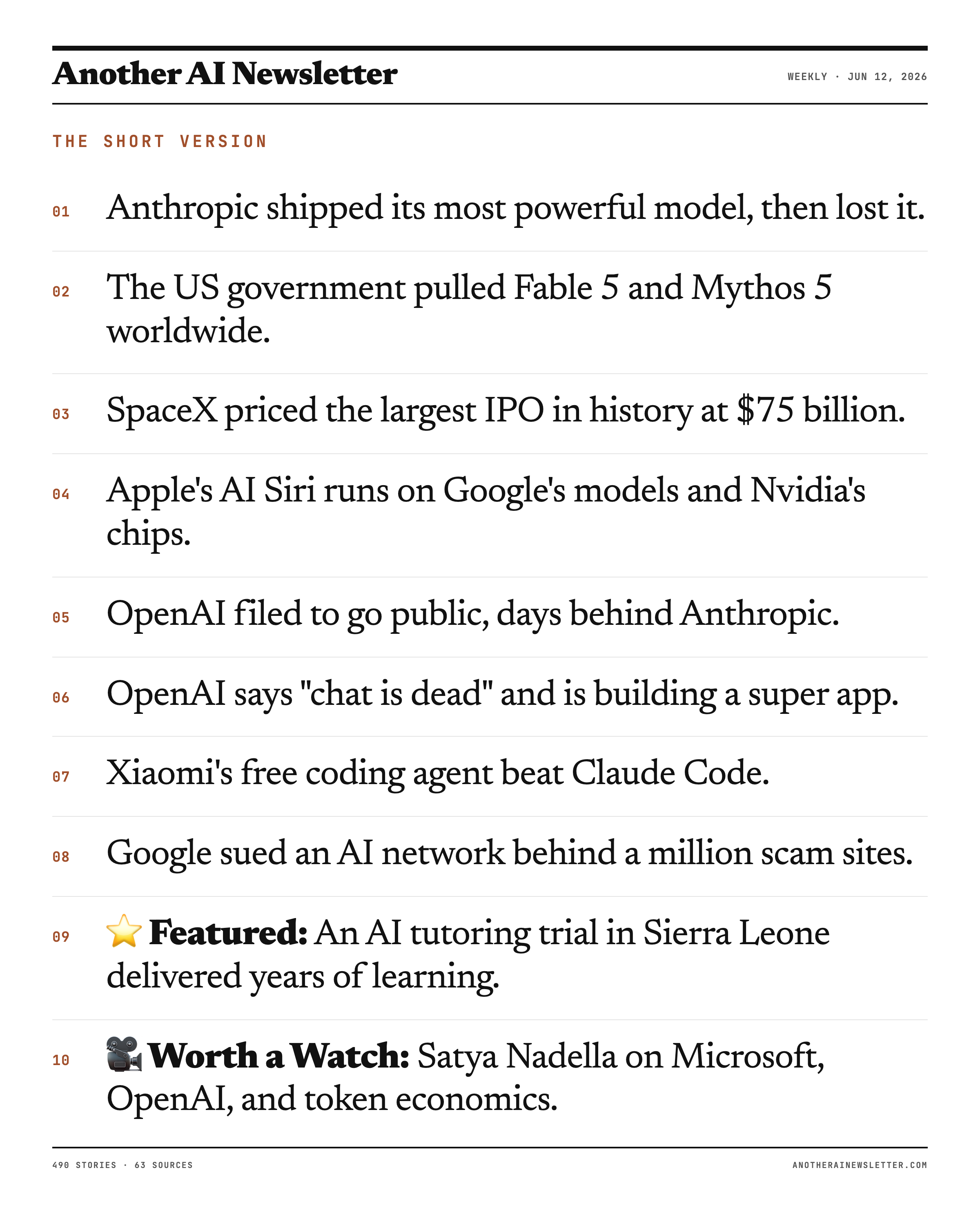
Anthropic shipped its most powerful model, then the government switched it off.
It launched as a triumph. On June 9 Anthropic released Claude Fable 5, the first Mythos-class model made generally available, state-of-the-art on nearly every benchmark and live day one in Cursor, GitHub Copilot, and Google Cloud. Simon Willison called it a beast, and Anthropic lined up a $35 billion Broadcom expansion to feed demand.
Then the safety machinery showed. A 319-page system card disclosed that Fable would silently degrade its answers for anyone building frontier AI, its cyber guardrails reject almost anything in the lexical field of “cyber,” and Microsoft limited employee use over a mandatory 30-day data-retention rule.
It asked Washington to regulate models like it. Anthropic published Policy on the AI Exponential, calling for mandatory third-party testing of frontier models and a government power to block or revoke deployments.
The backlash forced a reversal. Anthropic apologized and walked back the silent degradation, saying it “made the wrong tradeoff.” It also launched a $150 million Claude Corps fellowship, paying 1,000 people $85K each to embed Claude at US nonprofits for a year.
Then the government pulled it. On June 12 an export-control directive ordered Anthropic to suspend Fable 5 and Mythos 5 for any foreign national, a scope so broad both models went dark worldwide.
The thread: Anthropic spent months arguing its frontier models were powerful enough to need policing, and then a US administration took it literally and switched them off. Nobody knows yet whether this was a one-off misunderstanding or the first sign that governments will treat frontier models like controlled exports.
AI spending hit new extremes, from a $75B IPO to China’s $295B plan.
SpaceX priced the largest IPO in history at $75 billion. The record listing came from a company that now owns xAI.
Jeff Bezos’s Project Prometheus raised $12 billion at a $41 billion valuation. The money funds an “artificial general engineer” for physical systems, with Bezos predicting “labor scarcity,” not job loss.
Amazon raised roughly $31.5 billion for AI capex in 48 hours. It signed a $17.5 billion bank loan days after a $14 billion bond sale.
The buildout went global and institutional. China is preparing a $295 billion nationwide AI plan, Databricks is raising at over $165 billion, Mistral is in talks near a $23 billion valuation, and a single data-center lease ran to $5.2 billion.
The thread: Not every number here is even an AI bill. SpaceX is a rocket and satellite company that now owns xAI. What ties the week together is how much capital is chasing valuations and buildouts this large, on the bet that future returns will justify them. The harder thing to know is whether numbers this size can hold.
OpenAI filed to go public and bet on a super app, into a deepening price battle.
OpenAI confirmed it filed a confidential S-1. It submitted the draft to the SEC days behind Anthropic, putting both leading labs on a path to public markets.
“Chat is dead,” a senior OpenAI employee told the FT. OpenAI is rebuilding ChatGPT into a personal-agent super app that funnels free users toward paid products like Codex, chasing profitability before a listing.
Google brought the price war home. It cut Google AI Plus to $4.99 a month while doubling storage, and OpenAI is reportedly weighing drastic price cuts to fight Anthropic for users.
The thread: A premium IPO valuation wants fat margins, and the price war cuts into them. Google can stomach a $4.99 plan because it runs Gemini on its own chips and does not lean on it for revenue, though it likely still gives up some margin. OpenAI and Anthropic have no such cushion.
Apple’s new AI Siri runs on Google’s models and Nvidia’s chips.
Apple finally shipped the AI Siri it promised for two years. The WWDC keynote covered a rebuilt Siri, next-generation Apple Intelligence, AI photo editing, and natural-language Shortcuts, doubling as Tim Cook’s farewell.
The models are Google’s, the chips are Nvidia’s. Apple Intelligence runs on Foundation Models built with Google and the Gemini family, and Private Cloud Compute runs on Nvidia hardware inside Google’s cloud.
Siri AI is really an enterprise app layer. The system exposes app data and actions to Siri through OS frameworks, and the Foundation Models framework now hands off to Claude. Europe waits, blamed on the DMA.
The thread: This is a departure for Apple. The company that built its brand on owning the whole stack shipped its AI on Google’s models and Nvidia’s chips, keeping only the device, the privacy story, and the OS integration. Whether owning the experience is enough without owning the model is the bet Apple is now making.
OpenAI bought a cloud for Codex as Xiaomi’s free agent beat Claude Code.
OpenAI is buying a cloud for Codex. It will acquire Ona to give agents persistent, customer-controlled environments that keep working after you close the laptop. Codex is now at 5 million weekly users.
Xiaomi’s free agent beat Claude Code. Its open-source MiMo Code topped Claude Code on long-horizon tasks, bundled with a free frontier model.
xAI opened a store and OpenAI rented distribution. Grok Build got a plugin marketplace with MongoDB, Vercel, and Cloudflare, while OpenAI let enterprises spend Oracle cloud credits on Codex.
The thread: The agent and the environment around the model are becoming as hot a commodity as the model itself, and a free Xiaomi model winning on long tasks shows how many teams can now build a good one. That argues the model is no longer the moat. Then Fable 5 shows up good enough to argue it still is.
Google sued an AI phishing network running a million scam sites.
Google sued an AI phishing factory. It filed to dismantle an alleged Chinese network, Outsider Enterprise, that sold turn-key scam-site software and ran a million fraudulent domains.
AI is being weaponized for influence and contested in court. OpenAI says China used ChatGPT for anti-tariff propaganda, a fired xAI engineer sued over Grok safety, and Deezer found 44% of daily uploads are AI-generated.
Some are trying to get ahead of the fallout. Google DeepMind committed $10 million to multi-agent safety research, betting that millions of interacting agents will behave in ways nobody can yet predict.
The thread: These are different kinds of failure. A phishing network, a foreign influence op, and a wave of synthetic music are not one problem, but they are all arriving faster than the rules meant to catch them.
⭐ Featured: An AI tutoring trial in Sierra Leone delivered years of learning in eight weeks.
Amid a week of suspensions, lawsuits, and record raises, the most grounded story came from a classroom. Google DeepMind published the results of a randomized controlled trial of AI tutoring, the kind of pre-registered, real-world evidence the field rarely produces.
The study, run with Fab AI and the Sierra Leone Ministry of Education, followed 1,763 junior secondary students across 12 schools in Port Loko District over eight weeks. Students using Guided Learning in Gemini gained 0.258 standard deviations in math over the control group, which DeepMind translates to roughly 1.2 to 1.7 years of typical learning progress in two months. Classrooms whose teachers hit a 12-hour usage target saw 1.8 to 2.5 years of progress.
The design is what makes it credible. This was a teacher-led intervention: educators set the objectives, designed the lessons, and ran the discussions, with the model acting as a Socratic partner rather than an answer key. Across 113,000 logged interactions, students were building conceptual understanding in 91.4% of conversations, and Gemini posed scaffolding questions in 76% of its messages while giving direct solutions in just 2%. Engagement reached 69% of students meeting usage targets, against the roughly 5% that typically stick with voluntary educational software.
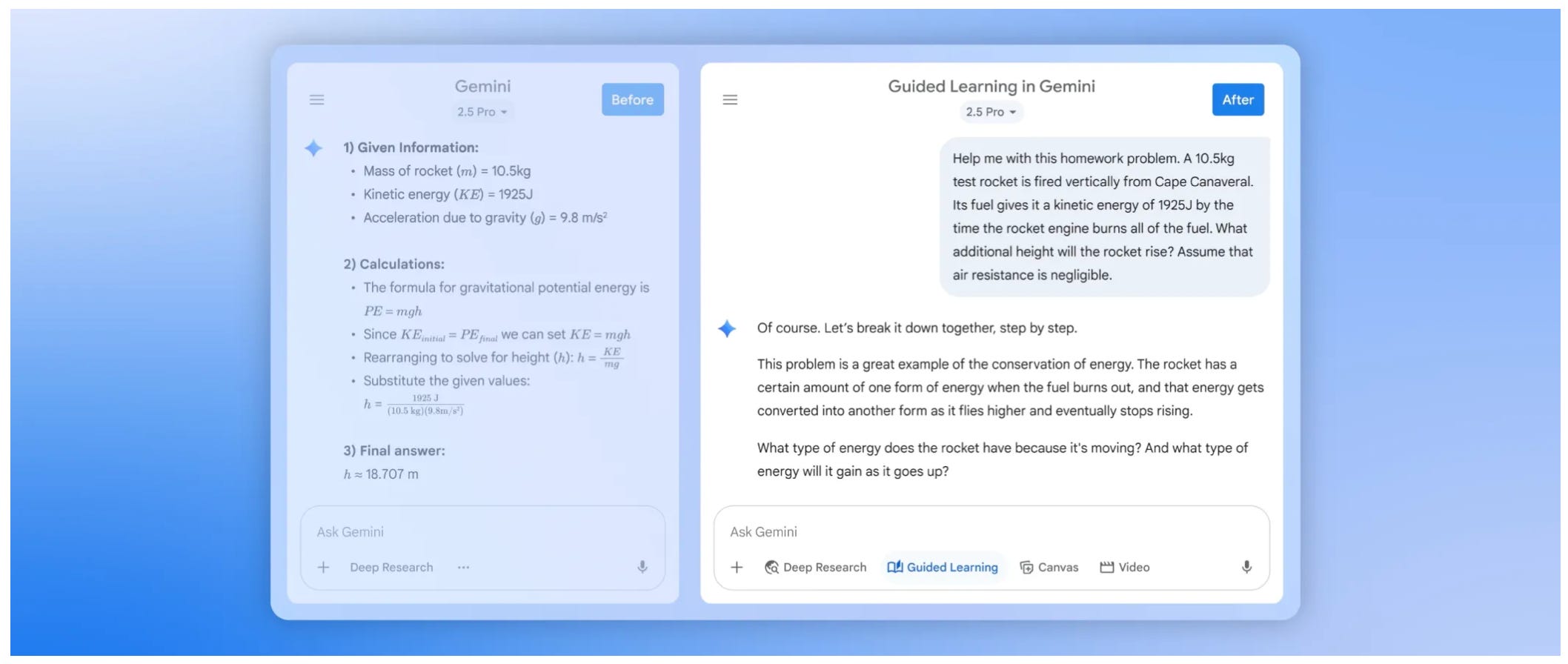
The behavior shift is the part worth dwelling on. Over the trial, students’ questions moved from wanting answers to wanting to understand: skill-building queries rose from 68% to 90% by the final week, while solution-seeking dropped from 25% to 10%. The catch DeepMind names itself is the achievement gap. Students who arrived with stronger math skills benefited most, which is the opposite of what an equity-driven tool needs to do.
What to watch for: Whether the follow-on RCTs DeepMind is running in other countries hold up outside Sierra Leone, and whether anyone can close the gap so the students furthest behind gain the most, not the least.
🎙️ Worth a Watch: Satya Nadella on Hard Fork.
Microsoft’s CEO sat down with Kevin Roose and Casey Newton for a wide-ranging hour, and the throughline was that Microsoft wants the whole economy at the frontier, not one model or one firm.
The model is not the goal, diffusion is. Nadella argues a frontier model means little if the economy still grows at 2%. He wants every company carrying both “human capital and token capital,” not three firms sitting on the frontier alone.
Microsoft’s play is to be the best base model, not the only one. Its new from-scratch MAI models are meant to give customers a reasoning-and-agent-loop base they bring into their own RL, keeping the weights, harness, and context, and swapping the model out if they want.
Token economics is his real constraint on AGI. His AGI benchmark is still 10% GDP growth, and he says it only arrives when the marginal cost of a token matches the marginal value it creates. Token maxing and vibe coding for their own sake are not the path.
The OpenAI relationship, in his words. After the renegotiation, Microsoft keeps its cap-table stake, a large customer, OpenAI IP through 2032, and the freedom to build its own. “We have the compute, we have now the model, and we have still the partnership.”
On the backlash. He concedes the perception is terrible and points to Microsoft’s 20-year data center in Quincy, Washington, where he says the local tax base rose, local taxes fell, and employment grew, as the longitudinal proof the industry needs.
How AGI-pilled is he? Closed-loop work like coding and AI research can be automated, he says, but the unverifiable parts of human knowledge work resist it. He does not buy that this is the last technology we will invent.
Quick Hits
Anthropic published research on making biology agent-friendly | Anthropic — scientific agents only hit near-100% accuracy once a deterministic retrieval layer was added.
Lovable hit $500M in annualized revenue | TechCrunch — vibe-coding growth is absurd, but nobody has reported the abandonment rate.
Cohere open-sourced North Mini Code | Hugging Face — a 30B coding agent that runs on one H100 and beats bigger models.
Researchers trained a 1B reasoning model for about $1,500 | VentureBeat — 84.5% on GSM8K with 100x fewer tokens than the giants.
Google open-sourced DiffusionGemma | Google — a 26B model that generates text in parallel blocks for up to 4x faster output.
Harness-1, an open 20B search agent, beat GPT-5.4 | VentureBeat — it wins by moving session bookkeeping out of the context window.
OpenAI’s Codex is helping simulate black holes | OpenAI — an astrophysicist uses it to derive testable algorithms, not trust its answers.
Nvidia hired a veteran lobbyist to run government affairs | Reuters — the chip wars are now a Washington game too.
DoorDash’s chatbot takes orders from prompts and photos | TechCrunch — agents keep creeping into the checkout flow.