
Another Weekly AI Newsletter: Issue 79
Commerce lifted Fable 5 export ban. Anthropic releases Sonnet 5, Claude Science, and a California deal. OpenAI offers Washington 5% stake. Microsoft's new FDE company. Zuck says agent use is behind.

The Short Version
Anthropic’s export ban is over.
Claude Sonnet 5 runs agents at Sonnet prices.
OpenAI offered Washington 5% of itself.
Microsoft built a $2.5B AI deployment company.
Zuckerberg says agents are behind schedule.
South Korea commits $550B to the memory crunch.
Claude Science turns Claude into a lab workbench.
Washington’s grip turned into a stake.
The Department of Commerce lifted export controls on Claude Fable 5 and Mythos 5. Anthropic said it received notice and began restoring access, and Simon Willison flagged the notice the morning it landed.
OpenAI proposed donating 5% of its equity to a US sovereign wealth fund. Under the proposal reported by the Financial Times, other AI companies would donate similar stakes.
California signed a first-of-its-kind Claude deal. Governor Newsom’s partnership makes Claude available to every state agency at half price, the first AI productivity tool offered statewide.
Chinese startups shipped Mythos lookalikes while the ban dragged. Chinese security firm 360 unveiled Tulongfeng, claiming it goes head-to-head with Mythos, and Epoch AI found high- and critical-severity CVE disclosures spiked in June, with timing that lines up with Mythos Preview but several possible causes.
Nathan Lambert argued the policy fight is becoming regulatory capture. He warned that pressure around model distillation risks squeezing open-source AI, and Sakana pointed to growing Fugu demand as US access restrictions reshape the market abroad.
The thread: lifting the controls restores access, not the status quo. While the models were dark, buyers watched a frontier capability switch off on a policy decision, and vendors from Tokyo to Beijing moved to fill the gap. Whether that window permanently pushed security customers toward models no government can turn off is the question the next quarter answers.
Anthropic shipped like it never left.
Claude Sonnet 5 launched as a cheaper way to run agents. Anthropic says the model plans, uses browsers and terminals, and runs autonomously at a level that recently required larger, more expensive models.
Sonnet 5 is the new default in Claude Code for Pro users, with a 1M context window at Sonnet pricing. It hit GitHub Copilot, Perplexity, and Notion on launch day, and Cursor reported 57% on CursorBench, up from 49% for Sonnet 4.6.
API rate limits went up 5x as Anthropic raised limits for all users and simplified tiers.
Claude went deeper into Microsoft’s stack. Claude in Microsoft Foundry hit general availability on Azure, and Anthropic’s models now run on NVIDIA GB300 systems in Azure.
Anthropic is discussing a custom chip with Samsung. The Information reported the talks, the strongest signal yet that Anthropic wants its own silicon.
Claude Desktop reached Linux in beta, bringing Claude Code and chat to Ubuntu and Debian.
The thread: the caveat inside the launch week is pricing. Simon Willison’s notes on Sonnet 5 found the new tokenizer makes English roughly 1.4x more expensive, so the sticker price and the effective price are not the same number. Whether agent workloads actually migrate down from Opus-class models or the bills just grow is what the usage curves will show.
The labs’ new product is people.
Microsoft launched Frontier Company, a $2.5B AI deployment business. The new operating company embeds 6,000 industry and engineering experts inside customer businesses to deploy and continuously improve enterprise AI, and TechCrunch notes it sells outcomes, not licenses.
Satya Nadella framed it as a learning loop. He described Frontier as human capital and token capital compounding, turning customer knowledge and workflows into AI systems that improve over time.
Amazon launched a $1B forward-deployed engineering org. AWS built the group explicitly on the model OpenAI and Anthropic pioneered: engineers who sit with the customer until the AI works.
The thread: the caveat is that embedding thousands of engineers is a services business, with services margins, inside companies that trained investors to expect software margins. Amazon copying OpenAI’s forward-deployed playbook suggests model quality alone is not closing enterprise deals. If deployment needs this much human scaffolding, is that a temporary bridge or the actual product?
The agent reality check arrived.
Mark Zuckerberg told staff AI agents haven’t progressed as quickly as he hoped. The internal comments came as Alexandr Wang teased the next Muse Spark update promising more competitive coding and agentic capability.
Ford rehired ‘gray beard’ engineers after AI fell short. The company brought back veteran engineers for work its AI systems could not handle.
A widely cited ChatGPT education study was retracted. The 2025 meta-analysis claiming ChatGPT improved learning was pulled in April after discrepancies undermined the findings.
The AI jobs debate got messier, with TechCrunch walking through conflicting displacement data, and the Jersey Mike’s IPO became the hype exhibit when a sandwich chain pitched AI in its filing documents.
The thread: these are single data points, not a trend line, and the counterexample landed in public view. Cat Wu says Anthropic’s internal Claude Tag lands 65% of the company’s product PRs. The gap between the best deployment and the median one is the real story, and the open question is whether that gap is the models or the integration work around them.
Memory is the new GPU.
South Korea’s chipmakers committed over $550B to ease ‘RAMageddon.’ Samsung and SK Hynix plan four new memory fabs in southwestern South Korea, part of a package framed as answering the AI memory crunch.
Apple is asking Washington for permission to buy Chinese memory. The FT reports Apple wants to source DRAM from CXMT, a company on a US blacklist over alleged military ties.
Wall Street thinks Micron is the next Nvidia. The Boise memory maker captured the market’s attention on the AI-driven supply crunch.
Google capped Meta’s use of Gemini over compute constraints. Reuters picked up the FT report that Google could not provide all the capacity Meta wanted, turning model access into a capacity-allocation problem.
McKinsey says US data-center investment is up about 200% since late 2022, while non-AI productive investment stayed flat.
The thread: the caveat is that these are multi-year commitments, not money spent today. But when Apple, the most supply-chain-conservative company in tech, asks permission to shop from a blacklisted Chinese supplier, the shortage is not theoretical. The question consumers should ask is when memory scarcity starts showing up in device prices.
⭐ Featured: Claude Science bets the workbench beats the model.
Anthropic released Claude Science, an AI workbench that pulls the fragmented tooling of computational research, the databases, file formats, Jupyter notebooks, and cluster terminals, into one environment. A generalist coordinating agent comes with more than 60 curated skills and connectors preconfigured for genomics, single-cell, proteomics, structural biology, and cheminformatics. It spins up sub-agents, hands work to specialist agents users build themselves, and runs a separate reviewer agent that checks citations and calculations as pipelines execute, flagging untraceable numbers and figures that don’t match their underlying code. Every figure ships with the exact code and environment that produced it, a plain-language description, and the full message history, and you can edit a figure conversationally: ask for a log-scale axis and the agent rewrites its own code. It runs on the lab’s own infrastructure, a laptop, Linux box, or HPC login node over SSH, so sensitive datasets never leave the systems they already sit on, and it submits jobs to your own cluster or a Modal account, scaling from one GPU to hundreds. NVIDIA’s BioNeMo Agent Toolkit connects it natively to Evo 2, Boltz-2, and OpenFold3.
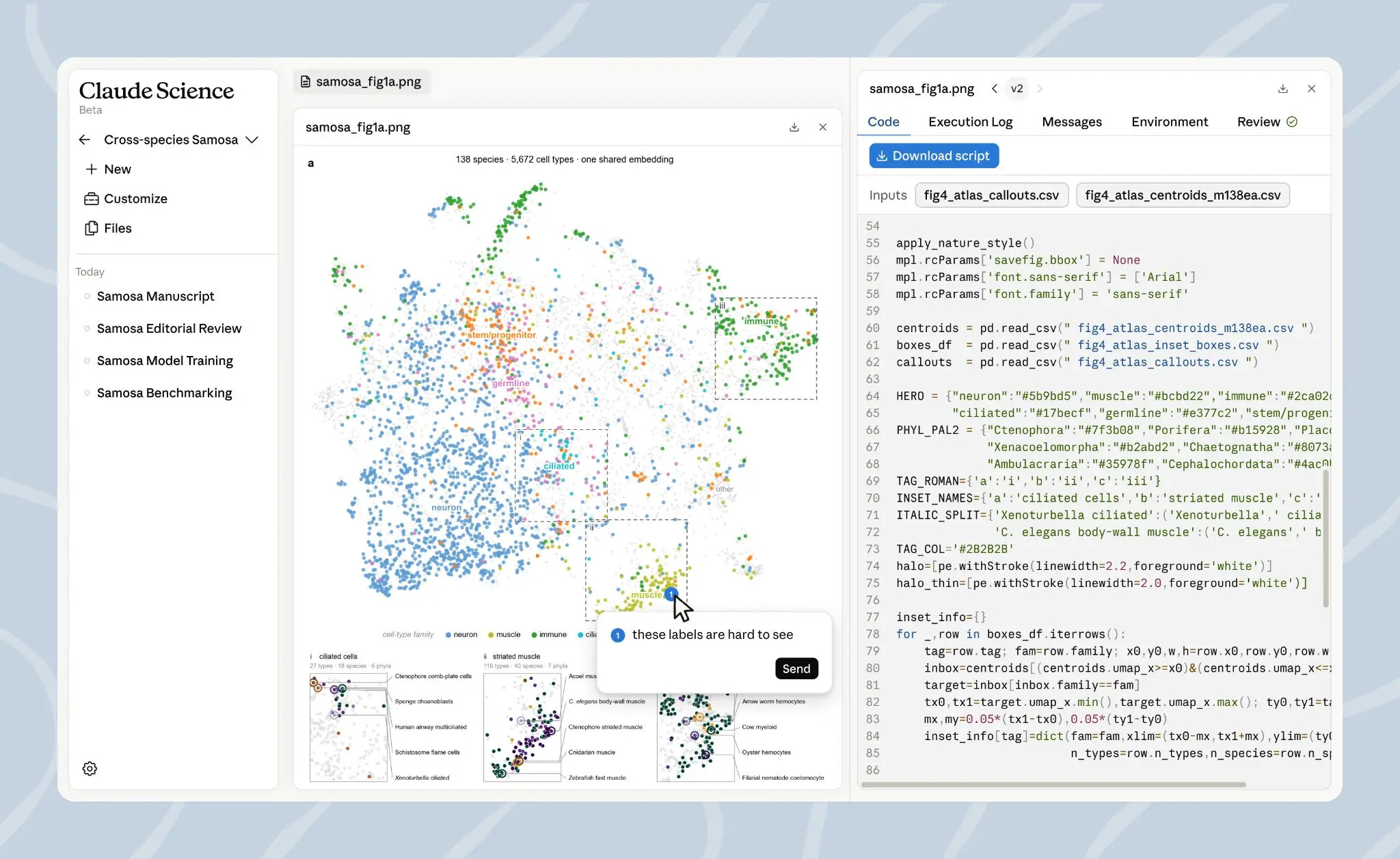
The beta users are the persuasive part. Manifold Bio used it end-to-end to nominate targets for tissue-targeting medicines, ranking candidates against criteria learned from its own proprietary data. Allen Institute neuroscientist Jérôme Lecoq built a review-writing pipeline from about 20 custom skills and actor-critic agent pairs: literature reviews that previously took his team up to two years now exist ten at a time, many over 100 pages, with citations checked by reviewer agents. A UCSF Brain Tumor Center lab cut comprehensive glioma germline workups to roughly a tenth of the previous time, with results independently validated. Notably, none of this involves a new model; it is the same Claude everyone already has. TechCrunch reads the launch as a three-way strategy split: OpenAI gates a fine-tuned GPT-Rosalind behind enterprise review, Google DeepMind owns AlphaFold and AlphaGenome outright, and Anthropic goes wide, with a beta for every Pro, Max, Team, and Enterprise plan plus $30,000 in credits for up to 50 research projects, applications open through July 15. It is the Claude Code playbook applied to science: own the workflow layer and let the model underneath be interchangeable.
🎙️ Worth a Listen
The talk is by Adam Brown, a former Princeton and Stanford physicist who now leads Blueshift, the Google DeepMind team focused on AI scientific reasoning, and is a core contributor to Gemini. He traces how language models went from babbling preschoolers to IMO gold medalists in five years, then asks what happens to physics if the trend keeps going.
Quick Hits
Cursor launched a native iOS app | TechCrunch — drive cloud agents from your phone, Composer 2.5 is 75% off in-app through July 5.
OpenClaw landed on Android and iOS | TechCrunch — the open-source automation agent goes mobile.
Google shipped Nano Banana 2 Lite and Gemini Omni Flash | TechCrunch — sub-4-second image generation at $0.034 per thousand images.
Meituan open-sourced LongCat-2.0 | VentureBeat — a 1.6T-parameter agentic coding model trained entirely on Chinese chips.
DeepSeek released DSpark | MarkTechPost — open speculative decoding that speeds DeepSeek-V4 serving 60-85%.
X now offers a hosted MCP server | TechCrunch — Claude, Cursor, and Grok Build can plug straight into the platform.
Meta quietly launched Pocket | TechCrunch — prompt-generated games from the Gizmo acquisition.
OKX wants AI agents to hire and pay each other | TechCrunch — a marketplace where agents find jobs and build trust.
Chamath raised a $135M Series A and took the CEO role | TechCrunch — the SPAC king now runs an AI coding startup.
Arena is now a $100M business | TechCrunch — the leaderboard everyone argues about found a business model.
The DeepMind trio behind a poker AI now runs a $500M quant lab | TechCrunch — game theory graduates to hedge funds.
Sebastian Raschka released Build a Reasoning Model (From Scratch) | X — 440 pages of inference scaling, RL, and distillation, 18 months in the making.