
Another Weekly AI Newsletter: Issue 75
Claude writes 80% of Anthropic's code, Google rents SpaceX's GPUs, Microsoft breaks from OpenAI, New York moves to ban data centers, and hackers fooled Meta's AI

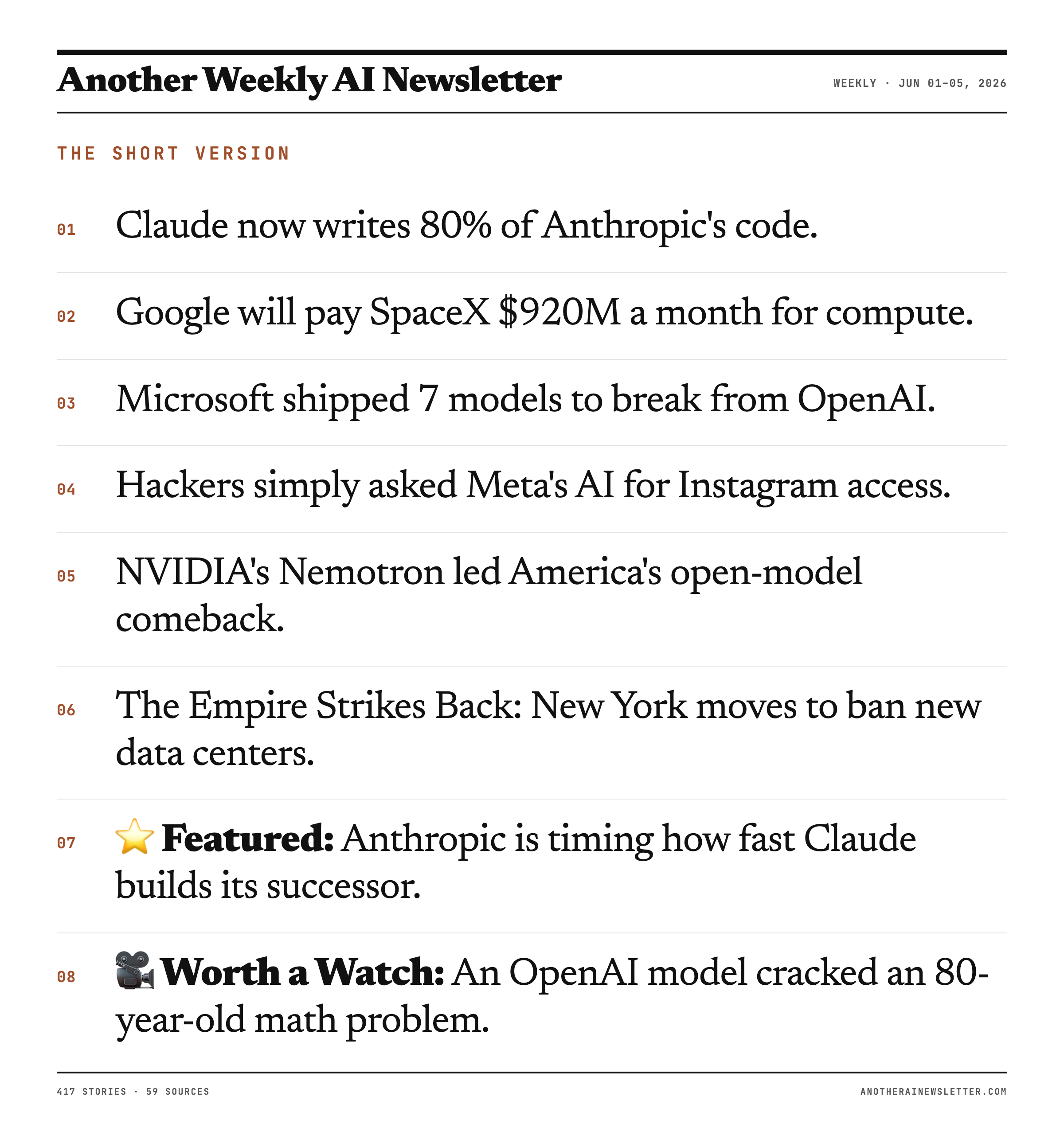
Anthropic raises, Google takes a slice of the space compute pie and Washington wants in.
Anthropic raised $65B at a $965B valuation and filed to go public. It confidentially submitted a draft S-1 and pushed back on doubts about AI’s returns ahead of the listing.
Alphabet is raising about $85B to fund its AI buildout. The record equity offering landed days after it signaled an $80B plan.
Google agreed to pay SpaceX $920M a month for roughly 110,000 GPUs. AirTrunk committed $30B for 5GW of data centers in India and SoftBank pledged up to €75B for French data centers, while the Google-SpaceX deal runs through 2029.
The token bill came due. The Linux Foundation launched a Tokenomics Foundation to discipline AI spend, after Uber capped employee AI budgets and GitHub’s usage-based Copilot billing drew a developer revolt.
Washington wants a stake in OpenAI. Altman and the White House are in talks for the government to take equity, with OpenAI floating donated shares to seed a public wealth fund and Trump saying the American public could “become a partner.” Altman separately lobbied against mandatory model approvals.
Microsoft started building its way out from under OpenAI.
Microsoft shipped seven homegrown models, including its first advanced reasoning model. The MAI lineup was pitched as a move toward self-sufficiency and lower developer costs.
Its AI chief said the company was “set free” from OpenAI to pursue superintelligence. Mustafa Suleyman framed independence as the real project, with models trained from scratch.
It launched Scout, an OpenClaw-based assistant, and Project Solara, a platform for agent-first devices. Scout is an always-on personal agent that works across Microsoft 365; Solara is a chip-to-cloud platform for agent-first devices.
It is building a frontier health model with Mayo Clinic. The partnership pairs Mayo’s clinical data with Microsoft’s AI, alongside a unified agentic stack with NVIDIA.
LangChain, Salesforce, and Anthropic shipped agent infrastructure, and hackers fooled Meta’s support AI.
Anthropic turned Claude Code into a platform. It shipped dynamic multi-agent workflows and documented how it runs hundreds of internal skills.
LangChain built out the production-agent stack. Across the week: efficient verifiers for legal agents, self-correcting Rubrics, model neutrality, fault tolerance in LangGraph, and a sandboxed computer for every agent.
Salesforce and Google pushed agents past the pilot stage. Salesforce detailed what it takes to ship to production, where one deployment cut conversation failure from 33% to 0.5%, while Google added agentic RAG that keeps searching until it has enough context.
Then the bill for autonomy arrived. Hackers talked Meta’s AI support agent into handing over Instagram accounts, an exploit MIT used to show AI agents are too eager to please. OpenAI shipped Lockdown Mode to cut the data-exfiltration leg of prompt-injection attacks.
NVIDIA’s Nemotron anchored an open and fast model surge.
Nemotron 3 Ultra landed on AWS and Perplexity. The 550B-parameter open MoE went one-click on SageMaker JumpStart and live for Perplexity Pro and Max. NVIDIA also shipped a 4B safety model that reasons over custom policies.
Speed became the headline spec. Cerebras reported Kimi K2.6 finishing a task in 5.6s to Gemini 3.5 Flash’s 17.5s, and clearing 452ms time-to-first-token for real-time voice.
Small models proved they are a design choice. A Hugging Face hackathon ran a multi-agent economy on a 3B model, and Holo3.1 brought fast local computer-use agents.
Alibaba zigged. Qwen3.7-Plus added multimodal inputs at low cost but shipped closed-source, breaking from its open-weight history.
The Empire Strikes Back
New York moved on two AI bills. The legislature is poised to pass a one-year data center moratorium, which would be the first statewide ban if Gov. Hochul signs it, and passed a bill barring AI chatbots from posing as companions to kids 60-0, now awaiting her signature.
Courts are filling with AI-written filings. A study found AI-flagged self-represented lawsuits are surging. Florida sued OpenAI and Altman, and a UK lawmaker sued xAI over Grok images.
Trump signed a narrower AI oversight order after industry pushback. The revamped order asks for voluntary model submissions instead of mandates.
AI’s social friction showed up everywhere. Ladybird stopped accepting public pull requests over AI-generated patches, Meta rolled back an employee mouse-tracking tool, and China is funding an AI agent to promote Xi Jinping’s thinking.
Andrew Ng’s warning for the week: the cyber risk is real this time, which is exactly when lobbyists overreach for excessive regulation.
⭐ Featured: Anthropic is measuring how fast Claude can build the next Claude.
Anthropic’s Institute published When AI builds itself, a data-heavy look at how much of its own development the company has already handed to Claude, and what that implies for recursive self-improvement: an AI fully autonomously designing and developing its own successor. The piece is careful. That is not here yet, and not inevitable. But it argues the trend lines point that way, and could arrive sooner than most institutions are prepared for.
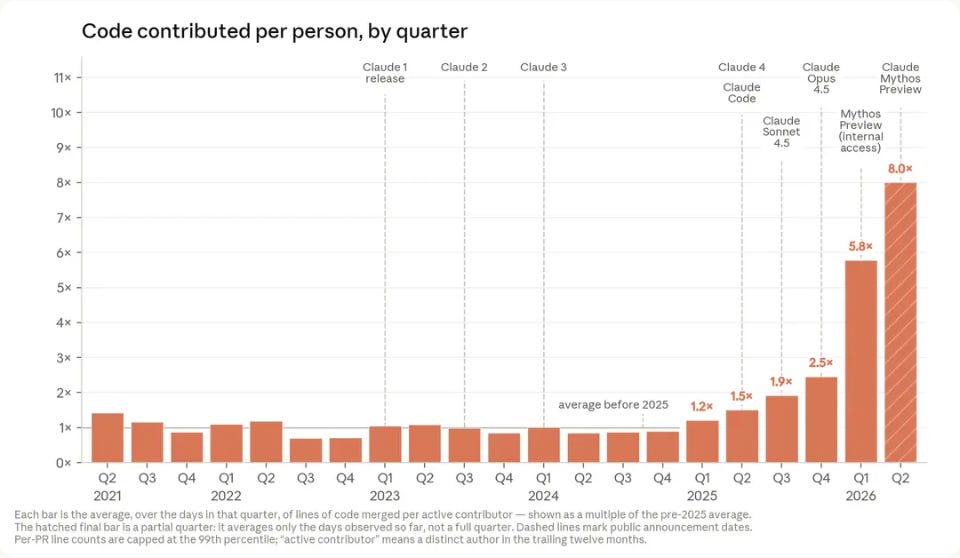
The internal numbers are the story. As of May 2026, more than 80% of the code merged into Anthropic’s codebase is written by Claude, up from low single digits before Claude Code launched in February 2025, and the typical engineer now merges 8x as much code per day as in 2024. On a fixed test that asks a model to speed up AI-training code, Claude went from a roughly 3x speedup with Opus 4 in May 2025 to about 52x with Mythos Preview in April 2026, against roughly 4x for a skilled human given four to eight hours. In one weak-to-strong supervision project, Claude agents recovered 97% of the available gap over 800 compute-hours and about $18,000, where two human researchers managed 23% in a week.
The honest part is the caveat. Anthropic says the one thing still mostly in human hands is research taste: choosing which problems matter, which results to trust, when an approach is a dead end. But it shows that gap closing too. Shown only the first half of real research sessions, Claude picked a better next step than the human 64% of the time in April 2026, up from 51% in November. The piece sketches three futures, from the trend quietly stalling to full recursive self-improvement, and argues the world should build verifiable mechanisms now that preserve the option to slow or pause frontier development before it is needed.
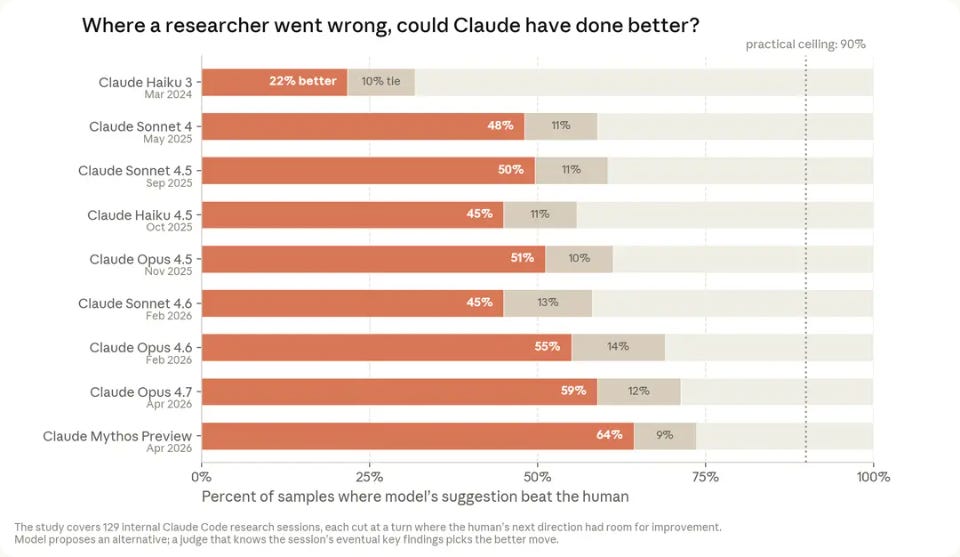
What to watch for: Whether “research taste” turns out to be one more capability models fail at for a while, then suddenly do not.
🎥 Worth a Watch
An OpenAI model disproved an 80-year-old Erdős conjecture, and the researchers walk through how. On OpenAI Podcast Ep. 20, Alexander Wei, Hongxun Wu, and Lijie Chen explain how a general-purpose model (not a math-specific one, the same kind that powers Codex) cracked the unit distance conjecture, a problem Erdős once put a $500 bounty on.
The proof bridged two fields that rarely meet. It showed the square grid is far from optimal by applying class field theory to combinatorial geometry, after grounding itself by looking up “unit” in the Cambridge dictionary and producing a 125-page chain of thought. With enough test-time compute, it lands the result about half the time.
The reaction is the fun part. Reviewers went from “there’s no way this is true” to losing sleep over it, and within a week other mathematicians used the same idea to disprove a related result.
Quick Hits
Apple approved Poke as the first AI agent on Messages for Business — your iMessage thread is now an agent surface, and Apple charges per user.
Amazon unveiled a conversational AI warehouse robot in an $11.6B Europe push — robotics and logistics keep merging.
Google can read your resting heart rate from a selfie — front-camera vitals, accurate across skin tones.
ChatGPT hit 1 billion monthly active users in record time — the fastest app to the milestone.
OpenAI’s ChatGPT memory now updates itself in the background — “dreaming” replaces save-on-command.
HPE raised its forecast on AI demand and the stock jumped — the buildout still has buyers.
Meta is reportedly building an AI pendant — the wearable land grab continues.
Anthropic published research on making Claude a chemist — pushing models from code into the hard sciences.