
Another Daily AI Newsletter - July 25

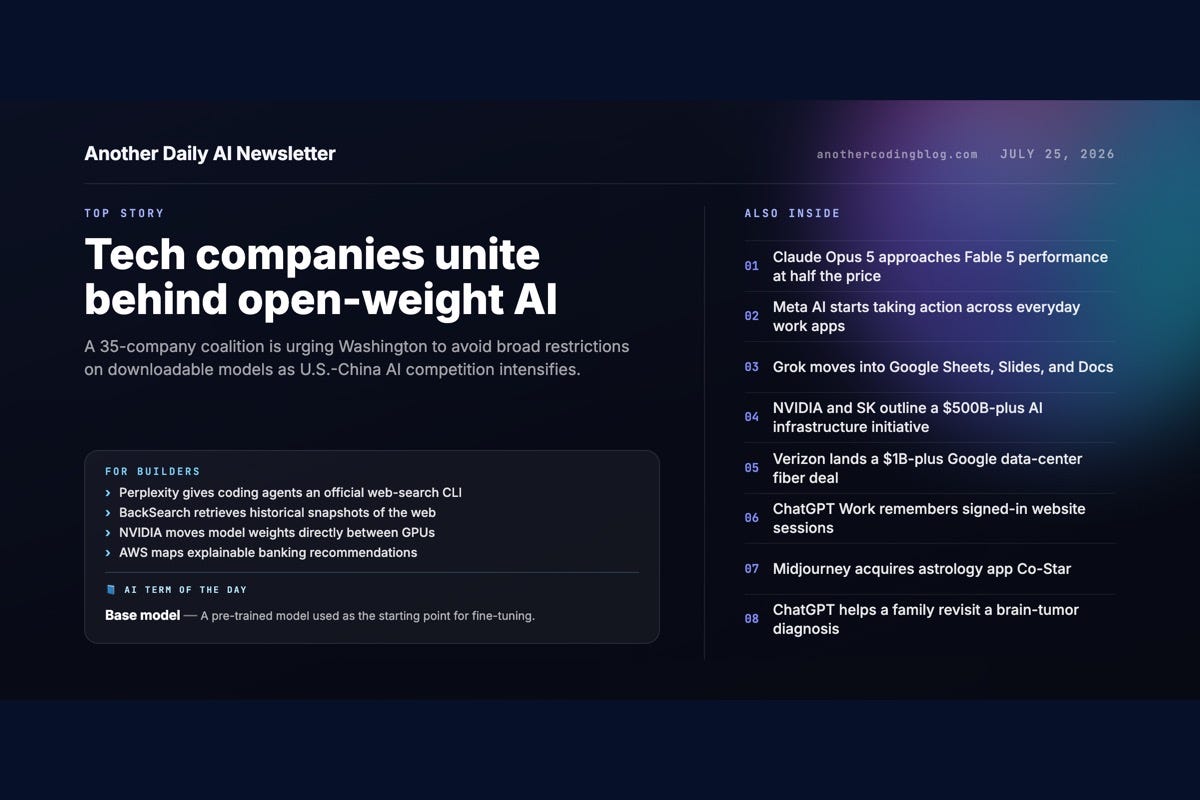
⭐ Top Story: Tech companies unite behind open-weight AI
NVIDIA and 24 other technology organizations released an open letter urging Washington to avoid broad restrictions on open-weight AI models. The coalition includes Microsoft, Meta, Mistral, Hugging Face, IBM, Mozilla, Perplexity, and Y Combinator.
Open-weight models can be downloaded, inspected, modified, and run on infrastructure controlled by the user. The coalition argues that this makes advanced AI less expensive to adopt, gives customers an alternative to permanent dependence on one provider, and lets researchers examine models for weaknesses. Companies can also adapt the weights around their own data, workflows, and hardware.
The letter acknowledges the risk that makes this policy debate difficult. Once weights are released, the original developer loses control over them, and modified versions can be difficult to trace or withdraw. The coalition’s position is that defenders, universities, startups, and public institutions still need access to capable models, while demonstrated misuse should be addressed through targeted legal and commercial rules.
Model distillation sits at the center of the argument. The signatories describe distillation as a normal way to train, evaluate, and improve models, while distinguishing it from unlawful attempts to extract value from closed systems. That distinction has become politically important as the White House considers how to respond to Chinese models such as DeepSeek and Kimi.
The coalition grew after NVIDIA published the original document. Microsoft’s live version now lists 35 signatories and includes OpenAI, which an early Washington Post report described as absent.
Industry leaders quickly reinforced the message. Jensen Huang argued that open models strengthen cybersecurity, innovation, and national sovereignty. Satya Nadella recently argued that companies should own the prompts, corrections, traces, evaluations, and adapted weights created through their AI use. His case gives the open-weight debate an enterprise angle: customers need control of the learning their work produces and the freedom to change models without losing it. Sam Altman said he wants the United States to win with both open and proprietary models. Nathan Lambert highlighted the letter’s distinction between legitimate distillation and intellectual-property theft, while Lee Robinson framed the practical choice as managed AI versus infrastructure a customer can operate itself.
The same policy direction appeared internationally. APEC’s July 24 statement encouraged support for open-source models and projects alongside strong security assurance. Open-weight AI has moved beyond a licensing argument. It is now part of the contest over who can build, adapt, secure, and control the systems that other industries will depend on.
Claude Opus 5 pushes frontier performance toward a lower price
Anthropic released Claude Opus 5 at the same $5-per-million-input-token and $25-per-million-output-token pricing as Opus 4.8. Anthropic positions it as a model that approaches Fable 5 intelligence at half the price. A separate Fast mode runs about 2.5 times faster at twice the base rate.
The cost-performance claim has independent support. Artificial Analysis found that Opus 5 at maximum effort led its agentic knowledge-work benchmark with a 1,720 Elo score, ahead of Fable 5 at 1,574. The benchmark estimated $17.79 per completed task for Opus 5 max versus $22.30 for Fable 5. The highest-effort runs also took more than 25 minutes per task and used many agent turns, so buyers are choosing among quality, speed, and cost rather than receiving all three at once.
Cursor reported a 66.7 score for Opus 5 at default effort versus 66.5 for Fable 5 on CursorBench, with Opus supporting zero data retention. Perplexity said Opus 5 trailed only Fable 5 on its WANDR evaluation while costing 57% less. These are vendor evaluations, but they point in the same direction as the independent test: Opus 5 brings high-end agent work into a more practical price tier.
Anthropic also changed how the model handles sensitive cyber work. The company says Opus 5 can find source-code vulnerabilities while blocking binary scanning, penetration testing, and exploit generation. Its classifiers are expected to intervene about 85% less often than Fable 5’s, with flagged requests falling back to Opus 4.8 by default. Anthropic’s alignment and safety findings remain internal evaluations.
Opus 5 arrived across the ecosystem on launch day, including GitHub Copilot, AWS, Cursor, Notion, and Perplexity. The release gives teams a stronger everyday option without requiring them to pay for Fable on every difficult task.
AI products are moving from answers to finished work
Meta AI can now plan work, use email and calendars, create presentations, conduct research, and run recurring tasks. The new behavior is powered by Muse Spark 1.1 and is beginning in selected markets, with WhatsApp support planned later. Meta’s performance claims are company-reported, but the product direction is clear: Meta wants its assistant to carry work across several steps instead of returning a single response.
Grok released a free add-on for Google Sheets, Slides, and Docs. It can cite spreadsheet cells, write formulas, create charts, build editable presentations from web and X research, and draft documents without moving the work into a separate chat. Connections to Drive and email extend that workflow across a user’s existing files and messages.
ChatGPT Work can now use websites that require a login. A user takes over the cloud browser to authenticate, then returns control to the agent. The session can persist across later tasks. That makes many more workflows possible, while raising the stakes for account permissions, session cleanup, and confirmation before consequential actions.
Google Flow Music expanded Spaces into a larger creative workspace. People can generate and edit songs, separate stems, create lyrics, and produce accompanying images or videos in the same project.
Bluesky’s Attie added Quests for researching conversations across the AT Protocol network. The beta assistant can also help build custom feeds. It remains a waitlisted product, but it shows how social networks can turn their public conversation layer into a research surface.
These releases share an operating model: the assistant receives a goal, reaches into the relevant tools, and returns an editable artifact or completed action. The quality of the surrounding permissions and handoffs is becoming as important as the model behind the interface.
AI infrastructure is expanding into memory, factories, and fiber
NVIDIA and SK Group announced plans for a $500-billion-plus AI infrastructure initiative. The companies signed letters of intent covering a two-gigawatt Vera Rubin DSX AI factory and a long-term memory partnership that includes SK hynix HBM4. The first factory is planned for 2027.
The figure describes a proposed long-term initiative, not completed spending. The scale still matters because it joins the two constrained parts of the AI stack: large compute facilities and the high-bandwidth memory required to keep accelerators supplied with data.
Verizon disclosed a Google data-center connectivity agreement worth well over $1 billion. Verizon will provide several dark-fiber routes connecting Google’s data centers, with revenue expected to begin next year. CEO Dan Schulman said the company expects additional agreements representing several billion dollars over the next few years.
The compute race now reaches well beyond accelerator purchases. Memory supply, power, buildings, and long-haul fiber determine how quickly new capacity can become useful.
Agent teams can ship more work, leaving review as the constraint
A practical guide to Codex Multi-Agent V2 shows agents taking distinct roles, messaging one another, and coordinating through shared inboxes. The coordinator can assign different reasoning levels, fork its context into a specialist, or start an agent with a clean context. Recurring coordination patterns can be stored as skills.
NVIDIA says manager agents helped its Kaggle teams earn two podium finishes. In the NeuroGolf competition, a manager coordinated specialist workers and maintained a shared knowledge base with reusable tools. The result is a company account, but it gives the multi-agent pattern a concrete competitive example.
Dex Horthy argues that software-factory benchmarks still reward passing tests without measuring whether the resulting system remains maintainable. The article describes its evidence as partly experiential and correlational. Its practical recommendation is to preserve human involvement in requirements, architecture, program design, vertical slices, and review.
Multi-agent systems increase the amount of work that can happen simultaneously. They also increase the number of decisions, assumptions, and code changes that need to be inspected. Coordination is improving faster than accountability can be automated.
Quick Hits
Elon Musk says Grok 4.6 is planned in two weeks and Grok 4.7 in four weeks. These are proposed timelines, not completed releases.
Elon Musk pledged to open-source every line of code touching X and subject it to a third-party audit next month. X has not identified the auditor, repository, license, scope, or release process.
💰 Funding & Moves
Anduril is reportedly discussing a financing that could value the defense-technology company at approximately $100 billion. The talks follow a recent round at a $61 billion valuation. The new financing and its terms have not been completed.
Midjourney acquired Co-Star, the astrology app with approximately 4.3 million monthly active users. Co-Star combines AI-generated material with writing from human astrologers. The companies did not disclose the acquisition price.
Prentis is reportedly seeking $100 million at a $1 billion valuation. Reid Hoffman, Mark Pincus, and Ritankar Das are building the new lab around computer-use models. The funding terms remain preliminary and come from a single report.
🔬 Research Radar
METR published a framework for measuring agent ability across score, time, tokens, spending, and human cost. Its central lesson is that one benchmark number can hide how much effort an agent consumed. Two systems can reach the same score while requiring very different budgets, and a model that performs best with unlimited effort may be less useful under a real production constraint.
Wei Dai proposed the “Long Self-Correction” as an alternative to an AI pause or a period of reflection. His argument is that humans may be unprepared to build, supervise, or define goals for extremely powerful systems, and that improving institutions and judgment could require a much longer process. It is a short conceptual essay, not empirical research or a concrete policy program.
A family revisits a brain-tumor diagnosis with ChatGPT
OpenAI shared the story of Kiley Lemasters, who was diagnosed with glioblastoma at 18 and remained stable for five years. Her husband used ChatGPT to understand a recent radiology report, then returned to her original biopsy record and noticed an IDH1 mutation. Kiley’s neuro-oncologist confirmed that under updated standards her tumor is described as an IDH-mutant astrocytoma, which carries a different prognosis.
The distinction needs medical context. The 2021 World Health Organization classification replaced the former term “IDH-mutant glioblastoma” with “IDH-mutant astrocytoma.” ChatGPT helped the family connect an older record with newer terminology; the clinical interpretation came from her specialist. The story shows how AI can help patients organize questions and understand records without replacing medical judgment.
🛠️ For Builders
Perplexity released an official CLI for structured web search and content retrieval. It returns agent-friendly JSON and requires a Perplexity API key; a Max subscription does not replace API authentication.
BackSearch introduced a historical search and fetch API with an `as_of` date. The early preview covers a limited news archive from December 2025 through July 2026, making it useful for forecasting tests without making it a complete historical search engine.
NVIDIA ModelExpress chooses the fastest available path for moving model weights into GPU memory. NVIDIA says it reduced DeepSeek-V4 Pro startup from eight minutes to one minute and 44 seconds on an eight-GPU B200 system. That result is a company benchmark tied to the published setup.
AWS published an architecture for explainable next-best-product recommendations in banking. The design combines SageMaker AI, PyTorch, AWS Glue, and attention-based explanations. It is an architectural guide rather than a step-by-step deployment tutorial.
📘 AI Term of the Day: Base model
Google defines a base model as a pre-trained model that can serve as the starting point for fine-tuning toward a particular task or application.
Base models explain much of the value behind open weights. Instead of training a capable system from the beginning, a company or research team can start with downloaded weights and adapt the model around its own domain, language, workflow, or hardware.
Google’s definition | Go deeper with IBM’s guide to model tuning and fine-tuning