

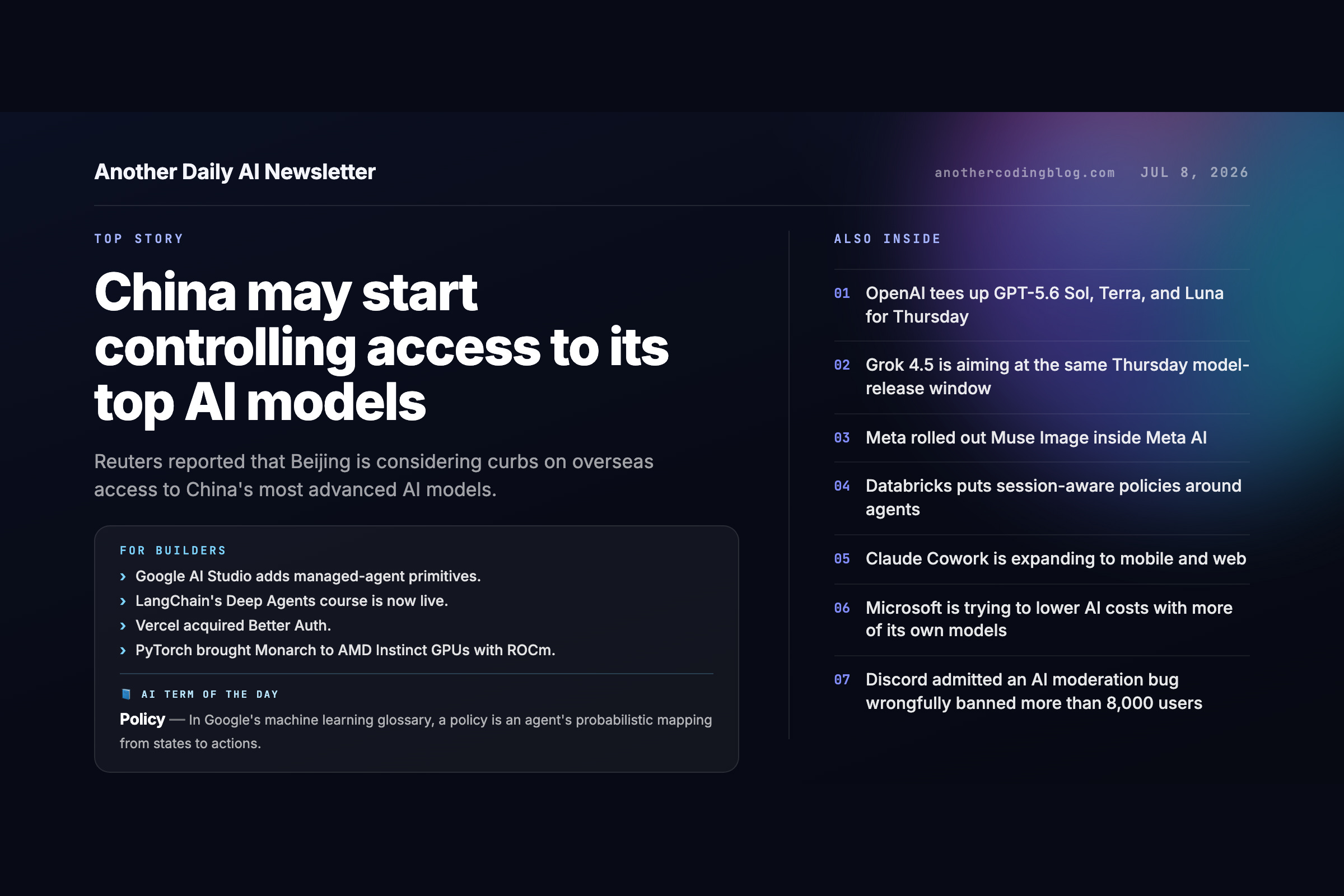
⭐ Top Story: China may start controlling access to its top AI models.
The proposal reportedly includes current and unreleased systems. The talks were led by China’s Ministry of Commerce and included major Chinese tech companies such as Alibaba, ByteDance, and Z.ai.
Times of India carried a detailed summary of the Reuters reporting: officials discussed restrictions on closed-source and open-weight models, stronger legal protections for AI technology, tighter limits on who can invest in domestic AI startups, and treating leaks or theft of proprietary AI systems as a national security issue. The curbs may apply only to future models.
The story matters because Chinese models are now useful enough globally that Beijing may want more control over them. DeepSeek changed the cost conversation last year. Alibaba’s Qwen family has become one of the most visible open-model ecosystems. ByteDance’s Doubao is a major domestic platform. Z.ai’s GLM-5.2 is getting attention from builders outside China.
The Atlantic reported that GLM-5.2 is drawing Silicon Valley attention as a cheap agentic model, and Business Insider reported that Z.ai’s ZCode coding tool undercuts Cursor pricing. That makes access itself valuable. If Chinese models are cheap, capable, and globally available, they become commercial infrastructure.
That is the tension. Global availability helped Chinese models build influence, especially through open releases. Restricting access could protect the best systems, but it could also slow the diffusion that made them matter. Reuters also says Beijing has been investigating Chinese AI startups that relocated abroad, including Manus, and discussed tighter limits on who can invest in domestic AI startups.
A separate Reuters-summarized report says DeepSeek is developing its own inference chip, reducing reliance on Nvidia and Huawei. Put together, the China story is becoming full-stack: domestic chips, domestic model labs, global developer adoption, and now possible limits on who gets to use the best systems.
OpenAI tees up GPT-5.6 for Thursday.
OpenAI tees up GPT-5.6 Sol, Terra, and Luna for Thursday. Preview access is expanding globally now, and the post is already pulling heavy attention.
This feels like tomorrow’s top-story candidate. For today’s issue, it is a watch item. For Thursday, it becomes the lead if OpenAI publishes launch details, model cards, pricing, benchmarks, access tiers, or developer docs.
Grok 4.5 is aiming at the same release window.
Grok 4.5 is aiming at the same Thursday model-release window. Elon Musk said it will be available to the public tomorrow and called it an Opus-class model that is faster, more token-efficient, and lower cost.
OpenAI and Grok are now teeing up GPT-5.6 and Grok 4.5 for the same Thursday model-release window. The real story should wait for the launch surface, but the timing is worth flagging now.
Meta turns image generation into a social product.
Meta rolled out Muse Image inside Meta AI. It is the first image generation model from Meta Superintelligence Labs and now powers image creation across Meta AI, Instagram, and WhatsApp, with Facebook, Messenger, and advertiser tools coming next.
Muse Image can work with Muse Spark before generating. Meta says it can plan layouts, look up real-time web context, blend multiple visual references, redesign rooms with real products, and edit directly on images.
The social layer is the interesting part. Meta says users can @ mention Instagram accounts so Meta AI can use public photos to build a visual, with a linked control setting for how content can be tagged for AI creation.
TechCrunch also reported that Meta is teasing Muse Video. That makes the release feel like the start of a broader creative stack inside Meta’s consumer apps.
This remains a big consumer AI story. Meta’s advantage is distribution: it can put image generation directly where people already share photos, message friends, create Stories, and eventually buy ads.
The question is whether users will experience that as useful personalization or as their social identity becoming prompt material.
Agents are becoming governed systems.
Databricks puts session-aware policies around agents. Omnigent’s contextual policies use session state, dynamic risk scoring, budgets, and least-privilege access to govern what an agent can do while it is running.
LangChain argues that improving agents is a data-mining problem. The point is sharp: once agents run real workflows, the traces become the training set for finding failures, patterns, regressions, and better harnesses.
LangChain is also framing secure computers as agent infrastructure. If agents operate browsers, terminals, and files, the execution environment becomes part of the product.
Schneider Electric’s LangSmith case study shows the enterprise version of the same shift: observability, self-hosting, and production LLMOps before broader rollout.
This is the most coherent non-Meta theme in the corpus. Agents have moved past prompts wrapped around tools. The supporting layer is becoming the story: policies, secure machines, trace mining, observability, and operating rules.
That is what real adoption looks like. The exciting demo is the agent completing the task. The valuable system is the one that can explain what happened, limit what happens next, and improve from its own traces.
The work surface race is moving beyond the IDE.
Claude Cowork is expanding to mobile and web. Anthropic is taking the Claude Code pattern into general knowledge work.
Notion launched an iPhone app for Agents. Mobile knowledge-work agents are becoming normal enough to deserve their own app surface.
The GitHub Copilot app is now available to all users. Copilot is becoming a standalone agent-driven development surface across macOS, Windows, and Linux.
Databricks is expanding Genie Code. The update adds a full-page command center and agentic help across MLflow, Model Serving, compute, and data work.
Hugging Face added one-click access to SageMaker Studio. The distance between model discovery and managed development keeps shrinking.
The pattern is surface area. AI work is moving into the places where work already happens: desktop apps, mobile apps, notebooks, data platforms, IDE-adjacent tools, and managed cloud environments.
That changes expectations. Once agents live inside the workflow, users will judge them as coworkers, copilots, schedulers, analysts, and operators.
The cost story is becoming architecture.
Microsoft is trying to lower AI costs with more of its own models. The reported goal is to reduce dependence on external frontier models in products like Office while keeping quality high enough for everyday work.
ClaudeDevs showed a Fable 5 advisor and Sonnet 5 executor pattern. That is cost architecture at the prompt-and-agent level: use the expensive model where judgment matters, then route routine execution elsewhere.
GitHub added per-user budgets for cost centers. AI spend is becoming something admins manage per team and per user, not a vague line item after the fact.
NVIDIA says the Vera CPU boosts AI factory throughput for agentic workloads. Serving cost is also a systems problem: CPUs, memory, scheduling, networking, and GPU utilization all matter.
Berkeley BAIR argues that falling intelligence costs change what data systems need to become. Cheap inference moves the bottleneck toward data, provenance, coordination, and verification.
This cost theme is stronger with the full corpus in view. It shows up at every layer: Microsoft choosing models, Claude builders routing model roles, GitHub budgeting users, NVIDIA redesigning throughput, and Berkeley asking what data systems become when the marginal intelligence gets cheaper.
The next serious AI products will probably have cost architecture baked in from the start. Model choice becomes one part of the bill, alongside routing, memory, traces, hardware, and the amount of human review still required.
AI is moving into systems where mistakes have real consequences.
Discord admitted an AI moderation bug wrongfully banned more than 8,000 users. The error reportedly treated benign images like spreadsheets, chessboards, and transparent backgrounds as policy violations.
MIT News covered novice coders building AI programs for military applications. The finding is useful and uncomfortable at the same time: AI lets nontechnical operators build software for local mission needs.
Forterra says U.S. autonomous ground vehicles are operating in Ukraine. Physical-world autonomy keeps moving from demo to deployment.
Google described AI work for crisis resilience and traffic congestion reduction. The public-sector side of AI is becoming more practical and more operational.
This theme is quieter than the product launches, and it may be more important. AI is being used to moderate communities, support military software development, route traffic, forecast crises, and move vehicles in conflict zones.
That makes evaluation harder. A hallucinated answer in a chat window is one failure mode. A wrongly banned user, a bad operational tool, or a brittle physical-world deployment is another.
Quick Hits
OpenAI showed Codex helping build a black-hole simulation. A good example of AI speeding up scientific implementation while the researcher still owns the judgment.
NVIDIA shared MOTIVE, a video model training approach for autonomous vehicles. Physical-world AI keeps needing better motion signals before deployment.
Google DeepMind released a “Predicting the Past” skill for Antigravity. Historical reasoning as an interactive AI skill is a nice use of specialized models.
Hugging Face is bringing models to Foundry Managed Compute. Model catalogs and managed compute are getting pulled closer together.
Claude extended Fable 5 access through July 12. That gives builders more time to test the model-pairing patterns forming around Fable and Sonnet.
NVIDIA showed a Nemotron agent for industrial alarm management. Narrow, high-context industrial agents are worth watching.
🛠️ For Builders
Google AI Studio adds managed-agent primitives. Background execution, remote MCP integration, custom function calling, and credential refresh all point toward longer-running agent workflows in the Gemini API.
LangChain’s Deep Agents course is now live. Useful if you want to think about agents as systems with planning, memory, tools, and deployment.
Vercel acquired Better Auth. Auth is becoming part of the AI-app platform story because agents still need users, sessions, permissions, and identity.
PyTorch brought Monarch to AMD Instinct GPUs with ROCm. Worth tracking if you care about distributed training and non-NVIDIA accelerator paths.
Hermes Agent added pluggable secrets and native 1Password support. Secret handling is one of those boring builder details that becomes very real once agents touch tools.
The builder lane today is all about making agents durable. Background work, remote tools, credentials, auth, secure execution, cost controls, and observability are the pieces that make an agent safe to run more than once.
🎥 Watch of the Day
OpenAI’s black-hole simulation video is worth a watch if you like seeing Codex used for real scientific implementation work. The best part is that the human still owns the scientific judgment while the agent helps move faster through code, visualization, and iteration.
📘 AI Term of the Day
Policy. In Google’s machine learning glossary, a policy is an agent’s probabilistic mapping from states to actions.
That definition comes from reinforcement learning, but it fits today’s agent stories nicely. A useful agent needs a policy for what to do next, what tools it can use, when to ask for help, and when to stop.
Go deeper: Databricks’ Omnigent writeup on contextual policies is a useful real-world version of the idea: policies become the way teams govern agent behavior at runtime.