
Another Daily AI Newsletter - July 13
Supabase's 2026 startup report shows AI-heavy codebases, smaller teams, and customer acquisition becoming the new bottleneck.

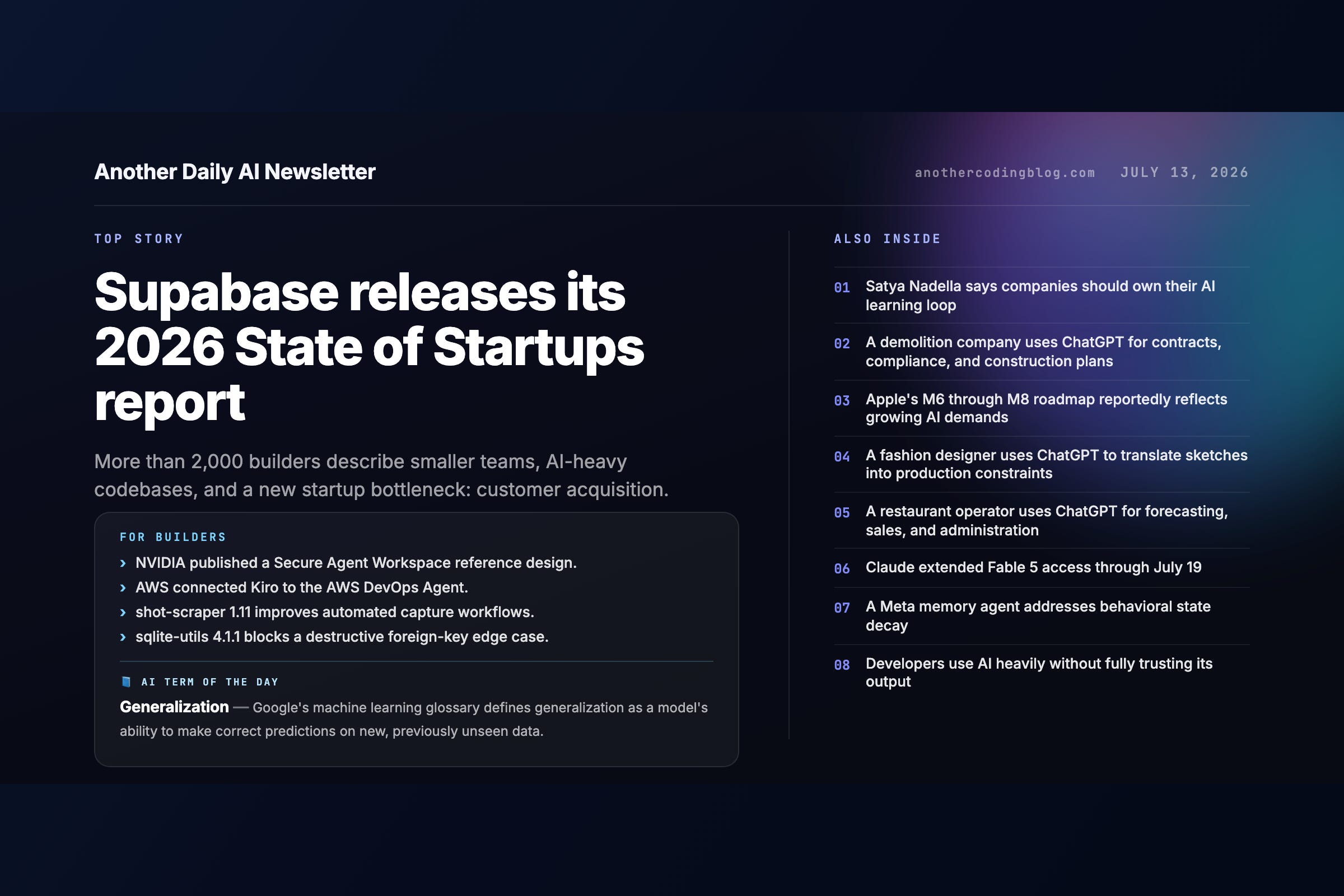
⭐ Top Story: Supabase releases its 2026 State of Startups report.
Supabase asked more than 2,000 startup builders what changed between 2025 and 2026. The technical barrier to starting a company is collapsing. Sixty-one percent said AI generated more than half of their codebase, 40% put the share above 75%, and only 2% used no AI-generated code.
Solo founders grew from 53% to 61% of respondents. Nontechnical founders now account for 22%, and founders age 40 or older rose from 18% to 25%. More than half of nontechnical founders said AI generated at least three-quarters of their code.
Anthropic captured much of the tooling shift. Claude Code was used by 63%. Paid Claude subscriptions rose from 28% to 59%, while paid OpenAI subscriptions fell from 57% to 39%. Anthropic also overtook OpenAI as the most-used model provider, 64% to 52%. Supabase’s developer-oriented audience makes this a strong signal from modern startups rather than a census of every company.
Technical complexity fell from 24% to 11% as the biggest business challenge. Customer acquisition now leads at 32%. Only 31% of the heaviest AI-code users are monetizing, compared with 56% of startups using no AI-generated code. Supabase notes that heavy AI users also tend to be earlier-stage and bootstrapped, making this a lifecycle correlation rather than evidence that AI code reduces revenue.
The operational layer is behind the products. Fifty-two percent are building agents, and 24% of those builders have multi-agent systems in production. Yet 47% lack formal prompt management, 36% have no formal evaluation process, and 59% do not specifically monitor AI workloads.
Distribution offers the sharpest divide. Sixty-seven percent have never tried paid acquisition. Only 10% built a developer community, but those companies find first customers through Discord, Slack, or Reddit at 38%, compared with 7% for everyone else. They convert open-source users at 29%, versus 3% without a community.
AI lets one person build what once required a team. Customer access, operational discipline, and a reason to care after launch are becoming the scarce capabilities.
Companies are trying to keep control of the learning loop.
Satya Nadella says companies should own their AI learning loop. Microsoft’s CEO calls it the “Reverse Information Paradox”: prompts, corrections, tool traces, evaluations, and adapted behavior can reveal how a business works. He recommends keeping that accumulated intelligence inside the company’s boundary and separating orchestration from any single model provider.
Developers use AI heavily without fully trusting its output. Sonar estimates that AI accounts for 42% of committed code, while 96% of developers say they do not fully trust AI-generated code.
Organizational governance is trailing AI adoption. GitLab found that 80% of organizations adopted AI tools faster than their governance could keep up.
Simon Willison says an AI agent should never be the directly responsible individual. A person can be accountable for a project’s success or failure. A machine cannot. The framing gives teams a simple rule for deciding where agent autonomy should end.
The pattern is ownership. Companies need control over what their systems learn, evidence for what those systems produce, and people who remain accountable for the result.
ChatGPT is finding work outside software.
A demolition company uses ChatGPT for contracts, compliance, and construction plans. James Costello uses it to review bid documents, organize regulatory requirements, and turn large plan sets into workable questions before crews move.
A fashion designer uses ChatGPT to translate sketches into production constraints. Big Chan works through materials, dimensions, and fabrication decisions while keeping the creative direction her own.
A restaurant operator uses ChatGPT for forecasting, sales, and administration. Patrick Cheng applies it to the operational work around hospitality, where small teams have little time for dedicated analysts.
These are ordinary businesses with specific, repetitive decisions. The adoption path runs through existing workflows and measurable time savings.
AI is reaching deeper into the machine.
Apple’s M6 through M8 roadmap reportedly reflects growing AI demands. Mark Gurman reports that Apple is planning M6, M7, M7 Pro, M7 Max, M7 Ultra, and M8 chips as on-device and cloud AI reshape its silicon roadmap.
Samsung pools CXL memory behind eight Blackwell GPUs. Samsung combined a 1 TB CXL memory pool with NVIDIA RTX PRO 6000 Blackwell GPUs, vLLM, and LMCache. The system held about 92% of local-DRAM performance while continuing to serve models after their memory demands exceeded GPU-attached capacity.
Google stabilizes Willow with continuous reinforcement learning. A controller trained across more than 1,000 device settings reduced logical errors by 20% and improved stability by 3.5 times. The work shows machine learning moving into the control loop of the quantum processor itself.
The hardware story now spans chip roadmaps, memory architecture, and live system control. AI workloads are changing how machines are designed and how they are operated.
Quick Hits
Claude extended Fable 5 access through July 19 and increased Claude Code limits while the model remains available.
Nathan Lambert warns that open-model licensing may tighten within six months as labs reconsider what capabilities they are willing to release.
Sam Altman asks builders what they have made with GPT-5.6 Sol as the first week of real-world experiments begins.
Research Radar
A Meta memory agent addresses behavioral state decay. Long-running agents can lose track of decisions, failed attempts, and open subgoals as the context grows. The proposed memory agent maintains a structured state and injects a reminder only when it is useful, improving results on Terminal-Bench 2.0 and tau-squared-Bench without changing the action agent.
The Knowing-Using Gap explains why memorized facts fail to generalize. Researchers found a large gap between what a fine-tuned model can recall and what it can apply in a new task. Their self-patching experiments expose 58% to 75% headroom, suggesting that retrieval from internal knowledge is part of the problem.
🛠️ For Builders
NVIDIA published a Secure Agent Workspace reference design. It gives long-running agents managed remote VMs, deny-by-default network access, credential brokering, signed delegation, audit logs, and human review for consequential writes.
AWS connected Kiro to the AWS DevOps Agent. The integration brings operational context into the coding workflow so builders can investigate and act on cloud issues without switching tools.
shot-scraper 1.11 improves automated capture workflows. Server-backed video and multi-capture jobs now wait up to 30 seconds for startup, and several commands can load JavaScript from a file, standard input, or GitHub.
sqlite-utils 4.1.1 blocks a destructive foreign-key edge case. A table transform now raises an error when an open transaction could silently trigger cascading deletes or modifications.
📘 AI Term of the Day
Generalization. Google’s machine learning glossary defines generalization as a model’s ability to make correct predictions on new, previously unseen data.
The Knowing-Using Gap shows why the distinction matters. A model may memorize a fact during training and still fail to apply it when the surrounding task changes. Recall is evidence that knowledge exists; generalization shows that the knowledge is usable.
Go deeper: Google’s generalization lesson explains how training data, model complexity, and overfitting affect performance beyond the examples a model has already seen.