
Another Daily AI Newsletter - July 23

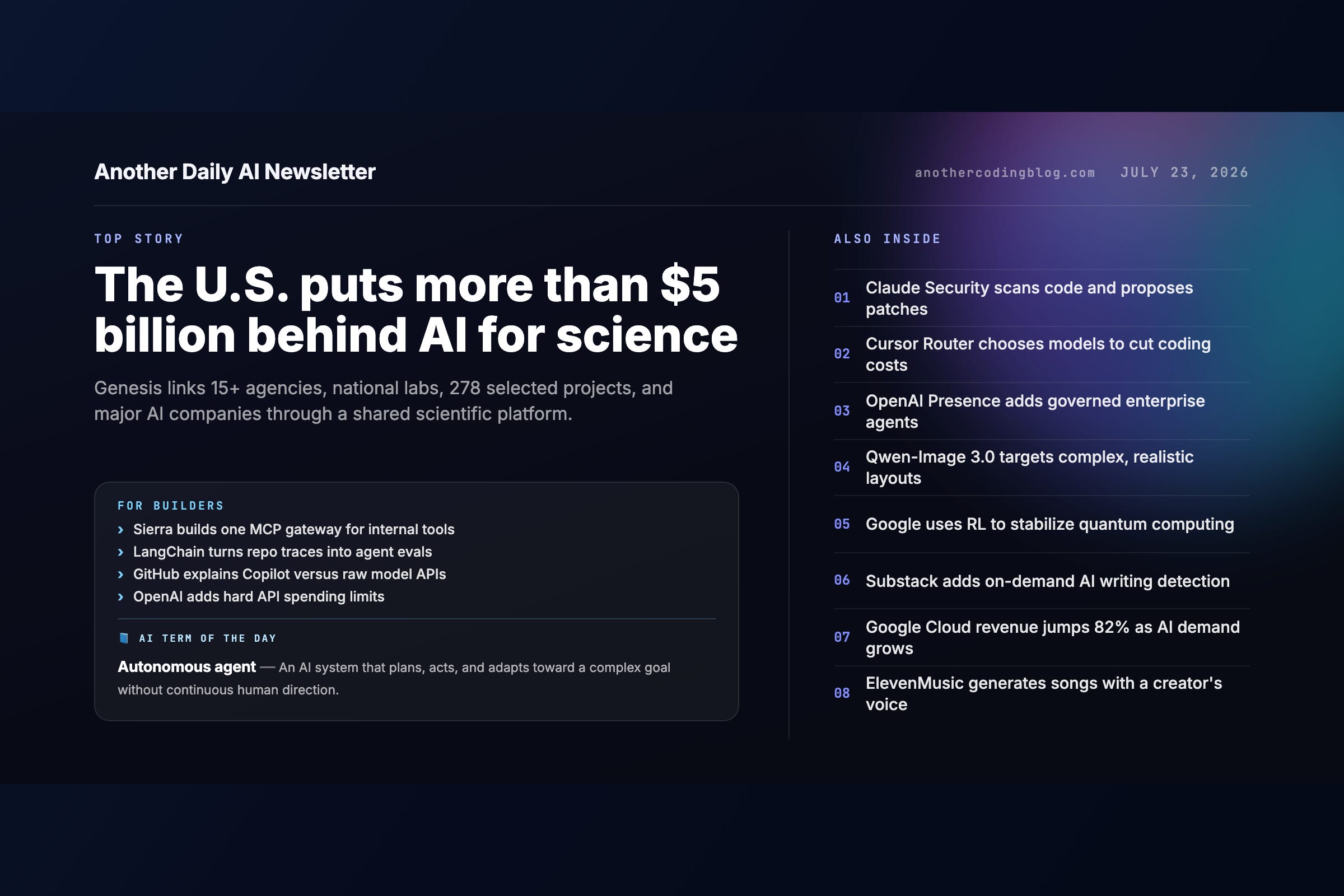
The White House says more than 15 federal agencies have committed over $5 billion to the Genesis Mission, an effort to connect government researchers, scientific datasets, national-lab computing, and private AI tools through a shared American Science and Security Platform.
The initial portfolio is unusually broad. The Department of Energy selected 278 projects from more than 5,000 proposals: 87 led by national laboratories, 168 by universities, 19 by companies, and four by nonprofits. Those selections involve 342 institutions and cover pediatric cancer, drug discovery, critical minerals, advanced nuclear energy, chip manufacturing, grid resilience, autonomous laboratories, and quantum systems.
The word “selected” matters. DOE says the projects are entering award negotiations, so they are not yet promises to fund every proposal. Nextgov reports that the largest proposed award is a three-year, $60 million nuclear-energy project. The scale is real, but the final terms and delivery milestones still have to be negotiated.
Private partners are supplying another layer. DOE says companies and philanthropies have committed more than $800 million in compute, models, cloud credits, technical expertise, research partnerships, and direct funding. That total should not be read as an $800 million cash pool.
The individual commitments show how the mission could work. OpenAI is offering Codex, API support, early model access, and cybersecurity capabilities, including campaigns on high-temperature superconductors and machine-accessible scientific data. Google committed $40 million in AI tokens and cloud credits, along with tools such as AlphaFold 3, AlphaGenome, AlphaEvolve, and WeatherNext. Microsoft committed a $60 million package split between Azure credits and solution engineering.
There are already hints of what better scientific tooling can change. Google says an AI-assisted calibration workflow at the National Laboratory of the Rockies reduced one microscope procedure from more than 90 minutes to about 13 minutes. NIH’s Bio Genesis program is targeting six health challenges and aims to double the pace of biomedical innovation over five to ten years. These are institution and company goals, not proven results for the broader mission.
Execution will be harder than announcing a project list. The Associated Press noted when Genesis launched that the initiative must reconcile sensitive public data, private computing infrastructure, rising data-center power demand, and recent cuts elsewhere in federal science. Research access, security, reproducibility, and experimental validation will determine whether the platform produces durable science.
Genesis is an attempt to turn AI for science from scattered demonstrations into national infrastructure. Its most meaningful score will not come from a model benchmark. It will come from shorter experimental cycles, discoveries that survive peer review, and scientific tools that researchers can use repeatedly.
Companies are adding budgets, routing, permissions, and schedules to their agents
Cursor Router chooses a model for each coding task. Cursor says its routing system reached frontier-model quality with 60% lower model spending in its own online tests. The router considers task requirements, latency, availability, and enterprise controls, making model selection part of the coding product instead of a decision users repeat for every prompt.
OpenAI Presence packages voice and chat agents for governed enterprise work. Eligible enterprise customers can scope what an agent knows, which actions it may take, when it must escalate, and how its behavior is evaluated.
Claude’s managed agents gained controls for effort, memory, events, and subagents. Developers can set effort per agent, initialize environments and memory through webhooks, stream subagent events, and load up to 500 skills in a session.
ChatGPT can run recurring tasks against connected tools. A scheduled task can create a morning brief, triage feedback, or check an operational system without waiting for a new prompt.
The agent control surface is becoming as important as the model: teams need to decide what runs, when it runs, which model handles it, what it can access, and how much it may spend.
AI security tools are moving directly into codebases and employee devices
Claude Security scans code, verifies suspected vulnerabilities, and proposes patches. The plugin is in beta for Claude Code users, while the broader product is in public beta for Claude Enterprise. Recurring scans, Slack and Jira webhooks, and audit exports move the workflow closer to normal software development, although Anthropic tells users to review every proposed fix.
Glow emerged from stealth with $180 million for AI-era endpoint security. The company, founded by former Meta and Snowflake executives, is valued at $1.2 billion and is building protection for the employee devices where agents, credentials, and company data increasingly meet.
Researchers found that small open models can contribute to practical malware analysis. A hybrid system using Qwen3-4B and Foundation-Sec-8B scored 35.30% on the paper’s benchmark, ahead of its strongest cyber-specialized baseline and just below a grounded Gemini system. The result is one paper on one benchmark, but it suggests useful security analysis does not always require the largest closed model.
Security is being inserted earlier in the workflow. Code review, patch approval, device protection, and locally deployable analysis all reduce the distance between finding a problem and acting on it.
Creative AI is becoming editable, realistic, and fast enough for production
Qwen-Image 3.0 targets complex layouts, small text, and multilingual design. Alibaba says the model handles prompts up to 4,500 tokens, text as small as 10 pixels, 12 languages, more than 100 styles, and optional web retrieval. Those are launch claims that still need independent testing.
Gemini can build fully editable presentations inside Google Slides. It can use context from Docs, Sheets, and PDFs, then place text and visual elements into a deck that a person can continue editing.
ElevenMusic now lets creators generate songs with their own voice. The release also includes a licensed Vocal Library, giving generated music a more controllable vocal layer.
NVIDIA released four-step Cosmos 3 Super models for physical-AI video generation. NVIDIA claims the distilled models run up to 25 times faster than their full-step counterparts, which could make synthetic training data more practical for robotics and autonomous systems.
The common improvement is editability and throughput. A slide deck that remains editable, a controllable vocal performance, and faster simulation video fit into production pipelines more naturally than a finished artifact that has to be rebuilt.
Companies are shifting money and headcount toward AI infrastructure and deployment
OpenAI’s projected infrastructure commitments have reportedly reached $750 billion through 2030. TechCrunch, citing The Wall Street Journal, says the estimate is 25% above the previous figure. OpenAI’s planned Project Camellia campus in Georgia accounts for about $20 billion and 3.2 gigawatts of capacity between 2028 and 2032.
OpenAI says Project Camellia will pay for its own electric infrastructure and use minimal water. The company also says it can reduce demand by up to one gigawatt when the grid is stressed. TechCrunch notes that the project received a 15-year, 50% property-tax abatement and that its eventual power sources remain unclear.
Google Cloud revenue rose 82% year over year to $24.8 billion. Google attributed the growth to AI demand and reported a $514 billion backlog, strengthening the case for continued spending on data centers and accelerators.
Travis Kalanick’s Atoms raised $1.7 billion for robotics. Andreessen Horowitz led the round, and Ben Horowitz is joining the board as the former Uber chief builds a portfolio around physical automation.
monday.com is cutting about 630 jobs while concentrating on its AI Work Platform. The roughly 20% reduction shows the other side of the spending shift: some companies are funding AI priorities by narrowing teams elsewhere.
Capital is moving toward compute, robotics, cloud capacity, and AI-centered product plans. The open question is whether the revenue and productivity created by those systems can arrive on the same timetable as the costs.
Quick Hits
Anthropic opened its Economic Index through a Claude connector. — Query public data about AI use across occupations, tasks, and regions.
Substack added on-demand estimates for AI-written text. — Pangram can scan eligible posts, notes, comments, and replies, but its scores are estimates and should not be treated as proof.
Synthesia is expanding from generated training videos into live AI coaching. — Roleplay Sessions let an avatar challenge and score sales or customer-service practice.
A U.S. allegation about Chinese model distillation is turning into a policy fight. — Treasury threatened action if covert distillation crosses an intellectual-property line, while Arcee and Nathan Lambert questioned the evidence, timeline, and legal premise.
🔬 Research Radar
Google trained a quantum-control system to adapt while the computer is running. The reinforcement-learning controller responds to hardware drift without stopping computation for a separate calibration cycle.
Google tested SymptomAI in a national-scale study of everyday symptom assessment. The work evaluates a conversational agent with messier real-world health questions, expanding beyond curated medical vignettes. It is research, not a substitute for clinical care.
METR modeled the economics of AI systems improving future AI systems. Its analysis finds that a feedback loop alone does not guarantee explosive progress because research costs, diminishing returns, and other constraints still matter.
NVIDIA open-sourced a GPU-accelerated medical physics simulation framework. The Isaac for Healthcare project models interactions between anatomy and medical devices so teams can generate edge cases and test robot policies before moving to hardware.
🛠️ For Builders
GitHub compared Copilot with raw model APIs after moving Copilot to listed API-rate billing. Its answer centers on the harness, integrations, policy, and workflow around the model.
OpenAI is rolling out hard API spending limits to all accounts.
📘 AI Term of the Day: Autonomous agent
Google defines an autonomous agent as an agent that plans, acts, and adapts while working toward a complex goal without continuous human intervention.
Genesis makes the term concrete. An autonomous laboratory agent might choose an experiment, operate approved tools, interpret the result, and decide what to try next. The autonomy does not remove human responsibility. It makes permissions, monitoring, reproducibility, and clear stopping conditions more important.
Google’s definition | Go deeper with the community roadmap for trustworthy autonomous science