
Another Daily AI Newsletter - July 17

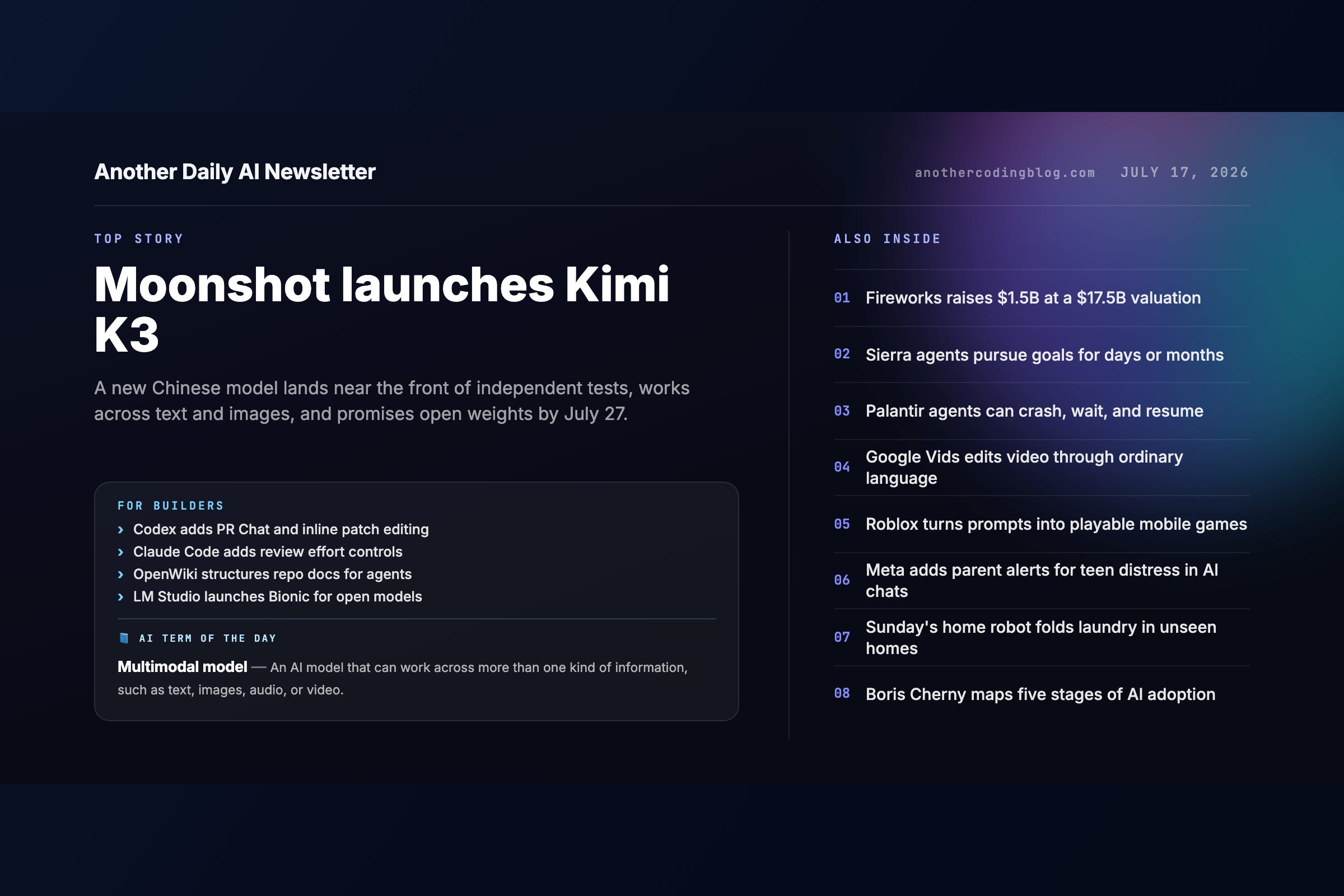
⭐ Top Story: Moonshot launches Kimi K3, with open weights coming July 27.
Moonshot AI has launched Kimi K3, a new model designed to work across text and images, follow long projects, write code, conduct research, and create visual material. It is available now in Kimi’s consumer app, desktop workspace, coding tool, and API. Moonshot says the full model weights will be released by July 27, which would give researchers and companies more freedom to inspect, adapt, and run it themselves.
The early results put K3 close to the leading group. Arena ranked it first in a blind comparison of models building web interfaces, where people judged the output without seeing which model made it. Artificial Analysis ranked K3 fourth among 189 models on its broader Intelligence Index. That independent testing also found tradeoffs: K3 was slower than average, more expensive than the median model in its class, and produced unusually long answers.
Moonshot’s own release is refreshingly direct about the limits. The company says K3 still trails Claude Fable 5 and GPT-5.6 Sol in overall experience, can make unexpected decisions when a request is ambiguous, and may become unstable if an ongoing session switches to K3 without preserving its prior reasoning. The weights are also promised, not public yet.
What makes this important is the widening field. A model developed outside the dominant U.S. labs is already showing up in real products: OpenCode added K3 for its Go users on launch day, although it warned that the model currently consumes usage limits faster because pricing has not been negotiated down. More strong models mean more choice for users and developers, stronger pressure on prices, and fewer reasons for the AI market to settle around only a handful of providers.
Agents are being built for work that lasts longer than a chat.
Sierra launched Horizon for goals that unfold over days, weeks, or months. Its agents can follow up across multiple conversations to schedule a medical referral, close a sale, or complete another outcome that cannot be resolved in one exchange. Sierra charges for completed outcomes rather than the number of AI tokens used.
Palantir introduced Orchestrator so agents can stop and resume safely. Its demonstration showed a patient-discharge agent being shut down mid-task, waiting days for a doctor’s approval, and resuming without losing its place or repeating an action.
Google gave Gemini Managed Agents budgets, schedules, and a free tier. A recurring agent can reuse the same working environment, while a token limit stops runaway tasks without deleting the work already completed.
Anthropic’s Boris Cherny mapped five stages of organizational AI adoption. The framework moves from gated access to one person supervising hundreds or thousands of agents. At each stage, the bottleneck shifts from getting access to reviewing output, supplying context, establishing trust, and enforcing guardrails.
These announcements point to the same next step. An agent that works for longer needs memory, a place to keep its files, a way to wait, a spending limit, and a clear record of what it changed. Better models help, but dependable work increasingly comes from the system around the model.
Creating with AI is becoming a normal product feature.
Google Vids can now generate and edit video through ordinary language. Gemini Omni can combine a prompt with reference images, then swap backgrounds, adjust lighting, or add effects without forcing the user to restart. A personal-avatar feature can create a presenter from a selfie and voice recording; Google says generated clips carry a SynthID watermark.
Roblox added prompt-based game creation to its mobile app. A player can describe a game, receive a playable starting point, modify it, and share it without writing code. Roblox says player retention will influence which AI-made games get promoted, an attempt to keep easy creation from overwhelming discovery with low-quality results.
Google’s AI Mode can now hand work to Instacart, Canva, and YouTube. A search can become a grocery cart, a set of design templates, or a saved playlist instead of ending with an answer on the page.
The interface is becoming less about learning a special AI tool. People can describe an edit, a game, or an errand inside software they already know. That makes AI easier to use, while placing more responsibility on product teams to show what was generated, what will happen next, and what remains under the user’s control.
Quick Hits
Fireworks AI raised $1.505 billion at a $17.5 billion valuation - the company says it has passed $1 billion in annualized revenue and now serves more than 40 trillion tokens per day, with over 95% coming from models specialized on customer data.
Meta will alert parents when a teen expresses signs of suicide or self-harm to Meta AI - the company says its assistant will continue directing teens to crisis resources while adding parental notifications for the most serious conversations.
Grok launched scheduled and trigger-based Automations - users can describe a recurring job once and have Grok run it and report back when a schedule or condition is met.
Databricks brought its Genie One data assistant to iOS and Android - mobile users can ask questions, explore dashboards, and open Databricks apps under the same identity and access controls used on desktop.
Cerebras explained the internal knowledge base answering more than 15,000 questions a day - the three-month-old system searches information where employees already create it, including documents, Slack, GitHub, and Jira.
OpenAI revised the ChatGPT desktop app after launch feedback - previous chats and cloud projects are back in the sidebar, and Chat now appears alongside Work mode.
Sunday Robotics previewed ACT-2 for reliable household tasks - its Memo robot folded laundry successfully in 778 of 785 attempts across unseen homes, garments, and starting positions. Sunday plans to place the system with beta families this fall; the results are company-reported and limited to a defined range of laundry tasks.
Google DeepMind and Isomorphic Labs outlined a joint bioresilience program - the effort uses AI to help prevent model misuse, detect outbreaks sooner, and accelerate vaccines or other medical countermeasures. The companies say they formed more than 15 government, research, and biosecurity partnerships during the past year.
ChatGPT Work added document, spreadsheet, and slide creation - people can now create and edit those files directly inside the workplace version of ChatGPT.
🔬 Research Radar
Safe-Psych tests whether an AI knows when it lacks enough information to diagnose. Across more than 1,000 real psychiatric notes revealed in stages, leading models frequently diagnosed too early and rarely asked clarifying questions unless explicitly prompted. Most failed to hold back in more than 60% of cases where the available evidence was still incomplete.
Researchers taught an agent to decide when to retrieve, reuse, or forget memories. Across six benchmarks, their lightweight memory controller improved task success by as much as 15.2 points while using 5% to 20% fewer tokens. The results are from a preprint and need independent replication.
STOCKTAKE measures whether an agent acts on what it correctly notices. In a simulated 26-week supply-chain task, several leading models identified most hidden problems but still made costly inventory decisions. The benchmark separates failures of understanding from failures of action.
🛠️ For Builders
Codex added PR Chat and inline patch editing. Developers can ask questions about a specific pull request, send review feedback to Codex, inspect the proposed change, and edit, accept, or reject it without leaving the review.
Claude Code added effort levels to `/code-review`. Teams can choose a faster, lower-cost pass or spend more tokens for higher recall when a change needs deeper review.
OpenWiki 0.2 adopted the Open Knowledge Format. Repository documentation now carries structured metadata, indexes, and update logs so coding agents can retrieve context without repeatedly searching an entire wiki.
LM Studio launched Bionic, an agent designed for open models. The team says it used Bionic while developing Bionic itself, and released the first version for people building with locally controlled models.
📘 AI Term of the Day
Multimodal model. Google’s machine learning glossary defines it as a model whose inputs, outputs, or both include more than one kind of information. In practice, that can mean combining text with images, audio, video, or code rather than treating each format as a separate task.
Go deeper: Google Cloud’s plain-language guide to multimodal AI explains how a model can use one type of input to produce another, such as reading an image and writing a description or taking a written prompt and creating video.