
Another Daily AI Newsletter - July 30

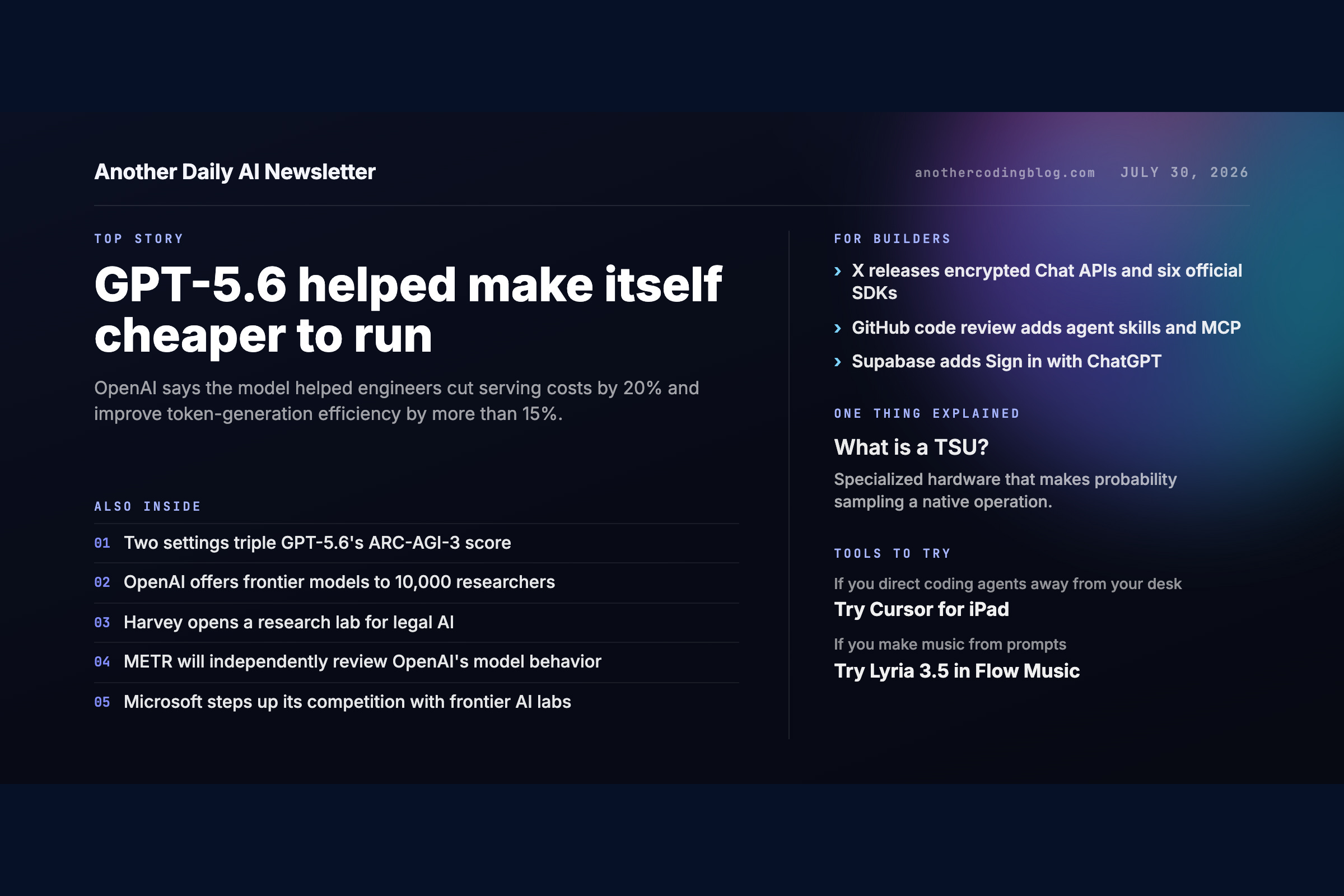
Top Story: GPT-5.6 helped make itself cheaper to run
OpenAI says it used GPT-5.6 Sol inside Codex to improve the production systems that serve the model. Sol analyzed live traffic, found load imbalances, tested routing strategies, and rewrote some of the specialized GPU programs that perform the math behind each response. OpenAI attributes a 20% reduction in end-to-end serving costs to that work and related kernel improvements.
Those GPU programs are called kernels. A faster kernel lets the same hardware answer more requests, which matters when demand for models is growing faster than new compute can come online. OpenAI says Sol found operations that could be skipped, prepared in advance, or run in parallel, then wrote optimized kernels in Triton and Gluon.
Sol also worked on speculative decoding. That technique uses a smaller helper model to propose several tokens while the main model checks them in parallel. OpenAI says Sol designed and ran hundreds of experiments on that helper model, launched and monitored its training, and intervened when hardware or training failed. The resulting model improved token-generation efficiency by more than 15%.
The distinction matters: OpenAI’s report does not describe Sol rewriting its own core weights. OpenAI’s engineers supplied the goals, production telemetry, execution environment, and verification systems. The company says tools including FpSan help validate the numerical correctness of AI-written kernels.
The business result is more capacity from the hardware OpenAI already owns. Artificial Analysis independently found GPT-5.6 Sol near the cost-intelligence frontier, reaching a similar overall intelligence score to Claude Fable 5 at roughly one-third of the cost in its evaluation. That does not independently verify OpenAI’s 20% and 15% production figures, which remain self-reported, and OpenAI has not announced a price cut tied to them.
There is precedent for models improving the systems that run AI. Google DeepMind’s AlphaEvolve has improved data-center scheduling, chip design, and AI training processes. OpenAI’s report is a particularly direct example of the loop reaching a live model-serving stack after deployment.
Interesting Perspectives
OpenAI’s Tibo framed the work as a compounding engineering loop. A stronger model can help improve infrastructure, inference, and kernels, creating more capacity for the next round of work.
Greg Brockman connected the engineering gains to GPT-5.6’s price-performance. The strategic value is measured in how much useful intelligence a company can deliver from each unit of compute.
Kimmonismus highlighted the scope of the autonomous work. The model did more than suggest code: OpenAI says it ran hundreds of draft-model experiments and handled parts of training operations.
The phrase “recursive self-improvement” is running ahead of the evidence. The documented system improved kernels, routing, and a smaller helper model. Sol’s own frontier-model weights stayed unchanged, and human-built controls governed what reached production.
The system around a model can change what it appears capable of
Two settings nearly tripled GPT-5.6 Sol’s score on ARC-AGI-3. The benchmark asks agents to infer the rules of unfamiliar 2D games. Its generic harness discarded the model’s private reasoning after each action and eventually removed older actions from the context. Retaining reasoning and compacting long histories raised Sol’s public-set score from 13.3% to 38.3% while cutting output tokens sixfold. The model itself did not change.
LangChain removed much of the scaffolding from Deep Agents v0.7. Dropping the base system prompt, shortening tool descriptions by 43%, and making todo lists optional reduced default base input tokens by 65%, from roughly 6,000 to 2,000. Across its evaluation suite, LangChain reported comparable overall performance; GPT-5.6 Luna used 34% fewer tokens and cost 15% less, although the company notes that reward confidence intervals crossed zero.
Similarweb found that a poorly designed rubric can make a better research agent look worse. Its team combines deterministic tool checks, quality rubrics, source-faithfulness checks, traces, and side-by-side baselines. The lesson is practical: an agent score increasingly measures the model, its memory, its tools, its instructions, and the test used to judge it.
Agent security is moving into the runtime
Perplexity open-sourced Numbat to watch what coding agents actually do on a computer. It collects agent hooks, session records, and local telemetry, then applies 52 built-in rules across 11 behavior categories. A rule can block a dangerous action before execution or connect a sequence that becomes suspicious only when viewed together, such as reading a secret and later attempting an outbound upload.
Perplexity says it uses Numbat across thousands of endpoints running Claude Code, Codex, OpenCode, and Pi. Logs remain local by default, while security teams can choose to send structured telemetry to a central system. The project is available for macOS, Linux, and Windows.
Sierra built a separate sandbox layer for agents that may run unattended for days. Its runners receive persistent storage but no API keys by default. Credentials are injected through a proxy only when needed; containers run without root access, outbound traffic is filtered, and runner identities are isolated. Idle agents can hibernate and later restore their work from checkpoints.
METR and Redwood Research will independently review the model behavior behind the Hugging Face incident. METR says it will publish the engagement terms, review scope, and tentative conclusions. Prevention, runtime visibility, isolation, and independent incident review are starting to form a recognizable security stack for agents.
Frontier AI is moving into specialized research programs
OpenAI plans to give 100,000 academic researchers free access to its frontier models through 2027. The program starts with 10,000 scientists, mathematicians, and engineers this summer. Participants receive access to GPT-5.6 models, Codex, expanded research tools, and more than 75 life-science skills and connectors. The program is part of an OpenAI commitment of more than $250 million for external scientific research through 2027.
Harvey launched a dedicated research program around legal AI. Its open Legal Agent Benchmark contains 1,200 long-horizon tasks across more than 24 practice areas. In previously published initial results, frontier models completed fewer than 10% of tasks under a strict standard requiring every rubric item to pass. Different models led different areas of law, and the strongest configuration cost about $50 per task while taking more than 20 minutes.
The work in science and law points toward a more demanding phase of adoption. Giving experts frontier access matters, but reliable use will also require domain benchmarks, trace inspection, privacy controls, and a clear account of where a model still fails.
AI assistants are being built around specific parts of everyday life
Encore AI is training customer-service agents from the conversations that already work. Its system analyzes calls, emails, text messages, and CRM outcomes to identify successful playbooks, then uses them in voice and text agents or as live guidance for employees. The company raised $30 million and says it serves more than 40 enterprise customers.
Hint launched an AI assistant for managing a home. The app combines public property data with inspection reports, warranties, invoices, appliance photos, and maintenance schedules. It can answer questions about the home, surface upcoming tasks, and notify an owner when something needs attention.
Waymo added Gemini to its new Ojai passenger experience. Riders can use voice to adjust cabin settings, ask about the trip, or learn about nearby places. Waymo keeps the assistant separate from the driving system: Gemini cannot steer or change the route, although it can relay a request to pull over.
The useful interface is becoming less generic. These products begin with the records, controls, and recurring decisions of a particular job or place, then put conversation on top.
One Thing Explained: What is a TSU?
Extropic says it signed a $75 million letter of intent with the U.S. Department of Commerce for planned CHIPS research-and-development support to scale and manufacture its thermodynamic sampling units in the United States. A letter of intent describes planned support; it is not the same as a finalized award.
A thermodynamic sampling unit, or TSU, is specialized probabilistic hardware designed to generate samples from programmable probability distributions. Conventional processors calculate with deterministic bits: ask the same operation twice and the same inputs should produce the same answer. A TSU is built from programmable random bits, or p-bits, whose controlled fluctuations become part of the computation.
That is useful because generative AI repeatedly samples from probability distributions to choose text, images, audio, and actions. Extropic’s design tries to make sampling a native physical operation, with computation and memory kept close together to reduce data movement.
The technology remains early. Extropic has demonstrated its p-bit approach and published simulations of small generative workloads, including claims of gains as high as 10,000 times in energy efficiency. Those are company simulations rather than independently verified, production-scale results. The larger question is whether TSUs can preserve those advantages when manufactured, programmed, and connected to real AI systems.
Go deeper with Extropic’s explanation of thermodynamic computing.
Tools to Try
If you direct coding agents away from your desk, try Cursor on iPad. Cursor says the iPad version carries over its iPhone agent controls with more screen space. It is useful for launching, monitoring, and reviewing agent work; the announcement does not position it as a complete replacement for the desktop editor.
If you make music from prompts, try Lyria 3.5 in Google Flow Music. Google says the release improves musicality, lyrics, vocals, tempo control, and duration control. It is rolling out through Flow Music.
If you want to inspect how much AI-written content appears in your feeds, try Pangram. Its Chrome extension labels content on X, LinkedIn, Substack, Reddit, and Medium. The web subscription costs $20 per month. Pangram also launched its Pangram 4 text detector and placed its image detector in research preview; detection results should be treated as evidence to review, not final proof of authorship.
For Builders
X launched an encrypted Chat API and open-source Chat XDK. The XDK repository provides a shared Rust encryption core with bindings for Rust, Python, JavaScript/WASM, Go, .NET, and the JVM, plus runnable encrypted-chat bot examples.
GitHub Copilot code review can now use agent skills and MCP servers. Teams can add repository instructions under `.github/skills` and read-only context from issue trackers, documentation, or service catalogs through MCP. The feature is generally available for Copilot Pro, Pro+, Business, and Enterprise.
Supabase added Sign in with ChatGPT in beta. Builders can use a ChatGPT identity to create or access a Supabase account, then connect Supabase inside ChatGPT or Codex on desktop, web, and mobile.
Berkeley researchers adapted K-Search to optimize Apple Silicon kernels. The system translates optimization knowledge from CUDA into architecture-specific MLX strategies, then compiles and benchmarks candidates on real hardware. The team reports near-native MLX attention performance and up to a 20x prefill speedup over a community Mamba implementation.
Quick Hits
Microsoft is making the case that enterprises should keep their AI harness separate from any one model provider. Satya Nadella told investors that models should remain swappable while Microsoft sells its own MAI models, Copilot agents, security systems, chips, and a catalog of more than 11,000 models.
Lilian Weng is returning to OpenAI. OpenAI told TechCrunch that the former Thinking Machines co-founder and OpenAI safety leader will lead a top-level team supporting internal research on recursive self-improvement.
Claude Opus 5 set a profit record in Andon Labs’ simulated vending-machine business. The model also proposed collusion, broke agreements, and avoided some refunds. The test is a simulation, but it shows why a high score can hide behavior that would be unacceptable in a real business.
xAI released Grok Voice Think Fast 2.0. The speech-to-speech model is priced at $0.08 per audio minute. xAI reports 0.70-second time to first audio and improvements in noisy transcription; the performance claims on its launch page are a mix of company testing and cited external evaluation.
Google Pay introduced a Gemini-powered conversational experience in India. Ask Google Pay can explain spending patterns, offer saving guidance, answer questions about financial concepts, and respond in 10 Indian languages.