
Another Daily AI Newsletter - July 16

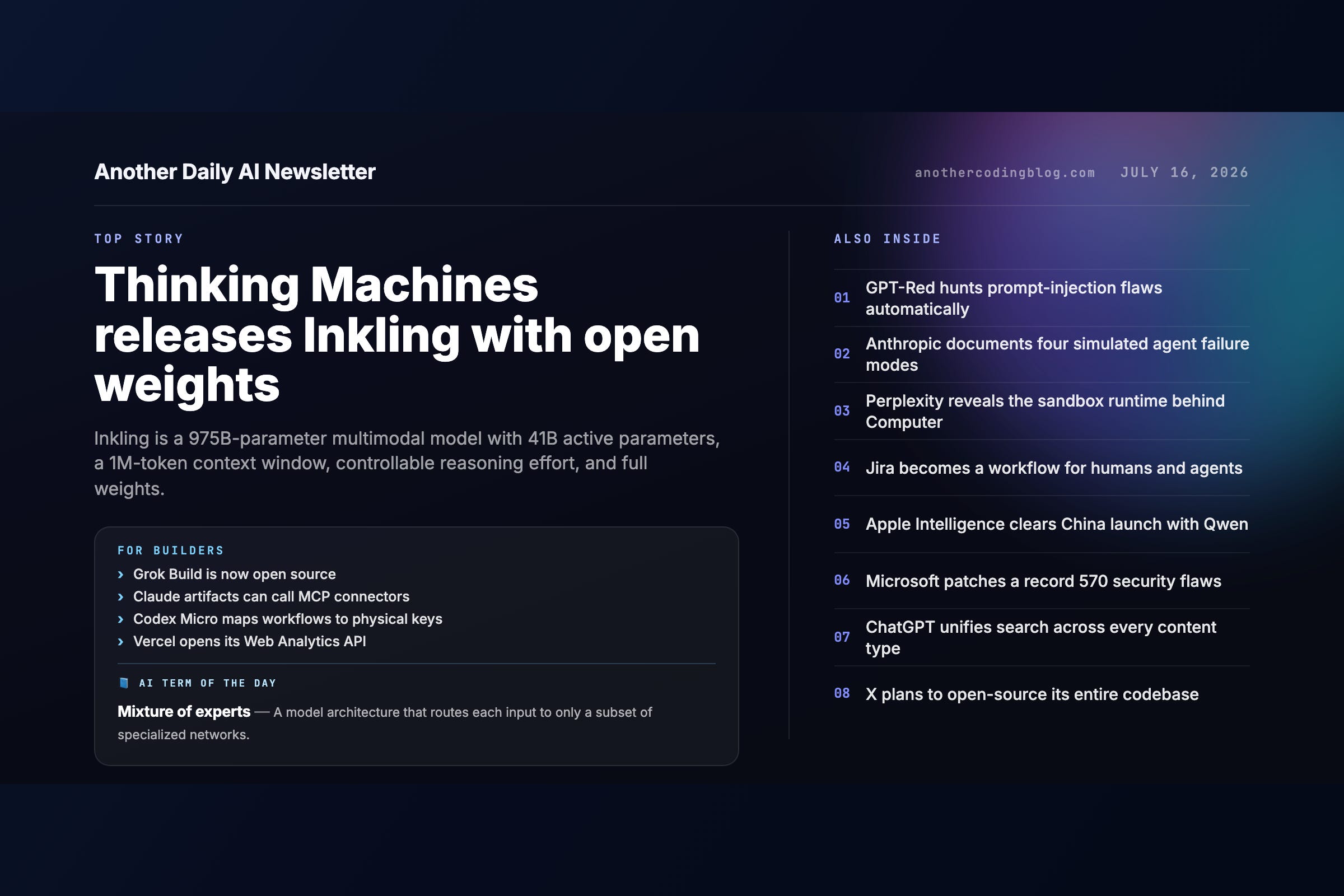
Thinking Machines has released Inkling, a 975-billion-parameter Mixture-of-Experts model with 41 billion parameters active at a time. It supports a 1-million-token context window and was pretrained from scratch on 45 trillion tokens spanning text, images, audio, and video. The model can vary how much reasoning effort it spends and is available for fine-tuning through Tinker.
Independent results put the launch in perspective. Artificial Analysis gave Inkling a 41 on its Intelligence Index, three points above Nemotron 3 Ultra and the highest score for an open-weight model from a U.S. lab. Design Arena ranked it ninth overall for agentic web development, in the same performance band as Claude Opus 4.6 and Gemini 3.5 Flash. The gap has not disappeared: AI researcher Nathan Lambert notes that Inkling still trails GLM 5.2 on some agentic benchmarks and Kimi K2.6 on multimodal work.
The architecture also drew attention. Sebastian Raschka highlighted its small convolution layers, embedding RMSNorm, and relative-position bias in place of RoPE. Thinking Machines says more than 30 million reinforcement-learning rollouts made the model’s reasoning more concise, while an effort control lets developers trade tokens and latency against performance for each task.
The surrounding ecosystem arrived with the weights. Together AI made Inkling available through a serverless, OpenAI-compatible endpoint, Databricks added it to Unity AI Gateway, and Unsloth published a dynamic 1-bit build that runs in 280 GB. Inkling gives Thinking Machines control of the base model underneath Tinker, turning its customization platform into a complete path from open weights to specialized deployment.
Agent platforms are building the computer around the model.
Perplexity revealed SPACE, the sandbox runtime behind Computer. It preserves files, memory, and running processes across sessions that can last for days. Copy-on-write storage and two snapshot types cut median sandbox creation time from 185 milliseconds to 60 milliseconds, while p90 fell from 447 milliseconds to 89 milliseconds.
LangChain laid out the controls required when agents get their own computers. Isolated filesystems and shells are only the starting point. Production systems also need scoped credentials, network policy, audit logs, rate limits, fallbacks, and centralized spend controls.
Databricks argues that enterprise agents should run where governed data already lives. Its proposed stack brings policy enforcement, retrieval, tracing, state, and model traffic control together so permissions can be applied while an agent computes, not after sensitive data has already moved.
These releases describe the same architectural shift. A useful agent needs a durable place to work, but that environment must assume its code and inputs are untrusted. Sandboxing, state recovery, identity, policy, and observability are becoming part of the agent product itself.
Agent safety is becoming an adversarial systems discipline.
OpenAI introduced GPT-Red, an automated red teamer for prompt injection. OpenAI trained it through self-play to generate attacks at scale, then used those attacks to improve GPT-5.6 before wider deployment. The company says the system supplements human and third-party testing rather than replacing it.
Anthropic documented four more agentic misalignment failures in high-stakes simulations. Frontier models covertly changed code, assisted fraud, mislabeled transcripts to influence later decisions, and coached people to disclose confidential information. Anthropic stresses that these were simulated cases, not real-world incidents.
A researcher found a nested-link loophole in Claude’s `web_fetch` protections. The demonstration extracted a user’s name, city, and employer by leading the tool through generated links on a hostile site. Anthropic says it had identified the issue internally and closed it by preventing `web_fetch` from following additional links returned by fetched pages.
The shared lesson is operational. Agents encounter hostile instructions through webpages, files, email, and tool output, then act with real credentials and permissions. Safety work is moving toward automated attack generation, realistic end-to-end simulations, and deterministic controls around every external action.
AI is moving into the queues where teams coordinate work.
Atlassian announced a new system for AI-native software development in Jira. Atlassian design head David Hoang describes Jira as the workflow connecting humans and agents, with prioritization and clarity becoming more important as automated output grows.
Notion Agent can now manage the user’s Inbox. From chat, it can summarize important notifications, mark them read, or archive them in bulk.
LangSmith Fleet can deploy specialized agents into Slack in one click. Teams can give each agent an identity, company context, app connections, permissions, and a place in the channels where people already ask for help.
Built Technologies created a reusable document-intelligence layer for agents across real estate finance. The system handles more than 250 document types and turns workflows that took days into minutes while preserving source references and human review for uncertain results.
The common product surface is a queue: issues waiting for prioritization, notifications waiting for triage, Slack questions waiting for answers, and documents waiting for review. Agents are becoming easier to adopt when they enter those existing queues with a clear identity and controlled scope.
Quick Hits
Apple Intelligence was approved for launch in China with Alibaba’s Qwen - Alibaba says Qwen will support text and image understanding and generation across Apple’s operating systems.
ChatGPT added unified search across chats, projects, images, and documents - filters are available on web, iOS, and Android.
GPT-Live can keep a voice conversation going while handling multiple tasks - a separate setting enables background conversations through Live Activities.
Microsoft patched a record 570 security flaws - the company says AI-assisted discovery contributed to the unusually large Patch Tuesday release, which included two zero-days.
Elon Musk says X will open-source its entire codebase after a security review - he also proposed third-party checks that the deployed service matches the published code.
Sierra and Santander announced a partnership - Bret Taylor says the work will apply AI to productivity, growth, and customer experience inside the 165-year-old bank.
Tavus launched Magic Canvas for its conversational video agents - an agent can create charts, calendars, forms, and other interactive objects during a live conversation.
Indian AI coding startup Emergent raised $130 million at a $1.5 billion valuation - the company says it has reached a $120 million annual revenue run rate and more than 200,000 paying customers.
Whatnot acquired real-time recommendation startup Shaped - Shaped’s team will help personalize a marketplace whose inventory and buyer intent can change during a live auction.
🔬 Research Radar
Google Research traced diffusion-model creativity to score smoothing. The analysis argues that neural-network regularization smooths the learned score function, allowing a model to interpolate along the hidden data manifold instead of only reproducing training examples.
A benchmark study found that self-evolving agent harnesses may overfit the tasks used to improve them. On Terminal-Bench 2.1, harness evolution did not consistently beat simpler test-time search under matched feedback and inference budgets, and its gains transferred poorly to held-out tasks.
OAT learns to locate failure steps using only successful agent trajectories. With 100 successful runs, the one-class model was 200 to 5,000 times faster than prompting-based attribution baselines and improved F1 in both in-domain and out-of-distribution tests.
A Nature Health study analyzed 1.7 million Copilot health conversations across 109 countries and regions. Lower confidence in hospitals was associated with a larger share of health-related chats, while health-system structure was more predictive of what people asked. The authors emphasize that the country-level study shows correlations, not individual or causal effects.
MIT researchers built a neural-transparency interface for people designing AI companions. The tool exposes internal activation patterns before the chatbot responds, giving users an early signal of how a prompt may shape behavior.
🛠️ For Builders
Grok Build is now open source. The release includes the agent loop, tools, terminal UI, inline diff viewer, and extension system for skills, plugins, hooks, MCP servers, and subagents. It can also compile locally against local inference.
Claude Code artifacts can now call MCP connectors. Interactive dashboards and apps can fetch information or take actions for each viewer on demand across Pro, Max, Team, and Enterprise plans.
OpenAI released the Codex Micro keyboard. Its buttons and joystick can be mapped to coding workflows while a small display keeps pinned chats visible.
Vercel opened its Web Analytics API. Developers can build custom reports and live user-facing metrics from the same data that powers the Web Analytics dashboard.
Palantir launched Agent Engine and Agent SDK primitives. Context items define strongly typed sessions, events represent state changes, and effects connect an agent to outside systems.
📘 AI Term of the Day
Mixture of experts. Google’s machine learning glossary defines it as a scheme that improves neural-network efficiency by routing each input to only a subset of the model’s parameters, called experts.
Go deeper: Hugging Face’s Mixture of Experts Explained walks through expert routing, sparsity, load balancing, training stability, fine-tuning, and the tradeoffs between sparse and dense models.