
Another Daily AI Newsletter - July 12
GPT-5.6 proposes a proof for a 50-year-old math problem, while AI science, workplace agents, and orchestration systems keep moving.

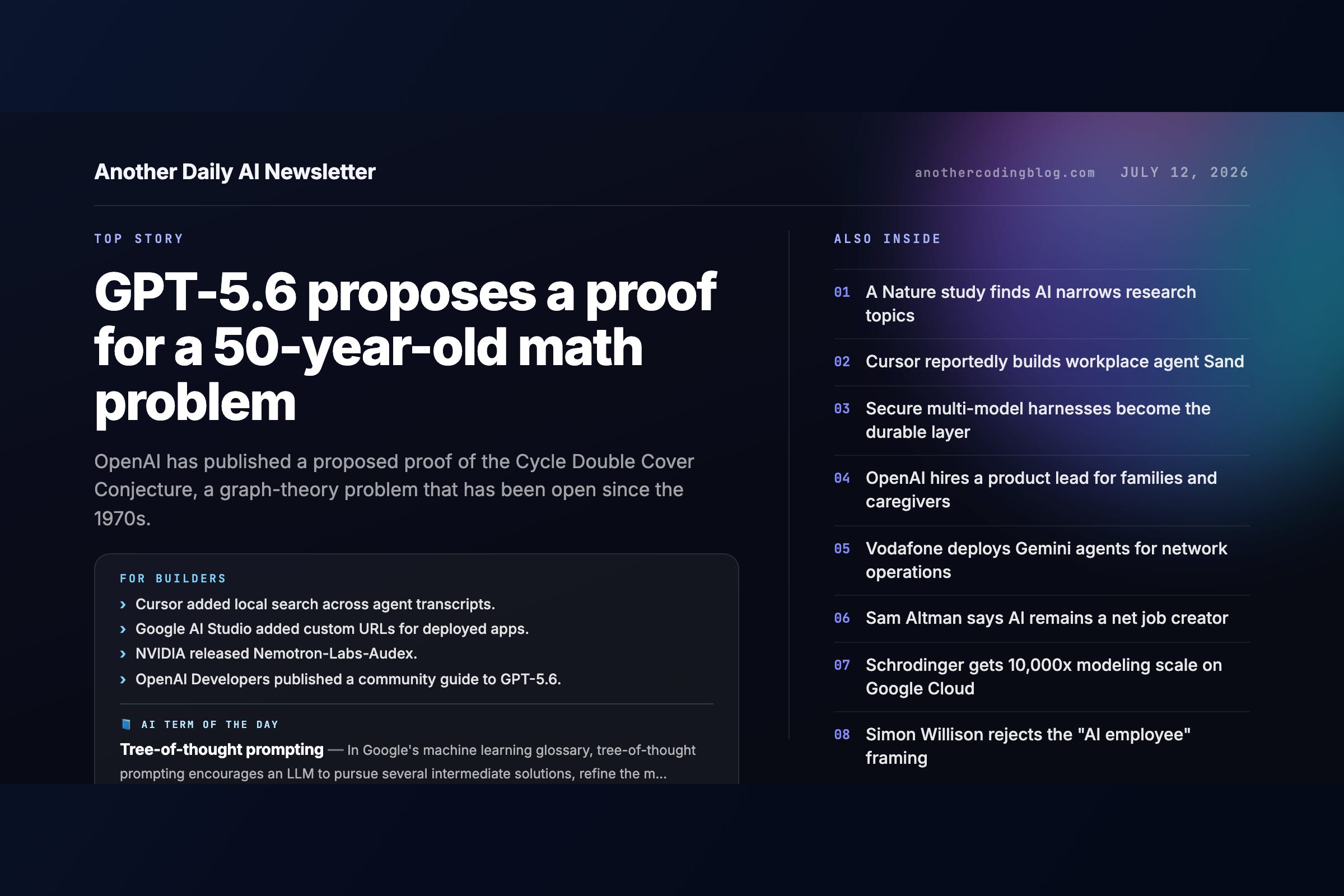
⭐ Top Story: GPT-5.6 proposes a proof for a 50-year-old math problem.
OpenAI has published a proposed proof of the Cycle Double Cover Conjecture, a graph-theory problem that has been open since the 1970s. The result came from GPT-5.6 Sol Ultra, which coordinated as many as 64 agents and reportedly returned the proof in under an hour.
The conjecture asks whether every graph without a bridge, an edge whose removal would split the graph, can be covered by loops so that every edge appears exactly twice. The three-page proof reduces the problem to cubic graphs, applies an established result about flows, and then uses linear algebra to construct the required cycle cover. The paper states that GPT-5.6 Sol Ultra produced the proof, while Codex and GPT-5.6 Sol helped write it up.
The prompt may be as consequential as the answer. OpenAI also released the full instructions, which told the system to keep several independent proof strategies alive, redirect agents away from crowded approaches, launch adversarial reviewers, and reject any missing lemma described as routine. This was organized research management, not 64 copies of the same prompt.
Independent verification is still underway. Early discussion among mathematicians has focused on whether the local edge-labeling argument really holds globally, and there is not yet a formal peer review or a public confirmation from an independent graph theorist. The honest headline is that OpenAI has published a serious proposed proof with enough detail for experts to audit.
The larger signal is easier to call. GPT-5.6 Ultra turns parallel agents into a research instrument: explore competing approaches, preserve diversity, attack the strongest candidate, and leave a compact artifact for humans to verify. Whether this particular proof survives review will determine how historic the result is. The workflow is already worth studying.
AI can accelerate science while narrowing what gets studied.
A Nature study finds AI narrows research topics. The researchers examined 41.3 million papers. Scientists using AI published more, received more citations, and advanced faster, but AI adoption reduced the collective range of topics studied by 4.63% and researchers’ engagement with one another by 22%.
Schrodinger gets 10,000x modeling scale on Google Cloud. Elastic compute and GPUs let scientific teams test far more molecular possibilities than a fixed local cluster could support.
The two stories belong together. AI can increase the amount of research an individual team produces while pulling many teams toward the same well-supported methods and questions. Faster discovery needs deliberate incentives for unusual hypotheses, replication, and independent verification.
Workplace agents are expanding beyond the engineering team.
Cursor reportedly builds workplace agent Sand. The product is said to handle email and text responses, spreadsheets, and engineering tasks. Cursor has not confirmed the project, and the report says it may not ship.
Vodafone deploys Gemini agents for network operations. The deployment targets outage response and infrastructure optimization, where an agent’s value can be tied to reliability rather than chat usage.
OpenAI hires a product lead for families and caregivers. ChatGPT is moving into trust-sensitive household workflows that require different defaults from an individual productivity tool.
Simon Willison rejects the “AI employee” framing. His comparison to adding spreadsheets to an org chart is useful: these systems can reshape work without becoming people or holding responsibility.
The market is spreading horizontally. Coding products are reaching for operations and office work, enterprise platforms are embedding agents in named business processes, and consumer assistants are moving into family decisions. Clear ownership and escalation paths will matter more as those surfaces get closer to real consequences.
Long-running agents are creating a new control layer.
Secure multi-model harnesses become the durable layer. Aravind Srinivas argues that as models improve and prices fall, the system that routes work, controls access, and preserves context becomes harder to replace.
Google Cloud traced and parallelized
a production match-brief agent. The demo shows why observability matters: parallel work is only useful when teams can inspect timing, tool calls, and failures.
Zhipu’s founder outlined a two-year push toward long-horizon tasks and agent societies. The translated internal letter pairs longer-running systems with self-training, mechanistic interpretability, safety research, and continued open-model releases.
An Alignment Forum essay argues that political will is now the safety bottleneck. Its case is that many useful practices already exist, but institutions are not consistently applying them.
The common layer is operational control: orchestration, permissions, traces, memory, evaluation, and governance. Model quality determines what an agent can attempt. The harness determines what it is allowed to do, what evidence it leaves behind, and when a human can intervene.
Quick Hits
Sam Altman says AI remains a net job creator — an early claim in a labor-market debate that will need harder data as adoption broadens.
ChatGPT desktop reportedly added more users in one day than in the previous two weeks — the GPT-5.6 launch appears to have pulled users toward the desktop app.
Aravind Srinivas expects frontier-quality models to get sharply cheaper — he predicts Fable 5-level quality at one-third to one-quarter the price within six months and a comparable local model within a year.
Nathan Lambert asked why the AI 2040 report largely omits open source — open weights remain a major variable in any long-range capability forecast.
A secondary benchmark report puts Grok 4.5 first on cost-adjusted AutomationBench-AA — useful directional evidence, but worth waiting for the primary benchmark record before treating the ranking as settled.
🛠️ For Builders
Cursor added local search across agent transcripts. Historical conversations can now become a usable project memory instead of a folder of disconnected sessions.
Google AI Studio added custom URLs for deployed apps. Small deployment details matter when prototypes need stable links for users and teammates.
NVIDIA released Nemotron-Labs-Audex. The 30B mixture-of-experts model uses about 3B active parameters and supports audio understanding, speech recognition, translation, text-to-speech, audio generation, and speech-to-speech work in one model.
OpenAI Developers published a community guide to GPT-5.6. It collects early examples and implementation patterns from builders working with the new model family.
📘 AI Term of the Day
Tree-of-thought prompting. In Google’s machine learning glossary, tree-of-thought prompting encourages an LLM to pursue several intermediate solutions, refine the most promising ones, and abandon weaker paths.
That is close to the search strategy in OpenAI’s math prompt. Agents explored different proof families independently, weak routes were marked as blocked, and adversarial reviewers tried to break the surviving candidates before the root agent assembled a result.
Go deeper: The original Tree of Thoughts paper explains how deliberate search over multiple reasoning paths can improve problem solving beyond a single left-to-right chain of thought.