
Another Daily AI Newsletter - July 10
GPT-5.6 shipped with OpenAI product upgrades.
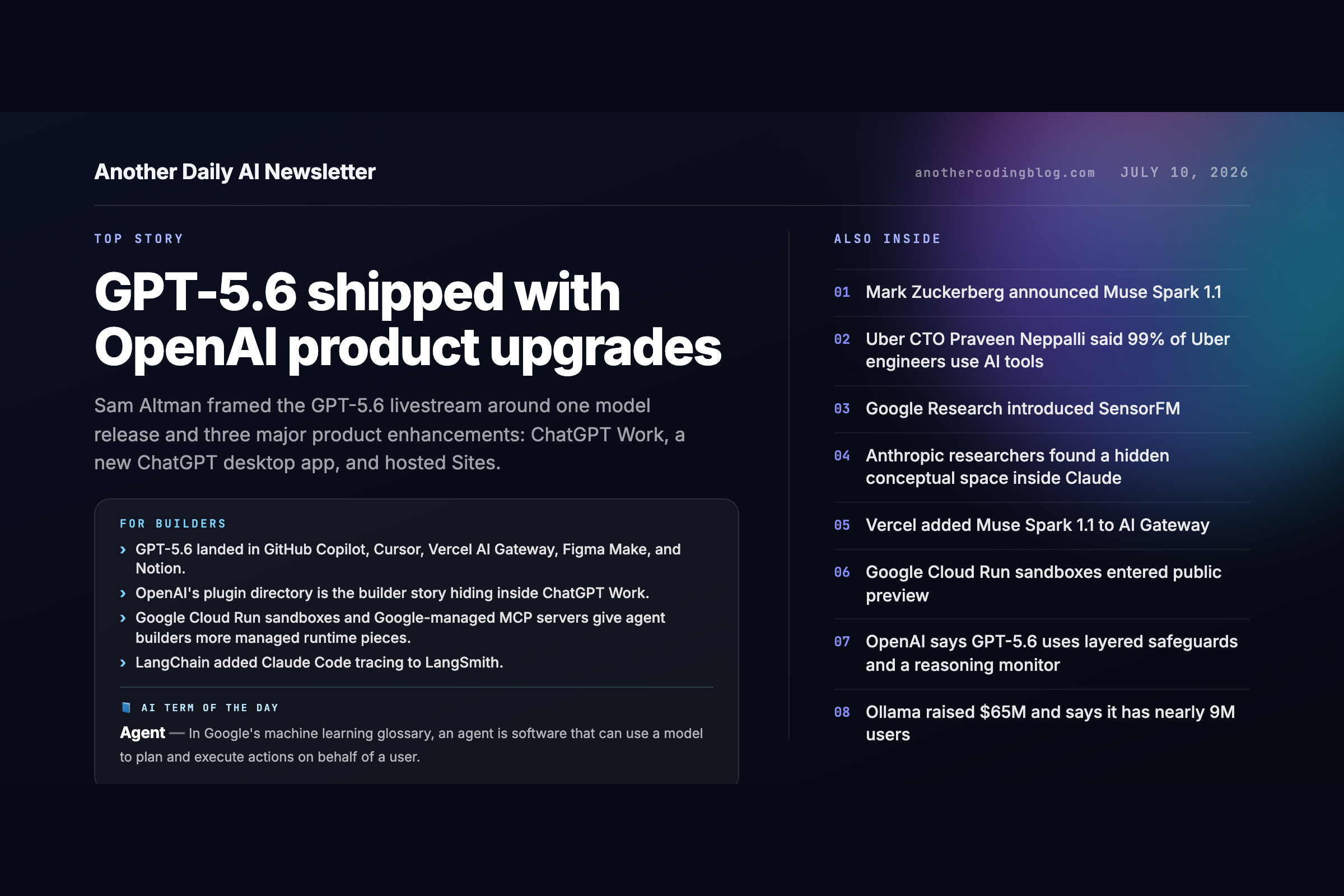
⭐ Top Story: GPT-5.6 shipped with OpenAI product upgrades.
Sam Altman framed the GPT-5.6 livestream around one model release and three major product enhancements: ChatGPT Work, a new ChatGPT desktop app, and hosted Sites.
OpenAI’s GPT-5.6 release is the model layer. Sol is the flagship tier for long-horizon coding, knowledge work, cyber, and science. Terra is the everyday performance-and-cost tier. Luna is the fast, cheaper tier for high-volume work. The API also adds Programmatic Tool Calling, `max` and `ultra` effort modes, and a multi-agent beta in Responses API.
ChatGPT Work is the workflow layer. OpenAI says it can act across apps and files, stay with long projects, create documents, spreadsheets, presentations, reports, and Sites, and use Scheduled Tasks for recurring work. It also brings connected apps, a built-in browser, Computer Use, and a Chrome sidebar into the same product surface. A quick tour from ChatGPT made the pitch feel like ChatGPT is becoming a workspace rather than a chat window.
OpenAI Developers filled in the desktop details: Codex and ChatGPT now live in one app, with new coding workflows, a Chrome extension, a rebuilt in-app browser, and faster Computer Use powered by GPT-5.6. Sites is in beta for Pro and Plus users, with hosting, storage, and optional auth built in. Computer Use now supports batching and parallel operations, and the in-app browser supports authenticated sites, multiple tabs, file downloads, and annotation mode.
The distribution came fast. Microsoft 365 Copilot made GPT-5.6 its preferred model for Word, Excel, PowerPoint, Chat, and Cowork. GitHub Copilot added Sol, Terra, and Luna. Cursor, Vercel, Figma, Notion, Perplexity, and Azure all surfaced GPT-5.6 the same day. NVIDIA said the model was trained and run on GB200 and GB300 systems, giving the launch an infrastructure layer too.
Sam’s post is the right anchor because it names the full launch shape. GPT-5.6 supplies the engine. ChatGPT Work, desktop, Sites, plugins, browser, Computer Use, and Microsoft distribution are the product enhancements around it. OpenAI is trying to make ChatGPT the place where work gets planned, executed, reviewed, and shipped.
Meta made its model strategy look more like a product launch.
Mark Zuckerberg announced Muse Spark 1.1. He described it as a low-cost agentic and coding model available through Meta’s new Model API and inside Meta AI.
AI at Meta opened the Model API preview. That matters because Meta has usually leaned on open model distribution, while this gives developers a hosted, paid path into Meta’s models.
TechCrunch framed Muse Spark 1.1 as Meta entering the coding-agent fight. Spark is being positioned near OpenAI, Anthropic, and xAI in the agentic coding lane.
Vercel added Muse Spark 1.1 to AI Gateway. The practical test for Meta is whether developers can route to it as easily as they route to OpenAI, Anthropic, Google, or xAI.
Meta’s new AI chips are reportedly moving toward September production. If the model API gets traction, the chip story becomes part of the same cost-control puzzle.
Meta’s signal today was packaging. Muse Spark 1.1 is a model release, but the Model API and AI Gateway support make it easier to treat Meta as another model supplier inside production systems.
Production agents are becoming an operations problem.
Uber CTO Praveen Neppalli said 99% of Uber engineers use AI tools. He also said more than 70% of pull requests are attributed to local or cloud agents, and Uber engineers have built 2,500+ agent skills. Uber is also scaling “Agentic Pods” beyond engineering, pairing an AI-proficient engineer with a domain expert for two-week cycles before shipping agents into finance, legal, operations, marketing, support, HR, and procurement.
LangChain highlighted the hard part: write-access agents. Read-only agents are easier to branch and test. Agents that touch production data still need better evals, approvals, logs, and rollback paths.
Google Cloud made Looker Embedded Conversational Analytics generally available. The product lets teams embed conversational analytics agents into apps and internal workflows.
Google Cloud Run sandboxes entered public preview. Sandboxes are becoming a default building block for AI-generated code and agent workloads.
AWS published practical MCP tool-design tradeoffs. The point is simple: exposing an API is not the same thing as designing a tool an agent can use reliably.
The pattern is getting concrete. Useful agents need permissions, sandboxes, observability, evaluations, and people who understand the workflow. The model is the engine. The operating system around it is where the hard deployment work lives.
Health and science AI had a real signal day.
Google Research introduced SensorFM. It is a sensor foundation model trained on one trillion minutes of wearable data from five million consented participants.
Google Research’s X post emphasized transfer across cardiovascular, metabolic, sleep, mental health, lifestyle, and demographic factors. The ambition is a reusable representation of human physiology from sensor data.
NVIDIA released a NeMo synthetic-data workflow for financial AI research. The interesting part is the iterative generation, deduplication, and curation loop rather than a single model claim.
MIT researchers built tiny robot boats that assemble floating structures. It sits outside the LLM lane and belongs in the broader automation story.
A clinical-reasoning LLM paper targeted hepatocellular carcinoma risk stratification. Medical AI keeps moving toward narrower, higher-stakes workflow support.
AUTOPILOT VQA benchmarked incident-centric dashcam understanding. Driving systems need models that can reason about events as well as label scenes.
This is the quieter counterweight to launch day. AI is becoming more useful when the input is specialized, the workflow has a clear owner, and the evaluation target is specific.
Governance and interpretability are getting more operational.
Anthropic researchers found a hidden conceptual space inside Claude. MIT Technology Review’s story focuses on a technique that gives researchers a clearer view of how models represent concepts while answering or acting.
OpenAI says GPT-5.6 uses layered safeguards and a reasoning monitor. The system card details matter less than the direction: more capability is being paired with more account-level trust, monitoring, and targeted access.
The White House said no government approval is required for model releases. That clarification followed reporting about OpenAI’s limited preview and federal safety testing.
Anthropic added Ben Bernanke to its Long-Term Benefit Trust. AI governance is increasingly mixing technical safeguards, institutional boards, and access-policy decisions.
Claude launched Reflect usage recaps. Usage dashboards may look minor, but they point toward healthier controls around how people use increasingly sticky assistants.
The governance story is no longer only about abstract safety statements. It now includes model internals, trust tiers, usage controls, and the political question of who gets early access to frontier systems.
Quick Hits
OpenAI’s unified plugin directory is live. Shared discovery, install, auth, contextual suggestions, and distribution across ChatGPT and Codex are now part of the plugin story.
OpenAI is sunsetting Atlas while folding browser work into ChatGPT Work. The browser idea did not disappear; it moved into the work agent.
ClaudeDevs reset 5-hour and weekly limits. Demand spikes around Claude launches are still visible in the developer surface.
Google will disclose which ads are made with AI. AI provenance keeps moving from policy language into product UI.
Character.AI entered microdrama production. Entertainment apps are still probing what AI-native media formats should look like.
Perplexity previewed a GLM 5.2-based Computer orchestrator. Lower-cost orchestration is worth watching as computer-use agents spread.
Sierra wrote about AI-pilling its company. Internal adoption is becoming its own operating discipline.
💰 Funding & Moves
Ollama raised $65M and says it has nearly 9M users. Local AI tooling is still a major developer demand signal.
Gradium raised a $100M seed round backed by NVIDIA. Voice infrastructure remains hot even after the first wave of voice-agent hype.
Lyzr reportedly let its own agent run a $100M fundraise. Cute story, but also a reminder that agent startups will use their own workflows as marketing.
Anthropic, OpenAI, and SpaceX are now framed as exit-scale anomalies. The private-market scale of frontier AI still looks detached from normal venture math.
Fidji Simo is stepping down from OpenAI’s No. 2 role. Leadership churn matters more when the company is simultaneously shipping platform, model, and enterprise moves.
🔬 Research Radar
Switch-Reasoner. The paper trains multimodal models to decide when explicit reasoning is worth the cost.
UniClawBench. A benchmark for proactive agents operating real-world tasks.
HumanForge. A human-centric deepfake video benchmark with multi-agent forgery rationales.
OPSD-V. On-policy self-distillation for faster autoregressive video generation.
Cognitive-structured Multimodal Agent. A multimodal agent design aimed at understanding, generation, and editing without blindly carrying every historical input forward.
Stanford’s LLM-as-a-Verifier. Verifier scaling keeps showing up as a path to stronger agents and benchmark performance.
Stanford’s Distill to Detect. Hidden model bias is easier to audit when the bias can be distilled into a detectable form.
🛠️ For Builders
GPT-5.6 landed in GitHub Copilot, Cursor, Vercel AI Gateway, Figma Make, and Notion. The model switchboard got very crowded very quickly.
OpenAI’s plugin directory is the builder story hiding inside ChatGPT Work. Discovery, install, auth, contextual suggestions, and ChatGPT/Codex distribution are now one lane.
Google Cloud Run sandboxes and Google-managed MCP servers give agent builders more managed runtime pieces. Sandboxed code execution and managed tool access are becoming table stakes.
LangChain added Claude Code tracing to LangSmith. Agent debugging is moving toward traces, not vibes.
LangChain also highlighted OpenWiki brains for agent memory. Durable agent memory keeps showing up as the next layer after tool calling.
Mistral launched a system of record for prompts and skills. Teams need versioning, ownership, and review around prompts the same way they need it around code.
GitHub Copilot can now summarize a repository for first-time visitors. Repository onboarding is a small but practical place for AI help.
The builder lane is shifting from “which model is best?” to “which model can be governed, traced, routed, remembered, sandboxed, and shipped?”
📘 AI Term of the Day
Agent. In Google’s machine learning glossary, an agent is software that can use a model to plan and execute actions on behalf of a user.
That definition is the whole newsletter today. ChatGPT Work, Codex, Uber’s agentic pods, LangChain’s write-access warning, Google Cloud’s sandboxes, and OpenAI’s plugin directory all depend on the same question: what can the agent see, what can it do, and who approves the risky steps?
Go deeper: The Shift to Agentic AI: Evidence from Codex is a useful research read on how agentic tools change work patterns, especially as Codex use moves beyond traditional software development.