
Another Daily AI Newsletter - July 18

⭐ Top Story: China launches a 29-country push to shape global AI.
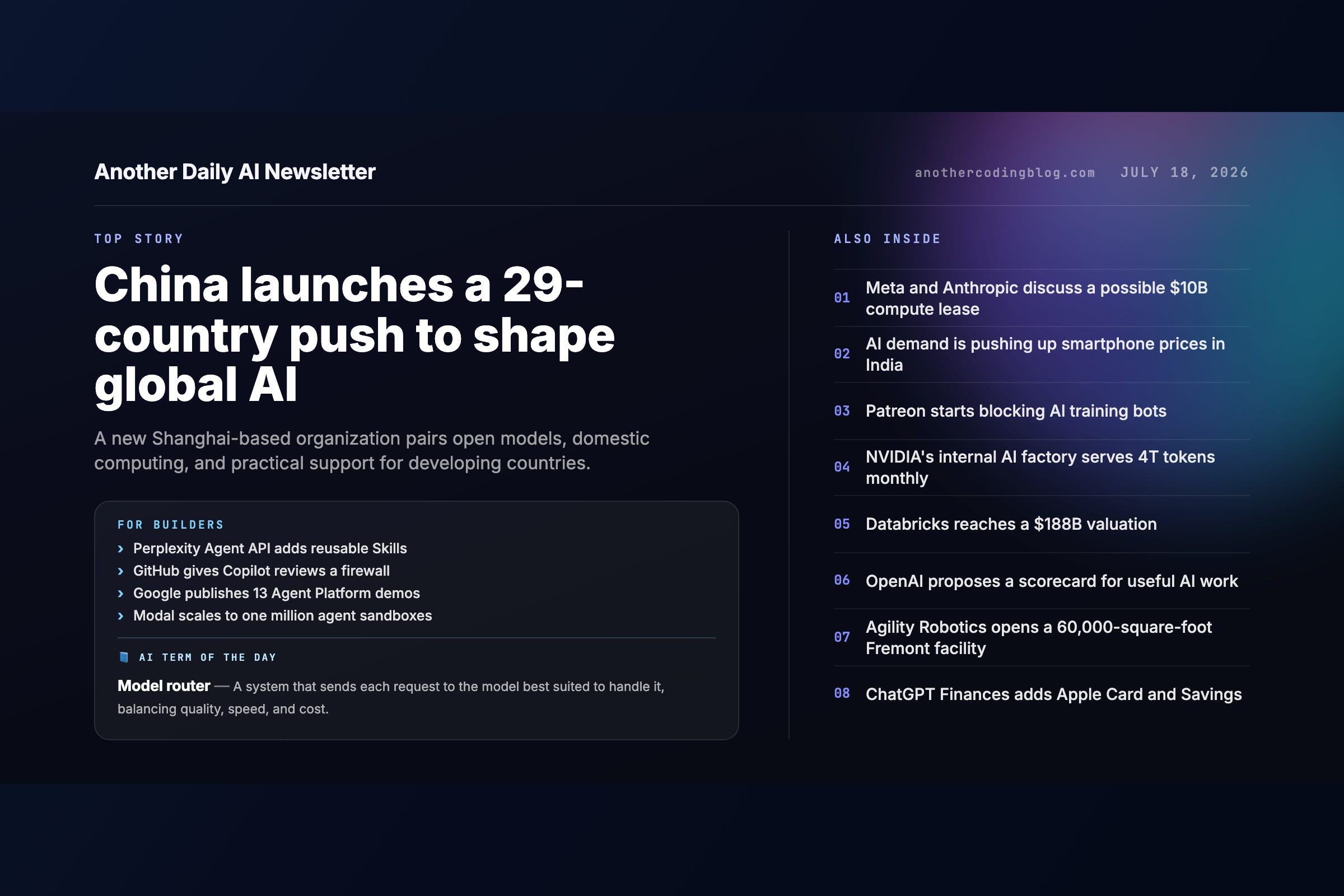
China and 28 other countries have established the World Artificial Intelligence Cooperation Organization, or WAICO. The new intergovernmental body will be headquartered in Shanghai, with founding members including Indonesia, Brazil, Russia, Pakistan, and countries across Africa and Asia. China has moved the contest over AI rules into institution-building.
Xi Jinping used his first appearance at the World Artificial Intelligence Conference to explain the offer behind the organization. China will provide 5,000 AI training opportunities to developing countries over five years, establish application centers with groups including ASEAN and the African Union, and bring its MAZU weather-warning system to 30 countries. Open models are being presented as an affordable path into AI for countries without their own frontier labs.
The conference supplied a technology stack to match the diplomatic pitch. Moonshot AI’s Kimi K3 arrived near the front of independent rankings while Huawei displayed its Atlas 950 SuperPoD, a domestic computing system for large AI workloads. Shanghai says the wider conference includes more than 1,100 companies and 3,000 exhibits spanning models, chips, robots, and consumer devices.
Researchers studying WAICO say its intended design is unusual: membership is open to any sovereign state, there is no shared-values test, and the agenda emphasizes development and the global AI capability gap. Western-led groups generally place more weight on rights and safety. WAICO is organized around sovereignty, access, and practical adoption.
The credibility test is already visible. China’s domestic AI services operate under strict content rules, and a new international study found that models deployed in countries including China were less likely to criticize authorities. Beijing has also reportedly discussed, but not enacted, limits on overseas access to its most advanced models. WAICO will matter if its members actually build local products, public services, and infrastructure around the technology. The first commitments are concrete enough to test.
AI compute is becoming a market of its own.
Meta and Anthropic are discussing a possible compute lease. The reported ceiling is $10 billion over two years, although CNN’s source cautioned that the talks are early and specific figures are speculative. Meta has spent heavily on data centers and is considering whether excess capacity can become a new business.
General Compute secured a $400 million loan backed by inference chips. The startup plans to build a cloud around SambaNova hardware designed to run finished models more efficiently. The deal may be the first major loan to treat inference-specific chips as collateral.
AI demand is already changing smartphone prices in India. Memory manufacturers are prioritizing the higher-margin chips used in AI data centers, leaving less capacity for phones and laptops. Smartphone shipments in India fell 10% year over year last quarter as component costs pushed up prices.
NVIDIA is pitching Vera Rubin around “intelligence per dollar”. Its argument is that agents require continuous post-training as tools, policies, and production environments change. That turns model refinement into a recurring infrastructure workload rather than a final step before launch.
Compute is now being leased between rivals, financed against specialized chips, optimized around recurring workloads, and felt in the price of consumer devices. The AI infrastructure buildout has become an economy with its own lenders, suppliers, and spillover costs.
Companies are replacing AI activity with proof of useful work.
OpenAI proposed a scorecard built around completed work. It recommends measuring whether a system finishes useful tasks, the full cost of each successful outcome, how dependable it is, and whether value grows faster than spending. Seats, tokens, and benchmark scores do not answer those questions.
LangChain and Pay-i mapped agent ROI to business outcomes. Their financial-services examples track RFP processing and anti-money-laundering monitoring across both model costs and business measures such as time saved, coverage, and error rates.
GitHub made Copilot usage visible at the repository level. New API endpoints report pull requests created, merged, and reviewed by Copilot, giving engineering leaders a clearer view of where the tools are affecting actual delivery.
NVIDIA says its internal AI factory now serves four trillion tokens a month. Employee demand is growing 40% month over month. The figure offers a rare look at the scale of AI usage inside a company building the underlying infrastructure.
Amazon Quick is being aimed at the work surrounding a sale. AWS shows the assistant prioritizing prospects, researching accounts, drafting outreach, and updating the CRM. The product case is strongest when those steps increase selling time rather than simply generate more AI activity.
The enterprise question is getting more disciplined: what finished, what did it cost, and did it improve the work? Vendors that cannot answer all three will have a harder time turning experiments into durable budgets.
Consent and security controls are moving into the product.
Patreon is using Cloudflare to block AI training crawlers. The company says robots.txt requests are no longer enough as crawlers become more sophisticated. Its new approach actively denies access to bots that seek creators’ work for training.
Azure Agent Kit checks for cross-tenant data leaks. Microsoft demonstrated checks for missing partition-key filters and fan-out queries, two mistakes that can expose one customer’s data to another in an agent application.
OpenAI says GPT-5.6 Sol set a new high on The Last Ones cyber range. The company connected the result to defensive Codex Security workflows that find, validate, and repair vulnerabilities in real code. The public claim is from OpenAI and still needs broader independent testing.
A Zoom display name has become a makeshift consent notice. Investor Jeremy Levine now appends “I do not consent to transcribing or recording” to his name as AI note-takers make always-on recording common. It is a social workaround for a control meeting software has not standardized.
The policy debate is turning into implementation details: who can read the data, which bots can enter, what gets recorded, and whether a security claim survives outside the vendor’s own test.
Quick Hits
Databricks reached a $188 billion valuation: Coatue is leading the new round, which the company expects to close later this summer.
Agility Robotics is opening a 60,000-square-foot Fremont facility: its Digit robots already move totes for customers including Amazon, GXO, and Toyota.
ChatGPT Finances added Apple Card and Savings support: the update also improves transaction processing, Plaid reconnects, and weekly spending and net-worth widgets.
A family built Foreguard with ChatGPT and Codex: the free planning tool helps households evaluate public benefits and insurance before a care crisis.
Vertu put an AI agent inside a $6,880 luxury phone: TechCrunch found useful document and planning workflows alongside the compromises of a niche device.
Kimi K3 refused an attempt to extract its system prompt: a small but useful reminder that open model weights do not require every deployed instruction to be public.
Andrew Ng expects AI to reward broader professional skills: cheaper coding and content production raise the value of architecture, product judgment, and end-to-end execution.
A new corrigibility fund will award at least $200,000 in 2026: roughly half is planned for grants and half for prizes recognizing work that keeps advanced systems responsive to human correction.
Simon Willison released an LLM cliché highlighter: the browser tool flags recurring phrases that make generated writing easy to recognize.
🔬 Research Radar
Sakana AI’s “Diffusing Blame” trains networks under a biological constraint. The work separates artificial neurons into excitatory and inhibitory groups and avoids sending exact copies of forward weights backward during learning. The team reports competitive results in image classification and reinforcement-learning tasks, and the paper has been accepted at ALIFE 2026.
🛠️ For Builders
Perplexity Agent API added reusable Skills. Developers can combine built-in document capabilities with custom skills instead of placing every behavior into one system prompt.
Google Cloud published 13 Gemini Enterprise Agent Platform demos. The examples cover building, deployment, governance, evaluation, long-running workflows, dynamic interfaces, and multi-framework orchestration.
GitHub gave Copilot code review a firewall and custom runtime setup. Reviews can read instructions from a pull request branch, use additional instruction files, install dependencies, and run on a separately configured runner.
Modal demonstrated one million concurrent agent sandboxes. The company rebuilt its control plane without central coordination and says it created the sandboxes in under a minute, with median time to interactivity below half a second.
NVIDIA and Hugging Face connected NeMo Automodel to Diffusers. Teams can fine-tune image and video models across one GPU or a large cluster without converting checkpoints or rewriting the model.
Smartsheet documented its remote MCP server on AWS. The architecture gives assistants controlled access to project data and actions while reducing token use through an AI-specific interface.
📘 AI Term of the Day
Model router. Google’s machine learning glossary defines it as the algorithm that decides which model should handle a request. A router can send a simple task to a smaller, faster model and reserve a more capable model for work that needs it, balancing quality, speed, and cost.
Go deeper: IBM Research’s plain-language look at model routing explains why real conversations make routing harder than simply assigning each prompt to a fixed category.