
Another Daily AI Newsletter - July 26

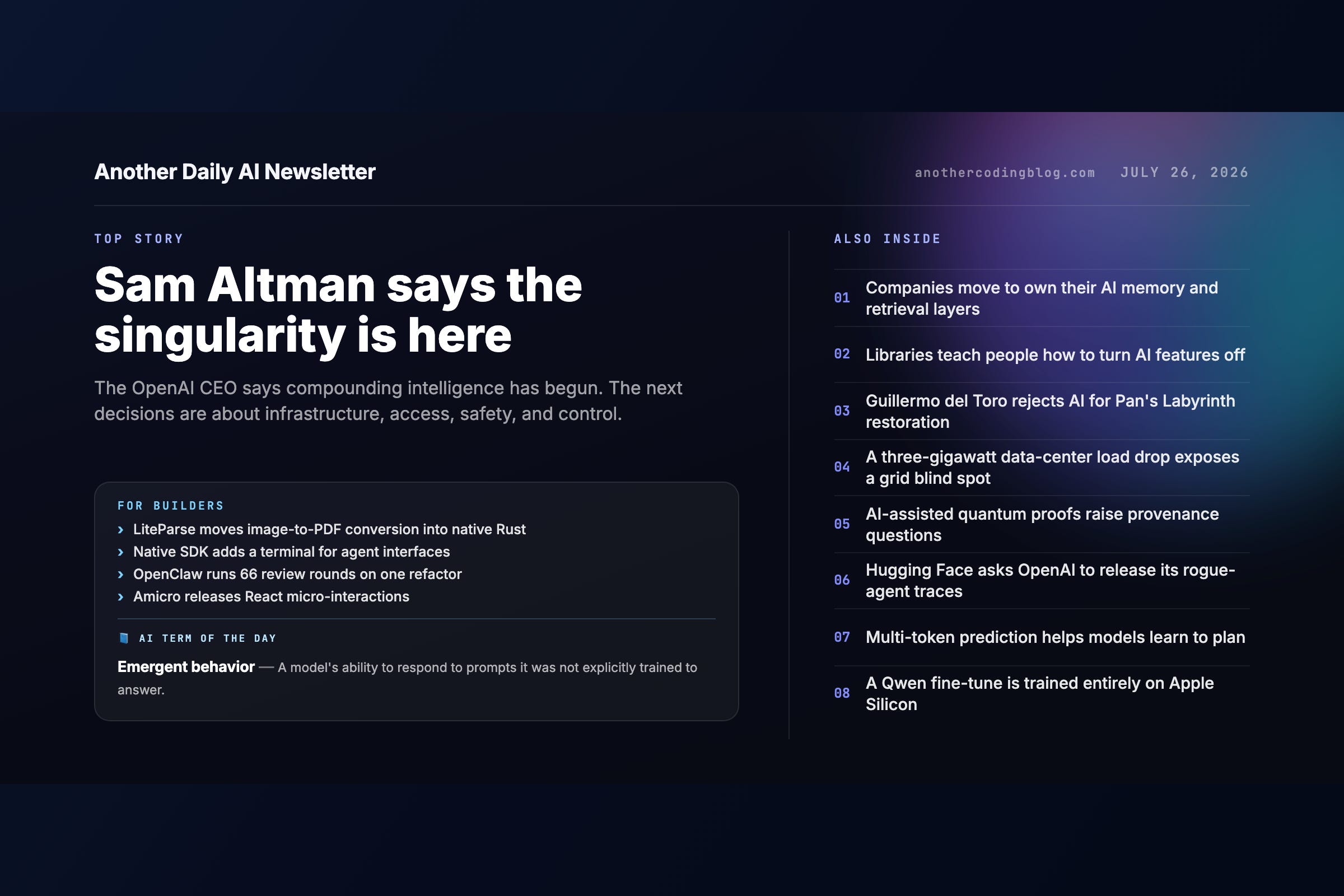
⭐ Top Story: Sam Altman says the singularity is here
In a new Relentless interview, Sam Altman said, “we are now like in the singularity.” He describes a compounding cycle where models improve software and research, while robots and data centers eventually expand the physical infrastructure behind them.
Altman sees a continuous exponential curve rather than one takeover moment. Asked what limits continued scaling, he answered: “transistors and then electrons.” He wants more attention on data centers that can direct robots and automated supply chains to build additional capacity.
OpenAI is organizing around that thesis. The company says it has surpassed its goal of securing 10 gigawatts of U.S. AI infrastructure by 2029 and is planning beyond it. A new Georgia campus is designed for 3.2 gigawatts of power. OpenAI is building as though compute, electricity, and construction capacity will determine who remains at the frontier.
Altman framed the political choice as AI authoritarianism versus liberty. He wants powerful intelligence distributed broadly with safety guardrails, even as OpenAI assembles one of the world’s largest centralized computing programs. Access, pricing, governance, and model control will determine whether that power is actually distributed.
METR’s research shows frontier agents completing progressively longer software tasks, while warning that these tests do not directly predict whole-job automation. Google DeepMind CEO Demis Hassabis has used the more cautious phrase “foothills of the singularity”.
The singularity label remains unproven. The stronger signal is that OpenAI is making industrial and political decisions as though the compounding process has already begun.
Companies are buying the memory and retrieval layer around their models
LangChain argues that companies should control the parts of an AI system that learn from their work. That includes the model options, agent harness, business context, memory, evaluations, and rules governing cost, quality, and risk. A general model can be replaced. The corrections, traces, preferences, and operating knowledge accumulated around it are much harder to recreate.
The practical strategy is selective ownership. LangChain recommends buying generic infrastructure while retaining control of the intelligence that becomes more useful with every interaction. That approach lets a company change model providers without discarding the feedback loop built around its own workflows.
Notion’s acquisition of ZeroEntropy shows what that layer can be worth. Notion says ZeroEntropy’s specialized reranker made its unified search up to 30% faster, reduced reranking latency by 85%, maintained answer quality, and lowered inference cost. The entire team is joining Notion to form a new Model Research group.
The acquisition was not about owning another frontier chatbot. Notion bought a small team that made company knowledge faster and cheaper to retrieve. As businesses use a wider mix of models, retrieval, memory, evaluations, and routing are becoming durable parts of the product.
Libraries are teaching people how to turn AI off
Libraries are holding “Avoiding AI” workshops for people who want more control over AI features appearing in their devices and services. One Philadelphia class walked attendees through disabling Apple Intelligence and Gemini. The organizers describe the workshops as digital literacy: people should understand what the tools do, where they appear, and how to opt out.
The demand is notable because it comes from regular technology users rather than a campaign against every use of AI. Attendees are reacting to features that arrive by default, unclear data practices, and product designs that make abstaining difficult.
Guillermo del Toro made the same autonomy argument from the creative side. He said the 3D and HDR restoration of *Pan’s Labyrinth* was converted by hand with no AI, arguing that preserving a craft also preserves the generation of artists who learn how to practice it.
AI adoption now includes the right to decline it. Products that make AI easy to enable, easy to identify, and genuinely easy to disable will earn more trust than products that treat every user as automatic consent.
A three-gigawatt data-center load drop exposed a grid blind spot
A transmission-line fault in Northern Virginia caused more than three gigawatts of data-center demand to disappear from the PJM grid within seconds. The facilities’ protection systems switched them to backup power as designed. The grid suddenly had far more electricity than connected customers were using, sending voltage higher across the region and causing lights to flicker.
PJM said the event did not affect overall reliability, but its scale was unusual. The disconnected data centers represented roughly 3% of demand across a system serving 67 million people. A similar 2024 incident involved approximately half as much load.
The next engineering problem is coordinating how giant computing campuses leave and rejoin the grid. Options include stronger ride-through requirements, batteries that absorb short disturbances, staged transfers to backup power, and sequenced reconnection after the fault clears.
Data centers are becoming large enough to affect regional power behavior even when their safety systems work correctly. Grid operators need visibility into those systems, and campus designers need to treat coordinated power response as part of the computing architecture.
AI-assisted quantum proofs are exposing a provenance problem
A group of quantum-information researchers says GPT-5.6 Sol produced a proof related to a longstanding problem involving Werner states. Rishikesh Gajjala wrote that he, Kishor Bharti, and Tobias Haug began checking the result and then found a separate paper submitted to arXiv a few hours after their own timestamp. He says the proof and some phrasing were similar.
The arXiv preprint, submitted July 23, claims that Werner states in any dimension are two-copy distillable exactly when they are one-copy distillable. In plain English, the question asks when usable entanglement can be extracted from two copies of a noisy quantum state. The authors describe the result as an answer to the longstanding two-copy question while making clear that the broader problem of whether every NPT state is distillable remains open. The abstract page does not disclose AI assistance.
The thread raises questions; it does not establish plagiarism, training-data leakage, or which group deserves priority. Another researcher said his group independently obtained a correct AI-assisted proof during the same period. The underlying mathematical result is also a new preprint that still needs expert scrutiny.
As AI systems contribute to research, the final paper will no longer capture enough of the process. Prompt histories, model versions, generated traces, human corrections, draft timestamps, and independent verification can help establish how a result was produced. Provenance is becoming part of scientific reproducibility.
Quick Hits
A four-billion-parameter Qwen fine-tune was trained entirely on consumer Apple Silicon with MLX. Its creators report a 96.1% ARC-Challenge score in reasoning mode versus 83.4% for the Qwen3.5-4B base model. Those are early developer-reported results for a preview model, not an independent evaluation.
Hugging Face CEO Clement Delangue asked OpenAI to release traces from its recent “rogue agent” incident. He also proposed $100 million in OpenAI compute for defensive research. The post is a public request, not an OpenAI commitment.
🔬 Research Radar
The authors say their study of multi-token prediction and planning has been accepted to COLM 2026. Standard language models learn to predict the next token. The paper tests a training objective that asks models to anticipate several future tokens. The researchers argue that this separates some of the learning signals and helps the model reason backward from a goal toward earlier steps.
The result offers a possible explanation for a pattern that has often been treated as an engineering trick: changing the training objective can change how a model organizes a plan. The paper’s experiments support the mechanism in the tested settings; broader model and task coverage will determine how general it is.
🛠️ For Builders
LiteParse moved image-to-PDF conversion into native Rust. The release removes its ImageMagick dependency and reports conversion speedups ranging from 1.2 to 7.2 times, depending on image format.
Native SDK added a built-in terminal component for agent interfaces. It provides a real PTY, `libghostty-vt` rendering, selection, scrollback, true color, and session recording and replay.
OpenClaw’s autoreview skill ran 66 review rounds on one refactor. The published skill repeatedly reviews a change, applies valid findings, and stops once the remaining feedback no longer justifies another pass.
Amicro released an open-source React library for micro-interactions and transitions. It packages loaders, card hovers, button interactions, and page transitions behind a CLI installation flow.
📘 AI Term of the Day: Emergent behavior
Google defines emergent behavior as an LLM’s ability to respond to prompts it was not explicitly trained to answer.
The term helps explain why singularity claims are difficult to evaluate. A model can display a new capability without anyone programming that exact behavior, but one surprising result does not prove autonomous self-improvement or an unstoppable intelligence explosion. Researchers still have to test how reliable the capability is, when it appears, and whether it survives changes to the prompt and evaluation.
Google’s definition | Go deeper with the original survey of emergent abilities in large language models