
Another Daily AI Newsletter - July 9
OpenAI and xAI deliver new frontier models. GPT-Live makes voice feel more live. Agent stacks get governed. Evals get messier.

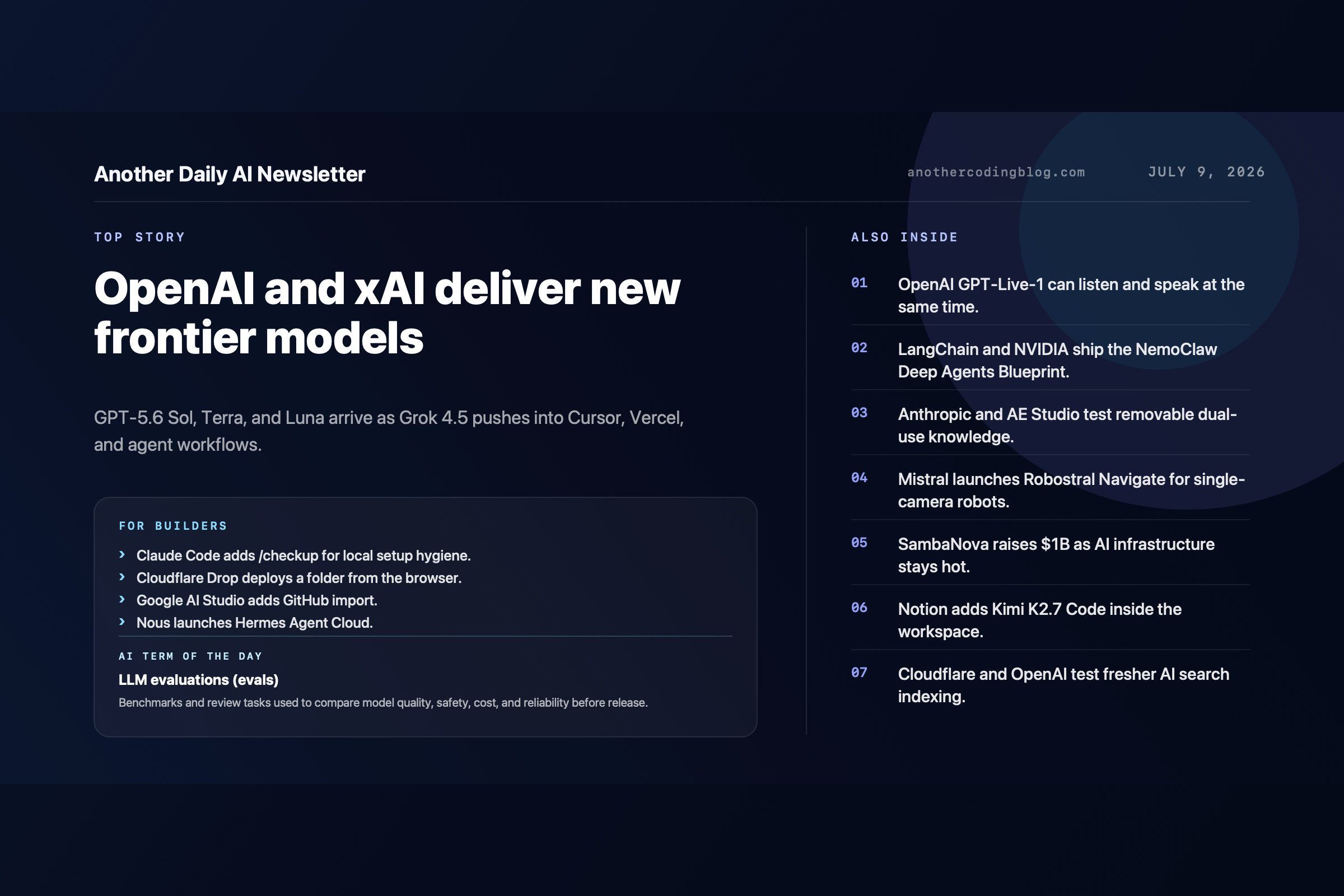
⭐ Top Story: OpenAI and xAI deliver new frontier models.
OpenAI says GPT-5.6 Sol, Terra, and Luna launch publicly today. Axios reports the broader release follows additional testing and discussions with government officials, after a staggered rollout that had kept access limited.
Axios’ preview of GPT-5.6 says early testers are praising Sol Ultra for speed, creativity, math, computer use, and complex tasks, while noting that independent review is still thin. Business Insider frames the lineup as three variants: Sol for advanced tasks, Terra for everyday use, and Luna for speed and cost.
xAI launched Grok 4.5 the day before, pitching it as its smartest model for coding, agentic tasks, and knowledge work. Axios framed Grok 4.5 as a business and engineering play. That matches the distribution strategy: Cursor helped train it, Vercel added it to AI Gateway, and Cline is already pointing to terminal-agent benchmark results.
OpenAI said the same day that SWE-Bench Pro is no longer a reliable frontier coding eval, after auditing the benchmark and finding broken tasks. For builders, the comparison now includes raw capability, cost, speed, and distribution inside the tools where work already happens.
GPT-5.6 has the stronger OpenAI platform gravity. Grok 4.5 is arriving through the engineering workflow itself: Cursor, Vercel, agent tooling, and lower published pricing. The immediate story is distribution: which model developers can put to work fastest, and where each one becomes useful first.
Voice AI is moving from turn-taking to live conversation.
OpenAI introduced GPT-Live in ChatGPT. The new voice model is built for more natural human-AI interaction and started rolling out in ChatGPT on July 8.
GPT-Live-1 can listen and speak at the same time. TechCrunch reports that OpenAI is using full-duplex voice models to improve turn-taking, interruptions, and live translation.
The API version is coming next. OpenAI Developers opened signups for GPT-Live-1 and GPT-Live-1 mini, which makes this more than a ChatGPT feature.
The Verge focused on the practical behavior change. The useful part is not a more expressive voice. It is a model that can wait through pauses, acknowledge that it is listening, translate while someone is still talking, and hand harder work to stronger text models.
Voice has always been the most obvious interface for AI and one of the easiest to disappoint. GPT-Live makes the interface feel less like a walkie-talkie. The next test is whether developers can build useful live workflows without making the assistant intrusive.
Agent work is turning into an operations problem.
LangChain and NVIDIA launched the NemoClaw Deep Agents Blueprint. The stack combines Deep Agents Code, Nemotron 3 Ultra, and NVIDIA OpenShell so enterprises can tune the harness, runtime, evals, and model together.
NVIDIA published the technical harness playbook. The interesting phrase is harness engineering: improving agent accuracy by changing tools, context, prompts, and eval flow without fine-tuning weights.
Databricks expanded Agent Bricks. The platform now points toward managed memory, MCP connectivity, sandboxes, governance, monitoring, and cost controls.
Databricks also benchmarked coding agents on its own internal tasks. Matei Zaharia said the team found real opportunities to lower cost and increase quality, including with open-source models.
Vercel Agent moved deeper into the dashboard. It can investigate production, answer project questions, and take action after approval.
AWS introduced Claude apps gateway for AWS. The gateway is aimed at centralized access, cost, and policy control for Claude Code and Claude Desktop in enterprise environments.
The useful pattern is clear. Agent systems need memory, policies, traces, sandboxes, routing, and cost controls. The model is still important, but the system around the model is becoming the part companies operate.
Model governance is getting more specific.
Anthropic published dual-use capability control research. The work focuses on suppressing specific dangerous knowledge without removing the rest of a model’s useful capability.
AE Studio introduced GRAM. The training method puts dual-use capabilities, such as virology knowledge, into removable modules.
OpenAI published its approach to government and national security partnerships. The post lays out principles for how governments use frontier systems in sensitive work.
A new arXiv paper argues for institutional red-teaming. Instead of only testing the model, the paper tests deployment rules by holding agents and objectives fixed while changing the rules around them.
The governance story is getting less abstract. Labs are working on removable knowledge, partnership principles, deployment rules, and eval limits. That is a better conversation than asking whether a model is safe in the abstract.
AI is pushing into physical and scientific workflows.
Mistral announced Robostral Navigate. The 8B model uses a single RGB camera to guide robots through natural-language navigation tasks.
NVIDIA highlighted BioNeMo Agent Toolkit for life sciences. The toolkits around scientific agents are becoming more specialized.
AWS published a GraphRAG approach for pharmaceutical research. The article focuses on connecting fragmented scientific knowledge through BYOKG and graph retrieval.
CARLA-GS targets autonomous-driving corner cases. The paper combines representation, reasoning, and physics simulation for safety-critical scenario synthesis.
MedPMC focuses on high-fidelity multimodal medical data. The main constraint is access to large, clean, clinically useful multimodal data.
These are not the splashiest announcements in the batch, but they are a good signal. AI keeps getting more useful when the problem is narrow, the environment is structured, and the evaluation target is specific.
Quick Hits
Notion added Kimi K2.7 Code. Another open-weight model shows up inside a work app.
Notion shared a Baseten custom-agent case study. The claim: repeated sales-knowledge lookup dropped from about 30 minutes to about 20 seconds.
Cloudflare and OpenAI announced an indexing research pilot. Search quality and freshness are becoming AI infrastructure problems.
OpenClaw announced the OpenClaw Foundation. The project is moving into nonprofit foundation form around personal AI.
Runway launched Runway Dev. Enterprise media teams are getting a developer platform for generative video and creative applications.
Krea and Runway added Seedream 5.0 Pro. Image generation and editing continue to move quickly at the application layer.
Mistral’s Robostral post showed the robotics model in motion. The single-camera setup is the part worth watching.
OpenAI also published K-12 AI skills guidance. The education work is becoming more practical and less theoretical.
💰 Funding & Moves
SambaNova raised $1B at an $11B valuation. AI chip and inference companies are still raising huge rounds.
Prime Intellect raised a $130M Series A. The pitch is enterprise agent building with compute and specialized software.
Lovable is reportedly in talks to double its valuation to $13.2B. Vibe-coding demand is still pulling capital toward app-generation tools.
StockMKTNewz reported Meta plans a $10B data-center investment in Canada. I would want a primary source before making this a lead, but it fits the larger infrastructure pattern.
🔬 Research Radar
Single-Rollout Asynchronous Optimization for Agentic Reinforcement Learning. Long-horizon agents need RL pipelines that do not wait for big synchronized batches.
HIVE studies post-hallucination reasoning in vision-language models. The paper looks at what models do after ambiguous visual evidence has already pushed them off track.
DiaLLM studies dialect adaptation. Models can understand dialectal English better than they can generate it.
Breaking Database Lock-in explores agent-generated storage readers. The paper looks at bypassing database-driver bottlenecks for analytical workloads.
Deep Native Structural Reasoning targets structure-property understanding. Biology, chemistry, and materials problems need models that can reason over native structure alongside text.
🛠️ For Builders
Claude Code added /checkup. It reviews unused skills, MCPs, plugins, CLAUDE.md structure, slow hooks, version drift, auto mode, and common read-only approvals before making changes.
Cloudflare Drop lets you deploy a folder from the browser. The temporary deployment lasts 60 minutes unless you claim it.
Google AI Studio added GitHub import. Build can now pull code from GitHub directly.
Nous Research launched Hermes Agent Cloud. Hermes Agent can now be provisioned through Nous Portal with model and server-size selection, org access controls, and unified billing.
GitHub added managed Copilot settings through MDM. Enterprise admins can push settings to VS Code and CLI through device management.
GitHub added enterprise-managed OpenTelemetry export. Copilot telemetry can now be routed to approved collectors.
The builder lane is getting more operational. The best updates today are not flashier prompts. They are setup checks, deployment shortcuts, managed settings, telemetry, access controls, and hosted agent infrastructure.
📘 AI Term of the Day
LLM evaluations (evals). In Google’s machine learning glossary, LLM evaluations are metrics and benchmarks used to assess large language model performance, compare models, and check whether systems are safe enough to use.
That is why today’s Grok 4.5 and SWE-Bench Pro stories belong together. Benchmarks are useful, but they are not neutral ground truth. They can break, saturate, leak, reward the wrong behavior, or fail to match how people actually use agents.
Go deeper: TIME’s explainer on why AI evals keep needing harder tests is a good background read.