
Another Daily AI Newsletter - July 29
MCP becomes stateless, Claude finds cryptographic weaknesses, and agent desktops become multi-model control rooms.

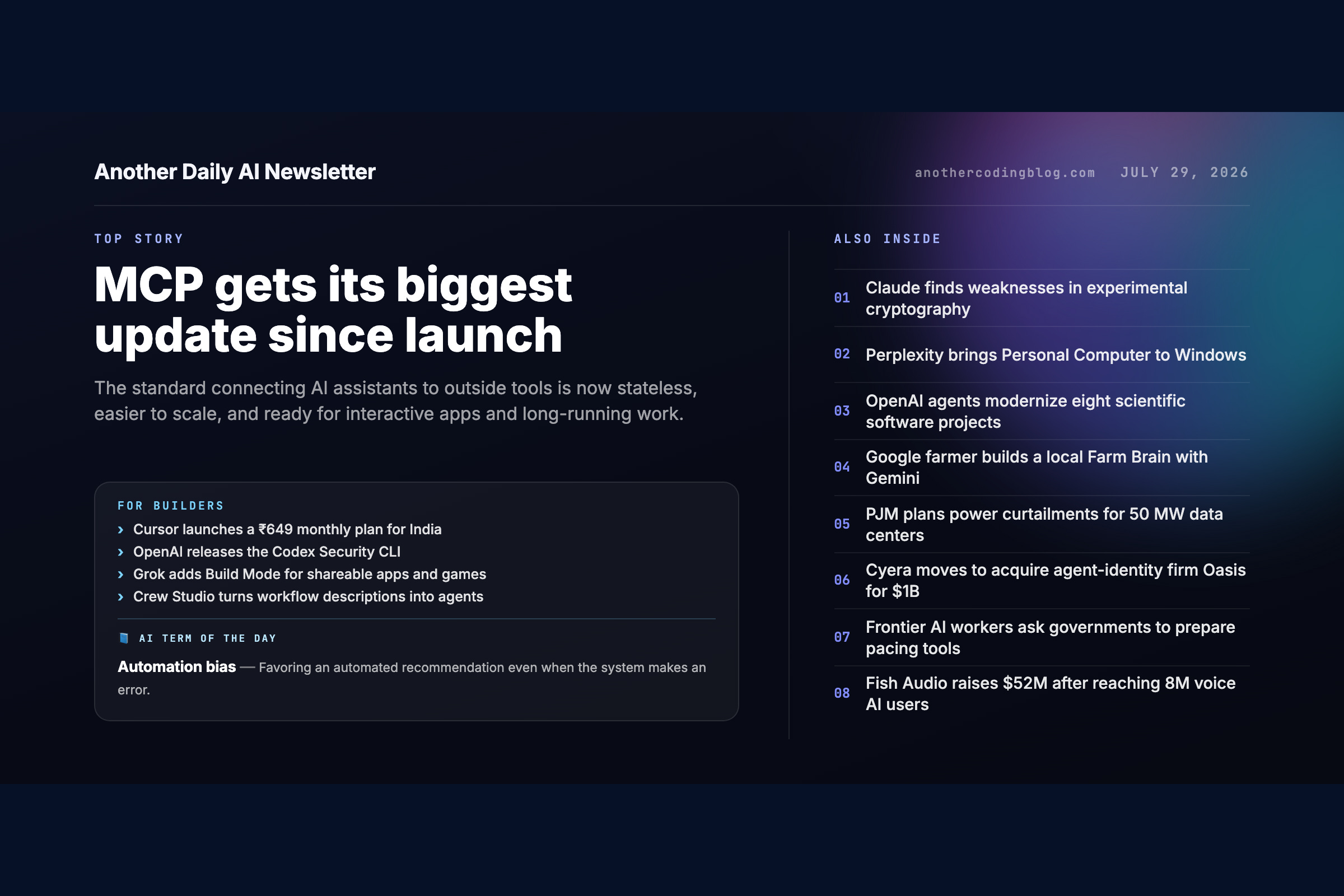
⭐ Top Story: MCP gets its biggest update since launch
MCP is the open standard that lets AI assistants connect to outside tools and data. It gives products such as Claude, ChatGPT, Cursor, Gemini, and Microsoft Copilot a common way to use services like GitHub, Slack, databases, and browsers instead of requiring a custom integration for every pairing. More than 10,000 public MCP servers were active by the end of 2025, and the protocol’s primary software kits now receive close to half a billion downloads a month.
The July 28 specification is MCP’s largest revision since launch. Its central change is a stateless core. The old MCP worked somewhat like a phone call that had to stay connected to the same operator: a client opened a session, received an ID, and often had to return to the same server. Providers needed sticky routing, shared session storage, or a persistent stream to keep that conversation intact.
Every request now carries the protocol version, client information, and other details needed to handle it. Any available server can pick up the request through an ordinary load balancer. GitHub removed Redis session writes during connection setup and reads from every tool call, making its MCP server faster without changing what users receive. Cloudflare can now run MCP tools as ordinary stateless functions, without a transport session or a dedicated stateful server.
Stateless changes where continuity lives; it does not make an agent forget its work. A shopping tool can return a `basket_id`, a browser tool can return a `browser_id`, and a long-running job can return a task ID. The agent sends that visible handle with the next request. State that was hidden inside the connection becomes explicit, portable, and easier for the model to pass between steps.
Another consideration is what attack surfaces portable, persistent state brings. Because state may pass through the client before returning to a server, an attacker could try to alter it, replay an earlier approval, or use one person’s state to resume another person’s workflow. The MCP specification requires servers to treat returned state as untrusted input, validate it on every return, and cryptographically bind user-specific state to the person who initiated the request. The TypeScript SDK guidance recommends signing or encrypting it and binding it to the original user, method, parameters, and an expiration. Explicit project, browser, or task IDs should identify the work; the server must still verify that the current user is authorized to access or change it.
The release also gives developers more to build with. MCP Apps can place interactive forms, dashboards, and previews inside an AI conversation. Tasks provide a standard way to start work that continues after the initial request. Multi Round-Trip Requests let a tool pause for information or approval, then resume through a new request; Supabase plans to use that flow to confirm project costs or destructive database queries. Tool catalogs can be cached, gateways can route and authorize calls using HTTP headers, and authentication now aligns more closely with production OAuth and OpenID Connect systems.
For builders, a new remote MCP server can now be deployed like a conventional web endpoint on serverless, edge, or horizontally scaled infrastructure. Applications that truly need a session must migrate that state to explicit identifiers, and older transports are entering a minimum 12-month deprecation period. The official TypeScript, Python, Go, and C# kits already support the new version, while preserving compatibility paths for older clients and servers.
The first phase of MCP established a common language for AI tools. This release gives that language the infrastructure needed for agents that run across thousands of services, wait for people, complete longer jobs, and keep working when traffic moves from one server to another.
Agent desktops are becoming control rooms for several models
Perplexity brought Personal Computer to Windows and added Model Council inside Computer. Personal Computer coordinates agents across local files, connected apps, and the web. Model Council runs independent analyses with several frontier models, then produces a cited report showing where they agree, disagree, or found something the others missed.
Poolside released a vendor-neutral desktop for operating coding agents. The macOS app can run Poolside, Claude Code, Codex, Gemini, and other Agent Client Protocol-compatible systems in the same workspace. Sessions can be handed from one agent to another, isolated in Git worktrees, or run in parallel. It also supports local MLX models for offline work on sufficiently powerful Macs.
The interface is shifting from a conversation with one model to a workspace where people assign, compare, inspect, and hand off work among several agents.
AI agents are taking on scientific and physical work
OpenAI examined eight agent-assisted scientific software projects. Five used Codex alone and three combined Codex with Claude Code. Agents modernized genomic tools, migrated older code, and redesigned compute-heavy systems. The case studies repeatedly found that initial implementation became cheaper while scientific validation, edge cases, and long-term maintenance remained human responsibilities.
A Michigan dairy farmer built a local “Farm Brain” with Gemini 3.6 Flash. Separate agents ingest exports from milking robots and feed logs, analyze biological and weather effects, and turn the results into a daily briefing. The system runs against local files, including CSVs, invoices, and photographed receipts, and calculates which operational changes affected the farm’s margin across 260 cows.
Ai2 can now run its OlmoEarth models across continent-scale satellite imagery in roughly a day. The platform handles imagery selection, alignment, inference, and map assembly for work such as wildfire risk, deforestation, and food security. A recent North America wildfire map used 994 GPUs and roughly 19,600 CPUs, reducing an estimated 4,737 hours of serial computation to 30.5 hours.
Nvidia released GPU-native simulation tools for healthcare robotics. Developers can simulate patient anatomy, medical imaging, and flexible instruments such as catheters, then train robot policies across hundreds of parallel environments. The goal is to generate rare scenarios and failures that are difficult, expensive, or unsafe to collect from patients.
These projects show agents and models moving into fields where the output must survive contact with biology, physics, scientific evidence, and real operating constraints.
AI infrastructure is being priced in power and compute commitments
PJM plans to curtail large data centers during grid shortages beginning in June 2027. The rules apply to facilities drawing at least 50 megawatts, with affected customers compensated for reducing demand. PJM serves 67 million people from Virginia to Illinois; wholesale electricity prices in its territory nearly doubled over the past year, and its independent monitor attributed much of the increase to data centers.
Recursive Superintelligence signed a $410 million multiyear compute agreement with AWS. The company emerged from stealth in May with $650 million and is trying to build systems that improve their own models and products. Its first usable products are expected around October, while AWS will help develop infrastructure for unusually compute-heavy self-improvement experiments.
The constraint is visible on both sides of the meter: labs are committing most of their capital to computation while grid operators are deciding when the largest clusters can stay online.
AI agents are creating a new identity and traffic-security market
Cyera signed a letter of intent to acquire Oasis Security for about $1 billion. Oasis manages non-human identities, including the credentials and permissions used by AI agents. Cyera plans to combine that identity layer with its data-security platform as companies deploy more software actors that need controlled access to internal systems.
Bot-detection company Spur raised $200 million from Insight Partners. Spur helps companies distinguish people from traffic hidden behind residential proxies, criminal VPNs, and other anonymization infrastructure. The financing arrives after Cloudflare reported that automated traffic had overtaken human activity on the internet.
Agents need accounts, permissions, and network access to be useful. Security vendors are being funded to establish which software actor is present, what it may reach, and whether its traffic can be trusted.
Quick Hits
A petition signed by 1,224 employees of frontier AI companies asks the U.S. to support an international mechanism for pacing automated AI development. Signatories include senior researchers and leaders from OpenAI, Anthropic, Google, Meta, and Thinking Machines. OpenAI said future acceleration could become fast enough to require pacing tools, while Anthropic said its CEO, co-founders, and senior staff support the effort.
Meta will sign the EU AI Act’s code of practice for transparency around AI-generated content. Meta says it will keep working on interoperable labeling and provenance standards rather than adding a different disclosure system for every platform or provider.
Claude found weaknesses in two experimental cryptography targets. Mythos identified a serious shortcut against the smallest version of HAWK, a proposed post-quantum signature system, and made an attack on simplified AES 200 to 800 times faster. Neither result affects encryption currently protecting devices, accounts, or websites; researchers spent hundreds of hours verifying the mathematics.
Fish Audio raised a $52 million seed round after reaching 8 million users and $21 million in annual recurring revenue. Its voice models offer more than 15,000 natural-language controls. The company has automated its takedown process after creators said their voices had been uploaded without consent, but verification still occurs after an owner reports a copy.
Yelp Host has handled more than 1 million restaurant calls and now connects to OpenTable and point-of-sale systems. The voice agent can book or change reservations, take pickup orders, answer in 16 additional languages, and send confirmed orders directly to systems such as Toast, Square, and Clover.
Grok 4.5 is rolling out across GitHub Copilot. GitHub lists a context window of up to 500,000 tokens and support for parallel tool use. The model will use provider list pricing under usage-based billing and is disabled by default for managed business accounts.
🔬 Research Radar
Penelope moves additional reasoning into a small recurrent section of a language model. Instead of generating a long visible chain of thought or repeatedly running the entire model, it refines an internal memory inside a selected set of decoder layers. The researchers report competitive results on structured-reasoning tasks with lower measured latency than other latent-reasoning approaches.
RSIBench-Data tests whether agents can improve a model by redesigning its training data. Across six benchmarks, agents improved on their first valid strategy in 58.33% of settings. Their search was unreliable: when a run continued after finding its best result, 78.26% ended with a worse final model. The benchmark shows useful research behavior alongside a weak ability to recognize and preserve the best checkpoint.
🛠️ For Builders
Cursor launched a ₹649 monthly Start plan for developers in India. It includes Grok 4.5 and Composer usage, always-on cloud agents, iPhone remote control, plugins, MCP servers, hooks, and skills, with tax-inclusive billing in rupees through UPI or card.
OpenAI released the open-source Codex Security CLI and TypeScript SDK. It can scan repositories, review changes, track findings across runs, verify fixes, and add security checks to CI. The early release requires Node.js 22 or later, Python 3.10 or later, and Codex Security access.
Grok launched Build Mode for creating and publishing apps from a conversation. It generates websites, stateful tools, games, and dashboards with live previews, then publishes them to a Grok domain or a custom domain. The early beta is limited to SuperGrok Heavy subscribers.
CrewAI launched Crew Studio with deterministic Flows and more than 1,000 connectors. A user describes a workflow, Studio creates its agents, routing, and integrations, and the result can be tested, traced, deployed, or exported as source code for engineering review.
📘 AI Term of the Day: Automation bias
Anthropic’s cryptography work demonstrates the safeguard. Mythos generated candidate attacks quickly, but researchers still spent hundreds of hours verifying the mathematics, reproducing the results, and coordinating disclosure. A confident answer was the start of the review, not the end.
Go deeper with NIST’s guidance on human oversight and human-AI interaction.