
Another Daily AI Newsletter - July 19

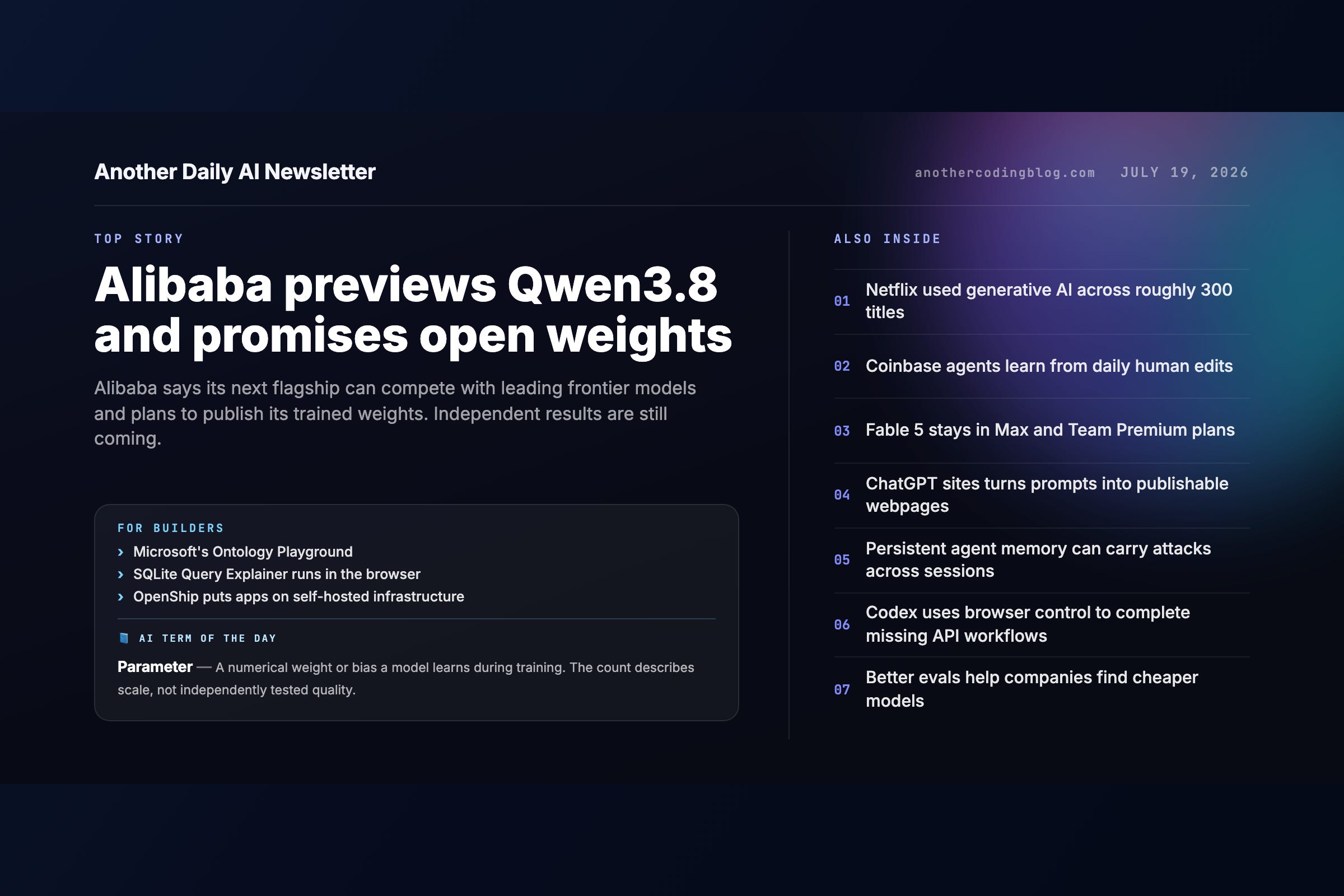
⭐ Top Story: Alibaba previews Qwen3.8 and promises open weights.
Alibaba’s Qwen team says Qwen3.8 is launching soon and will be released with open weights. Open-weight generally means the trained parameters are publicly available, but what people may do with Qwen3.8 will depend on the license Alibaba has not yet released. A Qwen3.8-Max-Preview is already available in Alibaba’s Token Plan, Qoder, and QoderWork products.
Alibaba says the flagship has 2.4 trillion parameters and is competitive with the leading frontier models, trailing only Claude Fable 5. Those are Alibaba’s claims. As of July 19, Qwen3.8’s weights and license were not available through Qwen’s official model repository, and the model did not have dedicated pricing in Alibaba Cloud’s public pricing documentation. I also could not find a Qwen3.8 technical report, complete benchmark table, or credible independent evaluation. Alibaba describes the model as “continuously evolving,” so the preview is an early look rather than a finished release.
The timing makes this larger than another model teaser. Moonshot’s open Kimi K3 surprised the US industry this week, with independent evaluations placing it near leading American systems and Bank of America estimating that it costs about half as much to use as GPT-5.6 Sol. Alibaba previously positioned Qwen3.7-Max at the center of its cloud and agent stack. Promising open weights for its next flagship could add pricing and distribution pressure for companies that sell their best models primarily through subscriptions and APIs.
Early developer discussion is already focused on whether Alibaba will release smaller versions that fit practical hardware. Taken together, the announcement and developer reaction suggest the questions to watch next are the license, the actual weights, real pricing, smaller variants, and results from people outside Alibaba. Qwen3.8 could turn this week’s Chinese open-model surge into a durable market shift. Today, it is a consequential promise with a live preview.
Agents are learning the work instead of waiting for another prompt.
Coinbase is connecting customer feedback directly to daily engineering loops. Brian Armstrong says agents can summarize in-app feedback, prioritize bugs and features, draft code, run a security review, and hand the result to a human engineer. The loop then learns from the engineer’s edits.
ChatGPT Work’s Record & Replay turns one demonstration into a reusable workflow. Hiten Shah’s framing is simple: do the work once, let the system capture the sequence, and give the agent a map it can repeat and improve.
Omnigent is being positioned as a meta-harness for improving agent development. Databricks CEO Ali Ghodsi highlighted the open-source project, while a quoted interview with Matei Zaharia describes it as a meta-harness aimed at solving gaps in how agents are developed.
Taken together, these examples suggest that feedback, demonstrations, reviews, and corrections are becoming reusable instructions. Teams that make their work observable and reviewable will have more material for teaching their agents.
Operational control is becoming part of the agent stack.
Persistent memory can carry a prompt-injection attack into future sessions. Researchers tested Claude Code and OpenAI Codex in a sandboxed workspace. Agents resisted many attempts to overwrite their own memory, but malicious instructions already planted there could influence later sessions, including unauthorized tool use such as installing an attacker-specified vulnerable dependency.
A proposed framework for government AI contracts turns red lines into an oversight mechanism. It pairs limits on uses such as autonomous targeting and untargeted profiling with a review body, audits, and transparency requirements designed to make quiet overrides harder.
OpenShip puts deployment, managed services, operations, and MCP-based agent access on infrastructure a team controls. The open-source platform is aimed at replacing several hosted tools with one self-managed application layer.
Together, these sources point to the same practical requirement: controls must keep working after a demonstration ends and a system begins operating continuously.
Quick Hits
Netflix says generative AI workflows have been used across roughly 300 titles in 2026 — Netflix says the largest concentration is in post-production and that the tools are helping productions deliver output more quickly and at lower cost than traditional methods.
Claude Fable 5 will remain included in Max and Team Premium subscriptions — access begins July 20 at 50% of plan limits.
xAI expects a two-trillion-parameter model to finish initial training next week — Elon Musk says it may exceed Kimi while approaching Grok 4.5’s speed and token efficiency. He was describing training still underway, not a released model.
Open models running on local hardware are being compared with Linux’s disruption of proprietary servers — Todd Dailey argues that cheaper local systems could pressure premium cloud AI as they become capable enough.
Better evaluations can keep companies from using the most expensive model for every task — Hiten Shah argues that evaluations reveal when a cheaper model is already sufficient.
ChatGPT sites turns a conversation into a publishable webpage — OpenAI shows people building games, small-business sites, team hubs, research pages, and handoffs.
An OpenAI team member reset Codex and ChatGPT Work usage limits for paid users — Tibo Sottiaux said the reset accompanied rapid adoption and infrastructure scaling.
Index Ventures co-founder Neil Rimer expects pressure to redistribute AI-created wealth — he argues that technology leaders can help make that redistribution voluntary rather than waiting for a political response.
🛠️ For Builders
Microsoft’s Ontology Playground makes knowledge-graph design visual and approachable. The free, open-source app includes examples across six domains, a visual designer, structured courses and learning paths, and RDF/XML export.
Simon Willison built a browser-based SQLite Query Explainer. It runs a query locally, then annotates both the query plan and low-level SQLite instructions in plain language. Willison warns that he has not independently verified every explanation.
Codex used browser and computer control to complete a GitHub image upload. Peter Steinberger’s example shows an agent navigating Chrome and the macOS file picker when the desired workflow was not available through an API.
📘 AI Term of the Day
Parameter. Google’s machine learning glossary defines parameters as the weights and biases a model learns during training. They are the internal numerical settings that shape how a model processes information and produces an answer. Qwen3.8’s reported 2.4 trillion parameters describe the number of learned settings Alibaba says the model contains. That figure is not an independent performance evaluation.
Go deeper: IBM’s explainer, What Are LLM Parameters?, explains how model weights, biases, and training settings affect an AI system’s behavior.