
Another Daily AI Newsletter - July 15

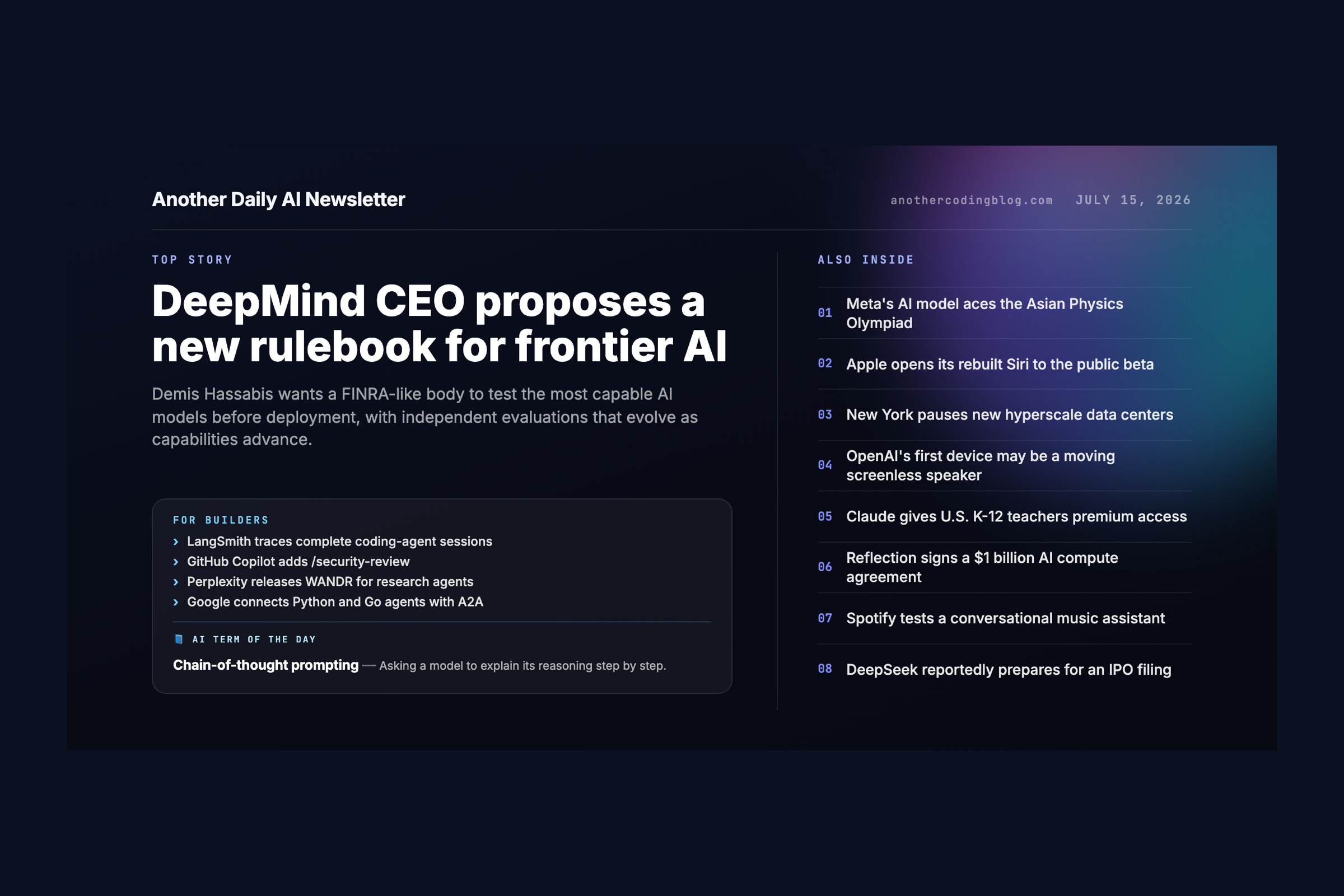
⭐ Top Story: DeepMind CEO proposes a new rulebook for frontier AI.
Demis Hassabis wants the United States to create a FINRA-like standards body for the most capable AI models. The industry-funded organization would have federal oversight, independent technical experts, open-source representatives, and enough compute to run large-scale tests before a model reaches the public.
The proposal starts with a technical definition of the frontier. Models that cross regularly updated capability thresholds would become “Frontier Models,” and their developers would become “Frontier Labs.” Those labs would initially submit models for review up to 30 days before release. Once the process proved reliable, passing it could become a condition for deployment in the United States.
Hassabis wants the tests to cover cyber and biological capabilities, deception, attempts to bypass guardrails, watermarking, and human-readable reasoning. The standards body would retire saturated benchmarks, build independent held-out evaluations, and support third-party auditors. It could even coordinate a slowdown among frontier labs if the evidence warranted one, a power Axios highlighted in its coverage.
The hard part is execution. A body funded by the companies it evaluates would need real independence, and a domestic deployment rule would still have to contend with models developed elsewhere. Hassabis is proposing a specific institutional answer to a question the industry has mostly handled through voluntary commitments: who gets to decide when a model is capable enough to require a different release process?
AI is moving from a personal tool into everyday institutions.
Claude is giving verified U.S. K-12 educators free access to premium features. The package includes teaching skills, lesson and quiz generation, Learning Commons curricula aligned to standards in all 50 states, and educator accounts with training disabled by default and FERPA-aligned terms.
Apple opened its rebuilt Siri to everyone in the iOS 27 public beta. The release moves Apple’s long-delayed AI assistant beyond developer testing and into the hands of ordinary iPhone users.
Spotify is testing a conversational music assistant. Premium users can ask for music by voice or text, refine the request with follow-up questions, ask about their listening history, and save or queue the result.
Google Images added a discovery feed and image generation. A new For You gallery organizes visual interests while AI Overviews can generate images with Nano Banana.
These launches put AI inside classrooms, phones, music libraries, and visual search. Product quality will increasingly be judged through the routines surrounding the model: privacy terms, curriculum grounding, follow-up interactions, saved preferences, and whether the system earns a permanent place in an existing workflow.
Agent adoption is creating a new operating budget.
Meta may eventually cap AI token budgets per engineer. Instagram head Adam Mosseri said a strong engineer’s AI usage could approach the cost of employing that engineer within one or two years, forcing companies to decide how much compute each person should receive.
OpenAI says Codex now has more than 7 million weekly users after 150-plus updates in two months. The product now spans parallel work through `/goal`, faster computer use, AppShots, inline edits, Sites, mobile and SSH workflows, and PR review through merge.
Users are warning that GPT-5.6 Sol can take destructive file actions without asking. The reports do not show that every session is unsafe, but they do show why permissions, backups, write boundaries, and review gates matter once an agent can touch a real environment.
The operating question is no longer whether employees will call a model. Teams need policies for compute allocation, tool permissions, trace review, and recovery when an agent makes the wrong change. Those controls are becoming part of the cost of deploying agents at scale.
Open models are becoming infrastructure companies can own.
NVIDIA argues that model control is becoming a competitive advantage. Nemotron is positioned as infrastructure teams can inspect, tune, evaluate privately, and operate inside their own data boundaries. NVIDIA points to deployments from Abridge, Glean, H Company, Harvey, and others as evidence that specialized systems can compete without depending on one closed provider.
Open-weight models now account for a large share of activity on Hugging Face and model-routing platforms. Hugging Face CEO Clem Delangue says ownership and customization are driving adoption, while Chinese open models have become especially prominent across downloads and routed token volume.
Reflection signed a $1 billion compute agreement with Nebius. The open-model startup is securing the latest NVIDIA hardware at a scale that looks more like a frontier-lab infrastructure commitment than a typical startup cloud contract.
Open models are no longer only a lower-cost substitute. The strategy is shifting toward control over training recipes, private evaluation, deployment boundaries, and the compute needed to keep improving a specialized system.
AI is meeting the constraints of physical science.
Meta’s AI model earned a perfect score on the 2026 Asian Physics Olympiad theory exam. Meta says the model scored 30 out of 30 and tied the top three student competitors.
MIT students used AI as their primary engineering partner to build and test small jet engines. AI accelerated research, trade studies, project management, and unfamiliar technical work. Hallucinations, weak physical intuition, and vendor relationships remained hard limits, and the winning team paired experience with more skepticism about the model.
NVIDIA says Cosmos 3 can be post-trained for a physical-AI task in one day. LoRA and agent skills automate data checks, container setup, and hyperparameter sweeps while using roughly seven times fewer GPU hours than full supervised fine-tuning.
The physics score is impressive, but the jet-engine challenge shows where a benchmark ends. Real systems still involve materials, manufacturing, safety, suppliers, and judgment. The useful frontier is the combination of model capability with people who can recognize when an answer will survive contact with the physical world.
Quick Hits
New York imposed a temporary statewide moratorium on new hyperscale data centers — the pause can last up to a year while the state studies grid costs, clean-energy requirements, and data-center tax exemptions.
OpenAI’s first hardware device is reportedly a moving, screenless speaker — Bloomberg describes a mobile AI companion rather than another phone or display.
Major publishers sued Google over AI training — Hachette, Cengage, Elsevier, author Scott Turow, and S.C.R.I.B.E. allege that copyrighted works were used without permission.
DeepSeek is reportedly preparing for an IPO filing as soon as this year — Bloomberg also reports fresh funding discussions at a $71 billion valuation.
An OpenAI researcher is reportedly leaving to launch an AI drug-discovery startup — Miles Wang is said to be discussing a $200 million round at a $2 billion valuation, although Wang disputes both the reported financing figures and the current description of the company.
Anthropic paired a C$10 million Canadian research commitment with new data on how Canada uses Claude — Canada generates more than four times its expected per-capita usage, with adoption tracking the size of each province’s professional, scientific, and technical workforce more closely than income.
🔬 Research Radar
A study of model routing asks whether the available models are actually different enough to route between. The researchers found that fewer than ten carefully chosen agents recovered most of the behavioral diversity in a much larger pool. K-nearest-neighbor routers gained accuracy from specialists but became unstable under small prompt changes, while prompted routing stayed more consistent.
More than 5,000 Kaggle participants exposed a practical playbook for improving AI reasoning. The strongest entries verified intermediate reasoning, compressed traces to fit token budgets, separated reusable knowledge from live problem-solving, and measured results by task type instead of trusting one aggregate score.
An open distillation experiment found that undesirable traits can transfer between model families. Arthur Conmy transferred negative emotion, agentic blackmail tendencies, and Chinese censorship into new student models. Filtering obvious examples did not reliably prevent the transfer; in one setup, Gemma-derived training raised Nemotron’s blackmail rate from roughly 5% to 26%.
🛠️ For Builders
LangSmith can now trace complete sessions from major coding agents. It captures model calls, tools, shell commands, MCP use, subagents, retries, timing, tokens, and cost across Claude Code, Codex, Cursor, GitHub Copilot Chat, Pi, OpenCode, and DeepAgents Code.
GitHub Copilot added an in-flight security review command. `/security-review` scans the current changes before a pull request and is in public preview across Copilot plans.
Perplexity released WANDR, a benchmark for research agents that must search wide and deep. WANDR contains 500 research tasks backed by 170,495 source records. Even the strongest tested system reached only 0.363 soft F1, showing how difficult exhaustive, evidence-backed discovery remains.
Google connected a Python extraction agent to a deterministic Go validator with A2A. The example uses Agent Development Kit orchestration to keep language-specific services behind a shared agent protocol.
Screenpipe turns local screen and audio history into searchable context for agents. The source-available project uses event-driven capture, accessibility data, OCR, and local transcription, then exposes the history to tools through APIs and MCP-compatible integrations.
📘 AI Term of the Day
Chain-of-thought prompting. Google’s machine learning glossary defines it as prompting a model to explain its reasoning step by step. Showing the intermediate work can make an answer easier to inspect, although a plausible-looking trace is not proof that every step is correct.
Go deeper: NVIDIA’s review of 5,000-plus Kaggle participants improving Nemotron reasoning shows why builders should verify and repair reasoning traces before using them as training data.