
Another Daily AI Newsletter - July 20

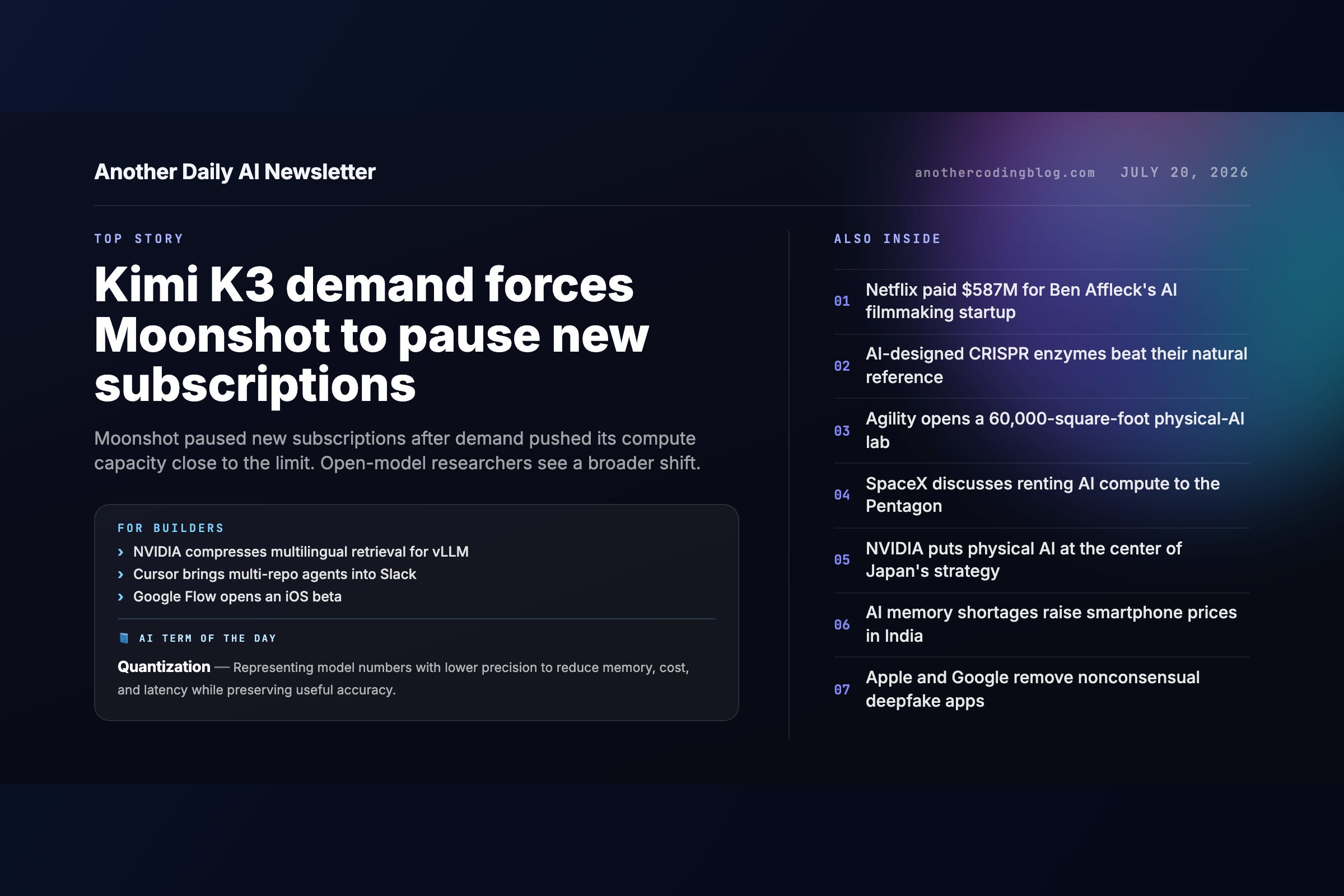
⭐ Top Story: Kimi K3 demand forces Moonshot to pause new subscriptions
Moonshot AI said Kimi K3 received more interest than expected and paused new subscription purchases after demand pushed its GPU capacity close to the limit. The bottleneck arrived only days after the model’s release.
Kimi K3 accepts text and images, supports a one-million-token context window, and is available across Moonshot’s products and API. Moonshot says trained weights are due July 27. Artificial Analysis found strong overall capability while also flagging slower output, above-median pricing, and unusually long responses.
The launch is also drawing attention to the way Chinese AI labs participate in open research. Researcher Nathan Lambert said frequent exchanges with Chinese labs have been normal for him, encouraged readers to study how those labs approach AI, and pointed to signs that Alibaba may be reconsidering how it releases its largest Qwen models.
Kimi has not settled the model race. It has shown that a credible open model can create production-scale demand almost immediately. Reliability, pricing, and available computing capacity now matter as much as benchmark position.
AI is reaching the physical world
Netflix bought a production workflow, not a model lab. A regulatory filing showed that Netflix paid $587 million in cash for Ben Affleck’s InterPositive. The startup builds AI-assisted tools around filmmaking workflows, and its 16-person technical team is joining Netflix.
AI-designed proteins are becoming laboratory tools. Researchers used AI models to create synthetic CRISPR proteins that edited genomes more efficiently than their natural reference proteins. The result moves generative AI from predicting biology toward proposing new biological machinery.
Humanoid robotics is getting more real-world training space. Agility Robotics opened a 60,000-square-foot facility in Fremont to train and test its Digit robots near Tesla’s manufacturing base.
Compute pressure is reshaping entire markets
SpaceX may become a military AI infrastructure provider. SpaceX is reportedly in talks to give the Pentagon access to data-center capacity worth billions of dollars. The discussions extend its role from launch and communications into the computing layer behind military AI.
Japan is treating AI capacity as national infrastructure. NVIDIA, Japan’s government, and industrial partners announced a national AI infrastructure program centered on domestic computing and physical AI.
Public-interest AI is attracting its own capital. Current AI says it is backed by more than EUR400 million to build shared tools, trusted datasets, and locally useful applications outside the largest commercial labs.
Inference chips are becoming financeable assets. General Compute secured a $400 million financing deal backed by specialized inference chips, showing that lenders are beginning to underwrite hardware built for running models, not only training them.
The AI memory boom is reaching phone buyers. Data-center demand is tightening memory supply and raising smartphone prices in India. The competition for chips is now visible in consumer electronics.
Agent security moves into infrastructure
Hugging Face faced an agent-driven intrusion. In its July security incident disclosure, the company said an autonomous agent framework carried out thousands of actions across short-lived sandboxes. Its defenders used AI for triage, but hosted-model guardrails initially blocked some forensic analysis of real attack commands and payloads.
Brex put policy enforcement in the network path. CrabTrap is an open-source HTTP proxy that inspects an agent’s outbound requests and checks them against allowed behavior before traffic leaves the environment.
Capital One released an open-source software security agent. VulnHunter analyzes source code for security flaws and produces evidence developers can review before a vulnerability reaches production.
Platforms respond to synthetic harm
App stores are removing nonconsensual deepfake tools. Apple and Google removed AI “nudify” apps after San Francisco’s city attorney demanded action against software used to generate sexualized images without consent.
TikTok is testing likeness detection. A new opt-in tool scans for AI-generated content that may use a creator’s face and lets verified creators review and report potential matches.
🛠️ For Builders
NVIDIA compresses multilingual retrieval for production. A 4-bit quantized embedding model is designed to reduce memory use and run through vLLM without giving up the retrieval workflow builders expect.
Cursor brings multi-repository agents into Slack. The integration can work across repositories, use richer Slack context, and continue coding tasks from a conversation.
Google Flow opens an iOS beta. Google’s AI filmmaking workspace is now available to invited TestFlight users.
Sebastian Raschka explains reasoning-effort controls. The guide walks through how models expose multiple reasoning levels and how those controls affect training and inference.
📘 AI Term of the Day: Quantization
Quantization represents a model’s numbers with lower precision so it uses less memory, costs less to run, and can respond faster. The tradeoff is that aggressive compression can reduce accuracy, so teams test the smaller representation against the original model before deployment. Google’s post-training quantization guide explains the main approaches and tradeoffs.