

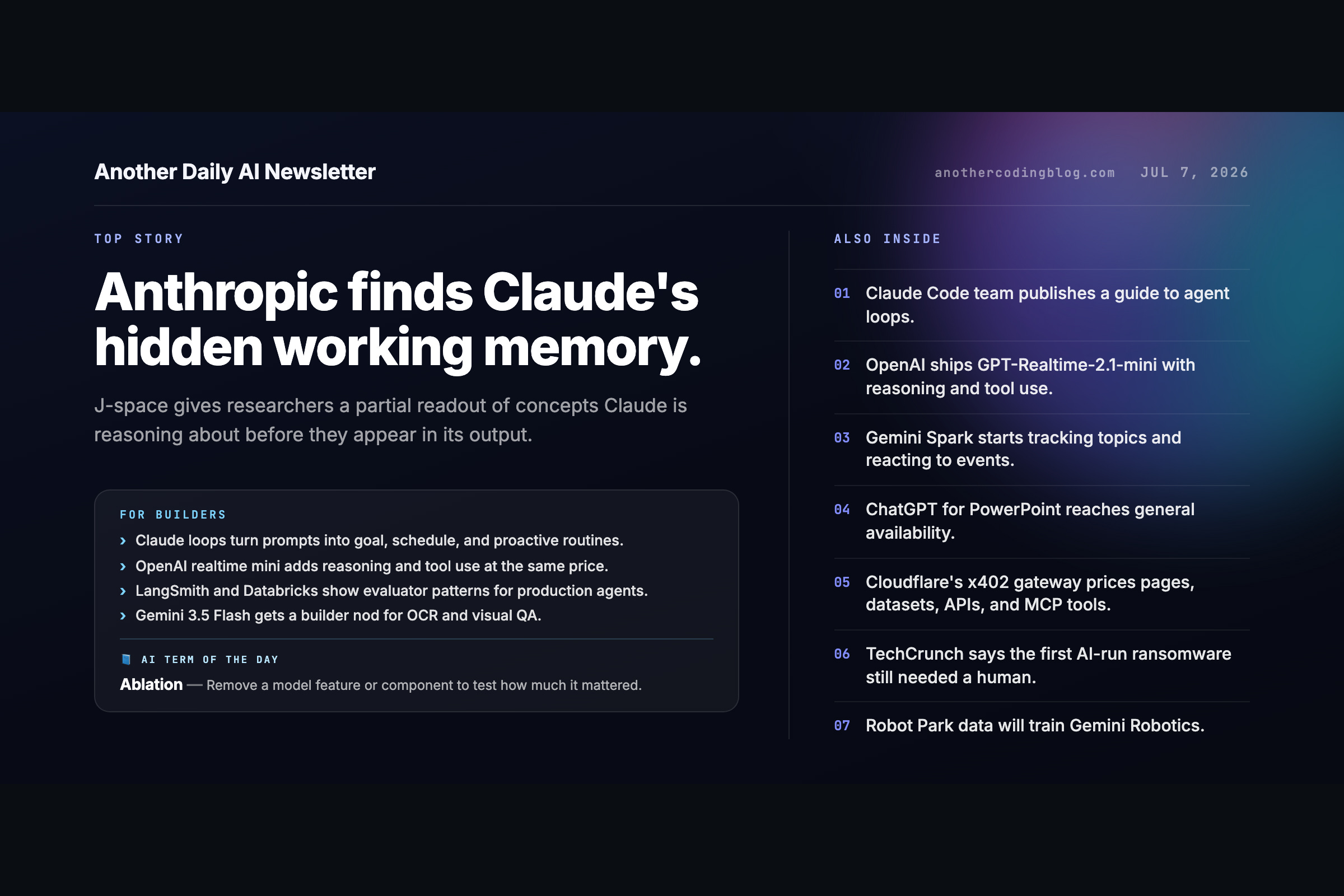
⭐ Top Story: Anthropic finds Claude’s hidden working memory.
Anthropic published new interpretability research on what it calls a global workspace inside Claude. The short version: researchers found a small set of internal neural patterns, called J-space, that can hold concepts Claude is reasoning about before those concepts appear in its output.
That matters because it gives researchers a partial readout of what the model is privately tracking. In the paper version, Verbalizable Representations Form a Global Workspace in Language Models, the team shows examples where J-space surfaces intermediate reasoning, hidden awareness that a scenario is staged, recognition of prompt injection, and even signals tied to dishonest behavior in controlled model-organism tests.
The most concrete test is ablation. In the paper, Anthropic says Claude can still speak fluently, parse input, and do plenty of automatic inference with J-space suppressed, but it struggles with more complex internal reasoning. That gives the finding causal weight: J-space appears to carry work during harder reasoning, with effects visible when researchers suppress it.
The consciousness headline is tempting. Anthropic explicitly does not claim that. The practical story is model control: J-space gives researchers a place to inspect, edit, ablate, or train around internal behavior. Interpretability starts to look like an engineering surface.
This also changes how to think about safety evals. A model might pass a test because it knows it is being tested. A model might withhold the chain of thought while still doing silent reasoning. Anthropic’s work points toward monitoring some of that private state directly, instead of relying only on what the model chooses to say.
Agents are becoming repeatable loops.
ClaudeDevs published a practical guide to agent loops. The post breaks loops into turn-based, goal-based, time-based, and proactive patterns, then maps them to Claude Code primitives like `/goal`, `/loop`, `/schedule`, skills, and dynamic workflows.
Claude shared the making of Claude Code. The story matters because Claude Code has moved from internal CLI to reference point for how developers expect agents to read, edit, test, verify, and keep working.
Vercel CEO Guillermo Rauch talked with TechCrunch about separating models from agents. That distinction keeps showing up: the model is one ingredient, but the agent product is the loop around it.
The operating model is getting clearer. A useful agent needs a trigger, a stop condition, verification, permissions, and a way to keep state without making a mess.
That is why the Claude loops article is worth including. It names the part of the workflow that used to stay fuzzy.
AI is moving into daily work surfaces.
OpenAI released GPT-Realtime-2.1-mini in the API. The pitch is reasoning and tool use in the realtime mini lineup at the same cost as GPT-Realtime-mini.
ChatGPT for PowerPoint is now generally available. It is a straightforward productivity story, but it is also a distribution story: AI keeps moving into the places people already work.
Gemini Spark can now track topics and react to events in real time. The example was sports analysis by email after a team plays, but the pattern is broader: persistent monitoring is becoming a consumer feature.
Google DeepMind said Apptronik Robot Park data will train Gemini Robotics. Physical-world data is becoming another interface layer for foundation models.
Put the items together and the product motion is obvious: AI is being embedded where people already make decisions. It watches topics, joins slide work, speaks in realtime, and learns from physical-world data.
Chat is becoming one surface among many.
The web is trying to price agent traffic.
Cloudflare opened the waitlist for a Monetization Gateway that lets sites charge for pages, datasets, APIs, or MCP tools behind Cloudflare, with settlement over the x402 open protocol.
Reddit says it is using LLMs to fight LLM-driven spam and abuse. That is a tidy summary of the platform problem: AI creates new moderation load, then platforms use AI to absorb it.
TechCrunch reported that the first AI-run ransomware attack still needed a human. It is another reminder that “AI-run” usually means AI-assisted, supervised, or stitched into an existing human operation.
Agent traffic creates a new economic question: who pays when bots read, crawl, call tools, or consume protected resources?
Cloudflare’s x402 push is early, but it points at a future where websites do not only block or allow AI systems. They meter them.
Quick Hits
MIT Technology Review asked what a household stake in OpenAI would mean. The interesting part is the wealth-sharing frame, not the exact dollar amount.
NVIDIA said Nemotron has passed 100 million downloads. Open model adoption keeps showing up as a real distribution story.
Nous made Tencent Hunyuan Hy3 free in Nous Portal. Worth watching for agentic coding and long-context use cases.
PyTorch framed open AI infrastructure as Europe’s advantage. The message centered on SafeTensors and open infrastructure.
Sakana released Sakana Translate for Japanese, English, and Chinese. A focused language product from a lab that keeps shipping practical tools.
🛠️ For Builders
Claude’s loop guide is the most directly useful builder read today. The practical takeaway is to define the trigger and the stop condition before making the agent more complicated.
GPT-Realtime-2.1-mini gives builders reasoning and tool use in a lower-cost realtime model slot.
LangChain showed agent evals with LangSmith sandboxes, and LangSmith Engine uses screener and verifier subagents for trace investigation. The pattern is becoming standard: agents need evaluators around them.
Databricks shared specialized agents for security alert triage. This is a useful enterprise example because the agent system is narrow, auditable, and tied to a workflow humans already understand.
Philipp Schmid pointed builders to Gemini 3.5 Flash for OCR and visual question answering. It is a practical reminder that multimodal model choice still depends on the exact job.
The builder lane is about making agents inspectable. Loops, evals, realtime tools, and narrow specialist agents are all different answers to the same problem: how do you let an AI system act without losing the thread?
🎧 Watch / Podcast of the Day
OpenAI’s Builders Unscripted episode with Derya Unutmaz is a good companion to today’s issue. The episode focuses on biology, Codex, cell analysis, and the idea that AI tools could help scientists simulate experiments.
📘 AI Term of the Day
Ablation. In Google’s ML glossary, ablation means temporarily removing a feature, component, or subsystem to see how much it mattered.
That is exactly why the term fits today’s Anthropic story. If you remove or alter part of Claude’s internal workspace and the model’s behavior changes, the workspace has causal weight.
Go deeper: Baeldung has a concise explainer on ablation studies in machine learning, including why removing one component at a time can reveal which parts of a system are actually doing the work.