

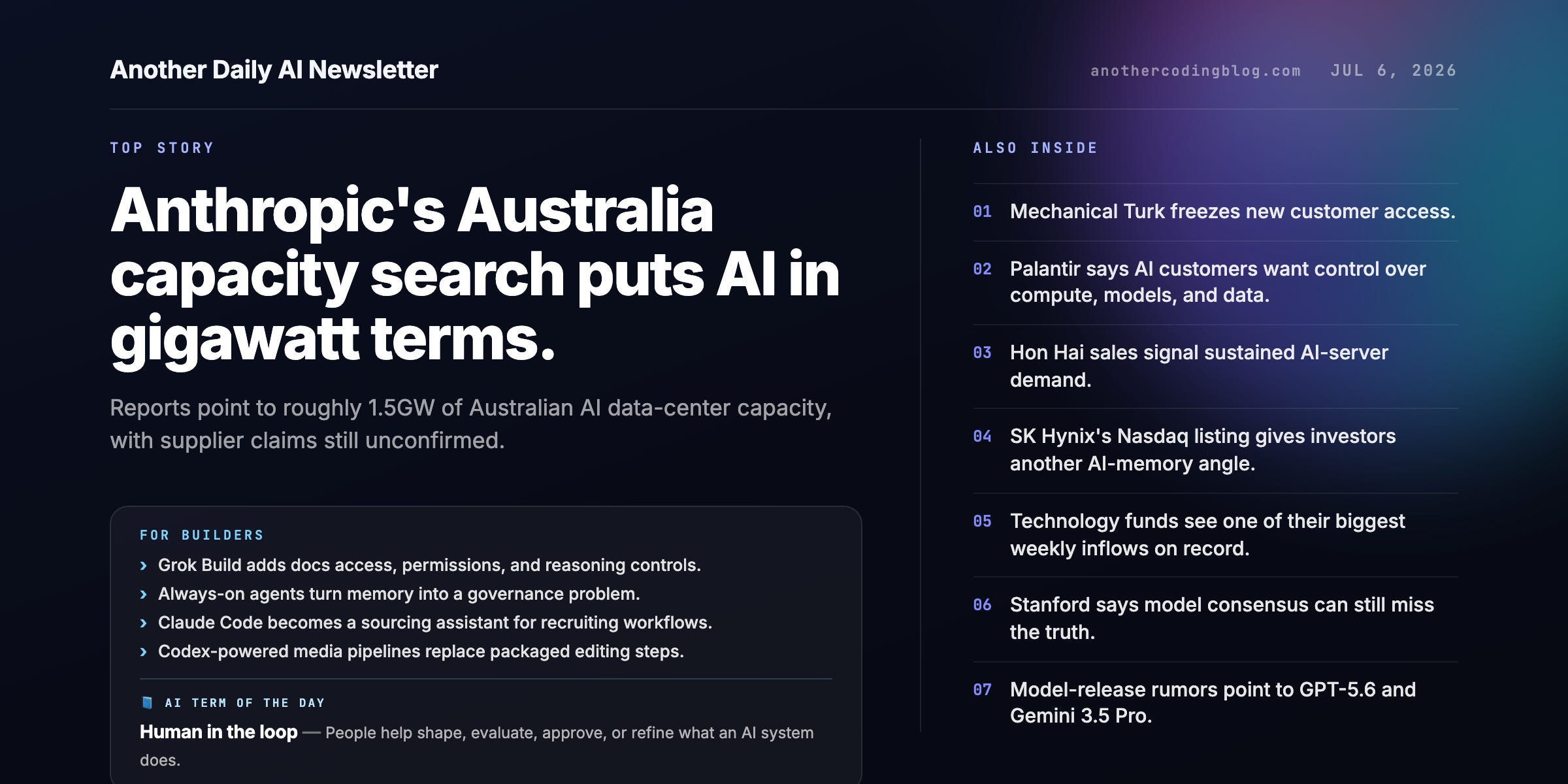
⭐ Top Story: Anthropic’s Australia capacity search puts AI in gigawatt terms.
The Australian reported in June that Anthropic could become an anchor tenant for a SunCable-linked data center in Australia’s Northern Territory. The key number was the part that stuck: Anthropic was reportedly looking for roughly 1.5GW of Australian data-center capacity, with development work starting by 2027.
Important caveat: Anthropic has not confirmed a signed build, lease, or ownership plan. The reported shape is still a capacity hunt, but even that changes the story. One of the frontier labs is now being discussed in the language of power markets, land approvals, grid access, and sovereign capacity.
The newer X chatter makes the story louder but not cleaner. Serenity posted screenshots described as leaked Anthropic documents pointing to 1.4GW of Australian capacity, but the supplier and dollar-amount claims still need corroboration. I would treat that as a watch item, not a confirmed deal.
The broader context is easier to verify. Guardian Australia reported that rapid AI data-center demand is already raising concerns around inflation, industrial land, housing, logistics, energy, and planning. That is why this feels bigger than a single Anthropic rumor. Frontier AI is becoming an infrastructure negotiation, and the unit of negotiation is starting to look like gigawatts.
Control is becoming the product.
Amazon is freezing new customer access to Mechanical Turk on July 30, 2026. Existing customers can keep using it, but AWS says no new features are planned.
Hermes Agent added admin-only approvals for blocked commands in Discord-served agents. Useful agents need permission surfaces, not just stronger model calls.
Palantir shared Alex Karp arguing that technical customers want control over compute, models, data, and business alpha. It is an older clip, but it fits the day’s pattern.
Mechanical Turk was one version of humans in the loop: hidden labor, small tasks, labeling, review, and judgment behind a marketplace. The newer version is more explicit. Humans approve commands, define workflows, own the stack, and decide when the system is allowed to act.
The sharper shift is that human judgment is moving from invisible labor to visible control points.
AI infrastructure keeps becoming market-readable.
Bloomberg said Hon Hai, Foxconn’s parent and an Nvidia server assembly partner, reported stronger-than-expected sales tied to AI demand. StockMKTNewz framed the same move through Foxconn’s cloud and networking revenue mix, which now reportedly represents more than half of revenue.
Shay Boloor highlighted SK Hynix’s expected DRAM margin strength and planned Nasdaq listing under SKHY. Tom’s Hardware’s earlier writeup said the offering would fund AI memory fabs, packaging, and EUV tool orders.
The Kobeissi Letter said U.S. technology funds saw $14.3 billion of inflows in the week ending July 1. It framed that as the second-biggest weekly inflow on record, while broader U.S. equity funds saw outflows.
The Anthropic/Australia story is the frontier-lab version of the same shift. The public-market version shows up in server assemblers, memory suppliers, packaging plans, listings, and fund flows.
The AI trade is getting easier to track because it is leaving marks outside model labs.
The truth layer is under pressure.
Stanford AI Lab shared ICML work on why polling multiple LLMs can fail. The key warning is that models may agree with each other more than they agree with ground truth.
Google DeepMind’s “From AGI to ASI” report is older than today’s window, but useful context. It maps four possible paths from AGI to ASI: scaling, paradigm shifts, recursive improvement, and large multi-agent collectives.
ICML announced its 2026 award winners. On a quiet news day, the awards are a useful signal for which research threads the field is rewarding.
This is the other side of the control story. If model agreement can create false confidence, then evaluation cannot just mean “ask more models.” It needs better ground truth, stronger human review, clearer uncertainty, and less magical thinking around consensus.
Quick Hits
Tibo said Ultra will be in Codex - a short reply, but a useful builder watch item if more official context follows.
A model-release rumor pointed to possible GPT-5.6, Gemini 3.5 Pro, and Nano Banana Pro windows - interesting enough to watch, not strong enough to treat as fact.
Jason Liu argued that AI shifts the bottleneck from making to noticing - taste and attention become scarce when output gets cheap.
ICML’s 2026 awards are out - useful research signal from an otherwise quiet Sunday.
Starlink reportedly received Bangladesh approval for regional bandwidth export - worth validating against a primary source before making it a bigger infrastructure story.
🛠️ For Builders
Grok Build v0.2.87 adds docs access, permission prompts, reasoning controls, and reliability fixes. That is the kind of release note that matters when AI coding tools become daily work surfaces.
A new arXiv survey on always-on agents treats persistent memory, state, provenance, permissions, and recovery as first-class system problems.
An Anthropic engineer shared a Claude Code workflow for sourcing candidates. The practical pattern is search, summarize, shortlist, then human judgment.
OpenAI transcription, ffmpeg, and Codex can replace a chunk of a packaged editing workflow. It is less polished than a single product, but it gives the builder control over every step.
The builder lane today is about control surfaces. Permissions, memory, search, provenance, and composable workflows are becoming the parts that make agent systems usable.
📘 AI Term of the Day
Human in the loop. In Google’s ML glossary, human in the loop can mean reviewing AI output critically or building systems where people help shape, evaluate, and refine model behavior.
Today’s issue is basically a tour of that idea. Mechanical Turk was one version of humans in the loop. Hermes approvals are another. Claude Code sourcing and Codex-powered media workflows are newer versions, where the person is less of a task worker and more of an operator.
Go deeper: Axios has a useful explainer on why “humans in the loop” is getting harder to define as agents become more capable and the handoff points become less obvious.