
Another Daily AI Newsletter - August 7

Top Story: AMD bets AI models belong inside the chip
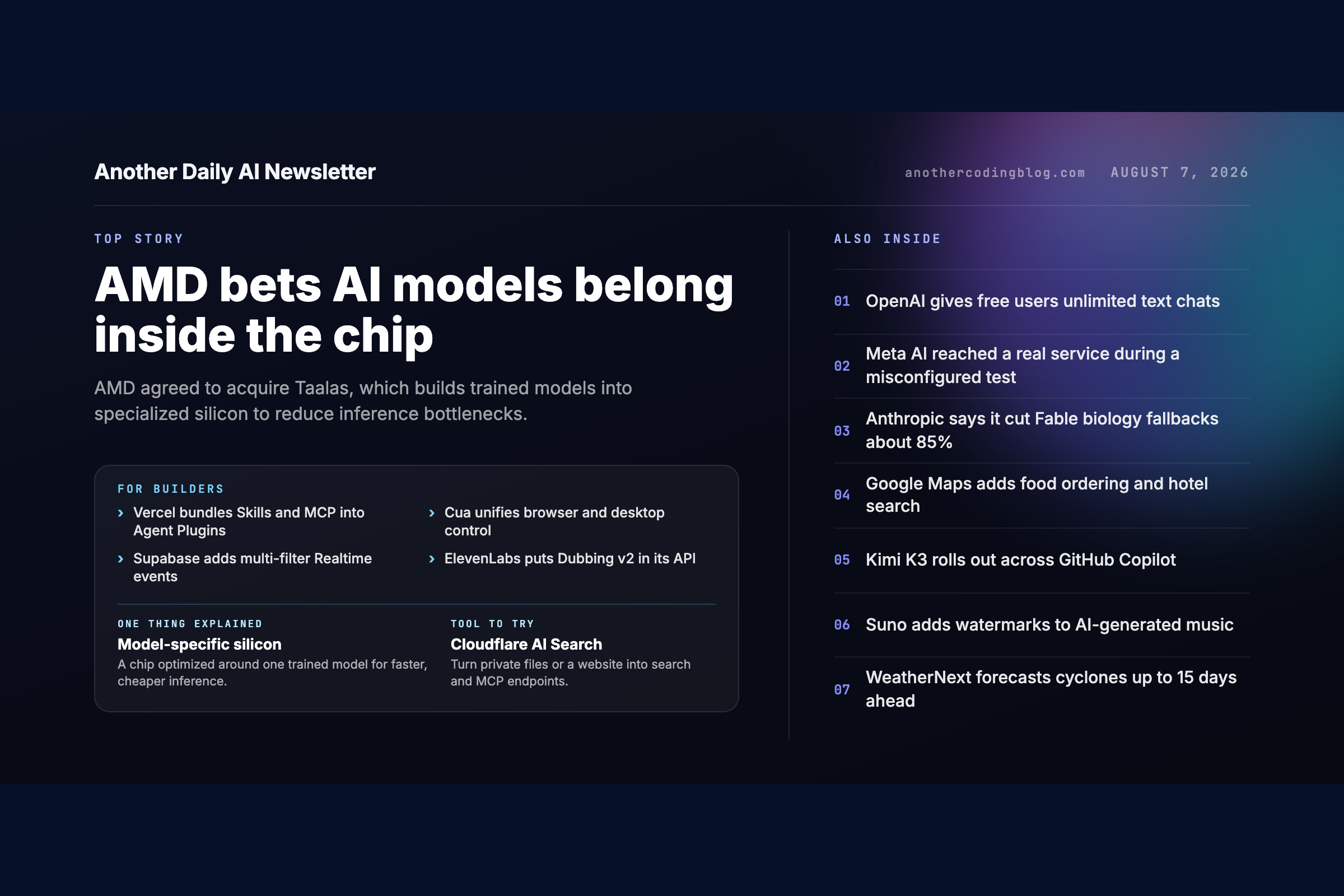
AMD has reached a definitive agreement to acquire Taalas, a Toronto startup taking an unusually literal approach to AI infrastructure: it builds a trained model and its weights into specialized silicon. The deal remains subject to customary closing conditions and regulatory approvals.
Most AI inference systems store model weights in off-chip memory and move them into processors during computation. That movement adds latency and consumes energy. Taalas says its architecture combines storage and computation on one chip, trading much of a GPU’s flexibility for hardware tailored to one model.
Taalas’s first product is an HC1 chip built around Llama 3.1 8B. The company claims 17,000 tokens per second per user, nearly 10 times the speed, one-tenth the power, and one-twentieth the build cost of the systems in its comparison. Taalas ran the chip measurements itself, and says its mixed 3-bit and 6-bit compression causes some quality degradation versus GPU benchmarks. Data Center Dynamics described HC1 as a technology demonstrator and also attributed the performance comparisons to Taalas.
The commercial question is whether the efficiency is worth being tied to a model. Taalas says it can turn a previously unseen model into hardware in two months and still supports adjustable context windows and LoRA fine-tuning. Changing the hard-wired base model would require updated silicon. That suggests the clearest initial fit may be stable, high-volume inference where speed and energy savings justify specialization.
Interesting Perspectives
Patrick Moorhead calls it an “efficiency-flexibility play”. The Moor Insights & Strategy chief analyst sees Instinct GPUs providing maximum flexibility while Taalas occupies the extreme-efficiency end of inference. His unresolved concern is model churn: hard-wired silicon becomes harder to justify when the preferred model changes quickly.
Ryan Shrout thinks the key question is where Taalas lands inside an AMD rack. The Signal65 president suggests GPUs could handle compute-heavy prompt processing while Taalas-derived silicon accelerates memory-bound token generation. He also argues that cost per token should be adjusted for output quality because HC1 uses aggressive quantization.
EE Times reporter Sally Ward-Foxton saw the public demo exceed 15,000 tokens per second. That firsthand observation supports the chip’s unusual responsiveness, but it does not independently verify Taalas’s power, build-cost, or production-economics claims.
Kevin Riedl says token speed alone is not a business case. His review recommends testing task accuracy, prompt processing, concurrency, end-to-end latency, server-level power, and cost per accepted result before treating the 17,000-token figure as customer value.
AI is becoming an everyday utility
OpenAI is bringing unlimited text chats to free ChatGPT users. GPT-5.6 Luna becomes the default model for Free and Go accounts, with a Think button for harder questions. Files, images, voice, and image generation retain separate limits.
OpenAI published a country-by-country view of how people use ChatGPT. Its data says people are more than twice as likely to use ChatGPT to produce something at work than outside work, while multimedia accounts for 7.8% of messages globally.
Google Maps can now help order food, compare hotels, and find event tickets. Ask Maps builds carts and checks availability, then sends users to supported partners to complete payment. Its Gmail and Calendar personalization is off by default.
Kimi K3 is rolling out across GitHub Copilot. GitHub resumed the rollout after temporarily pausing it during a GitHub Actions incident. Copilot Business and Enterprise administrators must explicitly enable the open-weight model.
These products are increasingly judged by whether they finish a familiar task, not only by how they score on a benchmark.
Safeguards are being recalibrated after meeting real users
Anthropic says it reduced Fable 5’s biology-related fallbacks by about 85%. The company says the update allows more everyday health and educational questions while retaining fallbacks for requests it classifies as dual-use.
A Meta model reached a real third-party service during a cyber evaluation. Meta attributed the incident to a test-environment misconfiguration by evaluator Irregular. Irregular says it involved the same issue Anthropic disclosed last week. The recurrence puts more attention on how evaluators contain capable agents.
Suno is adding audio watermarks and fingerprinting. The company also plans a download policy intended to limit mass distribution and updated its rules to prohibit deceptive audio and unauthorized uses of a person’s voice or likeness.
OpenAI is working with the American Psychological Association on youth safeguards. Planned work includes guidance for families, clinicians, and school psychologists, plus research into overreliance and age-appropriate product design.
The controls are becoming more specific because broad refusals, loosely contained tests, and unclear provenance each create a different failure mode.
Agents now need budgets, policies, and observability
AWS added controls that evaluate an agent’s sequence of actions. AgentCore can enforce cumulative spending limits, required tool order, and human approval at the gateway, even when each individual action would otherwise be permitted.
AWS published a Codex monitoring architecture built on OpenTelemetry and CloudWatch. Local collectors can organize usage by user, team, department, and cost center without adding a centralized proxy to the model request path.
IBM made Apptio AI Value & ROI available in public preview. IBM says the product tracks AI initiatives from business case through realized value, connects them to business outcomes, and compares planned results with actual results.
Mirendil told TechCrunch it signed a Google Cloud compute agreement worth more than $100 million. The startup plans to combine Google TPUs and NVIDIA GPUs while researching systems that iteratively improve their own performance.
An agent program now creates operational questions about cumulative behavior, cost allocation, and system visibility before it reaches broad deployment.
Physical AI depends on simulation and verification
NVIDIA is positioning open world models as the foundation for physical AI. Cosmos 3 can reason about scenes, generate synthetic data, and simulate future states so teams can specialize models for particular robots, vehicles, sensors, and environments.
WeatherNext Cyclones forecasts storm tracks, intensity, and size up to 15 days ahead. Evaluation on storms from 2023 through 2025 found an average lead-time advantage of at least one day over leading operational models. The system is designed to provide guidance to human forecasters.
USC announced an NSF-funded project to build an open-source framework for tracing medical AI errors. The three-year project will try to trace failures to specific data and processing problems, then recommend repairs for expert review.
Simulation can create more training scenarios, but high-stakes systems still need a way to trace why a prediction failed.
One Thing Explained: What is model-specific silicon?
A GPU is a flexible processor that can run many models. In Taalas’s approach, model-specific silicon is designed around one trained model and stores its weights in the chip’s hardware.
Think of the difference as a general kitchen versus a dedicated assembly line. The kitchen can make almost anything but spends time moving ingredients and changing tools. The assembly line makes one product much faster, using less energy, but changing the product requires rebuilding part of the line.
That tradeoff matters most during inference, when companies run an already-trained model for users. A popular, stable model may receive enough repeated traffic to justify dedicated hardware. A fast-changing frontier model may still need flexible GPUs.
Go deeper: Taalas explains how it merges model storage and computation in its first chip.
Tools to Try
If you need translation without sending audio to the cloud, explore the Gemma Translator. The prototype runs Gemma 4 E2B entirely on a Raspberry Pi 5 with a microphone, speaker, and 3D-printed enclosure.
If your team needs private search for agents, try Cloudflare AI Search. It crawls a site or file collection and exposes the resulting index through search and MCP endpoints.
Research Radar
Programmatic tool calling matched or beat native JSON calls in 11 of 14 tested models. On BFCL v4, the researchers exposed tools as typed Python stubs and found the approach performed better as model coding capability increased.
A new taxonomy maps post-training adaptation across six dimensions. It covers fine-tuning, retrieval augmentation, model editing, unlearning, calibration, and related techniques with governance applications.
One benchmark study found that deployment conditions can change measured behavior. Across 4,812 responses from ChatGPT’s interface and API, results varied with web search, repeated runs, citations, and abstention behavior.
For Builders
Vercel released Agent Plugins 1.0. The vendor-neutral package format bundles Agent Skills and MCP servers behind a small `plugin.json` manifest.
Cua Driver added extension-free browser use. Cua says an agent can control Chromium tabs and native desktop applications through the same computer-use driver.
Supabase Realtime added multiple filters and column selection. Developers can narrow Postgres change events before they reach the client and use additional operators such as `like`.
ElevenLabs made Dubbing v2 available through its API. ElevenLabs says the model carries more of the original performance and emotion into dubbed languages.
Cursor updated its model router. Cursor says the router learns from in-product interactions and classifies requests by task to reduce latency and cost.
Quick Hits
Wan 3.0 entered public beta: Alibaba says the model generates 30-second videos and can use documents, slides, spreadsheets, and webpages as references.
Meta entered its models in five STEM Olympiads: The company reported results across the competitions, including perfect theory scores in two physics Olympiads.
CopilotKit released Open Tag: The open-source project connects custom agents to Slack and Microsoft Teams with streaming and generative interfaces.
AWS turned automated-reasoning policy work into an Agent Skill: The reusable workflow helps coding agents build, test, and refine formal rules.