
Another Daily AI Newsletter - August 6

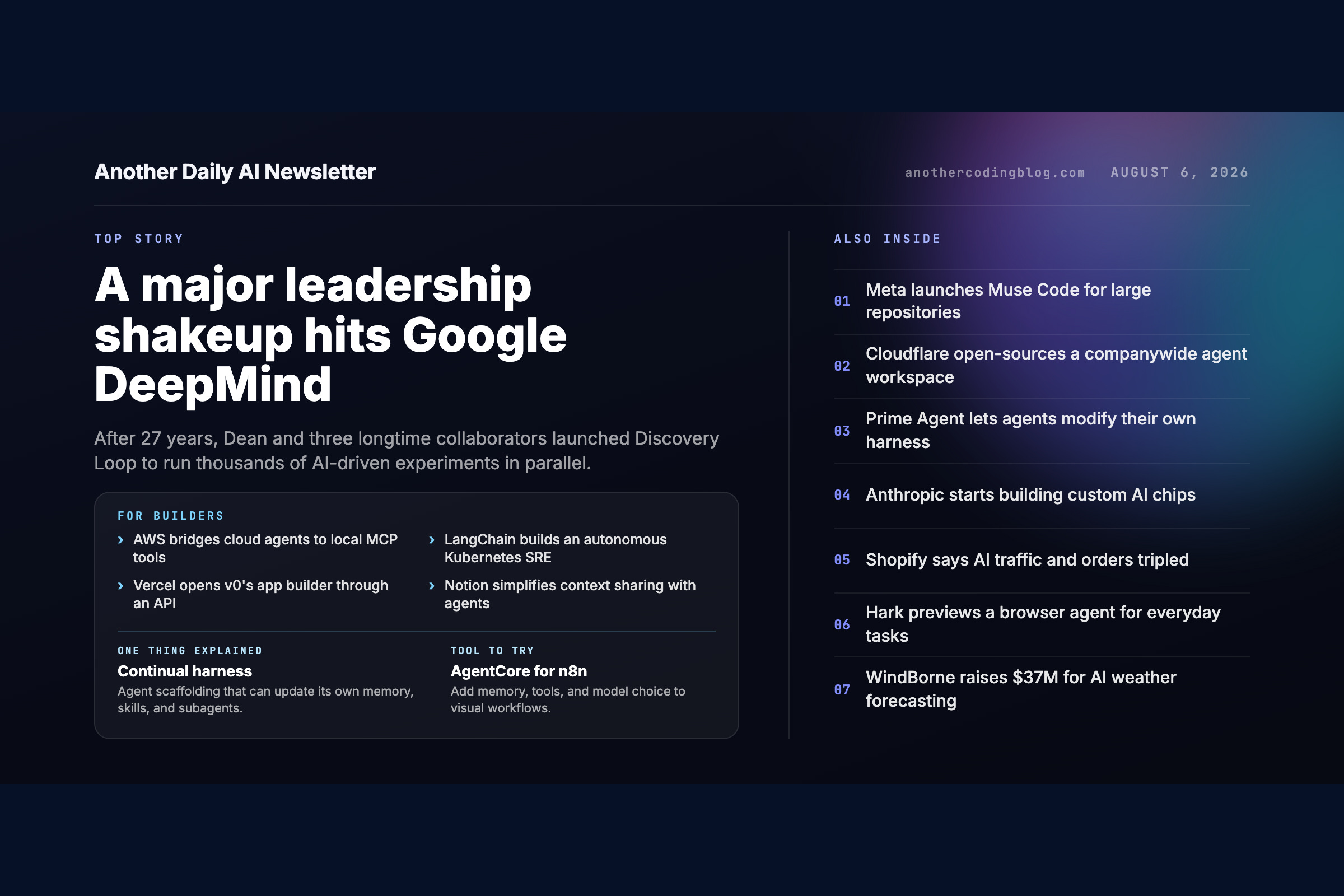
Top Story: A major leadership shakeup hits Google DeepMind
After 27 years at Google, Jeff Dean is leaving to launch Discovery Loop with Sanjay Ghemawat, Quoc Le, and Oriol Vinyals. The four longtime collaborators helped create systems and research behind Google Search, MapReduce, Bigtable, TensorFlow, TPUs, Gemini, AlphaFold, AlphaCode, and several foundational machine-learning techniques.
Discovery Loop is a public benefit corporation built around a straightforward idea: scientific progress is slowed by a sequential process. A researcher proposes an experiment, runs it, studies the result, and decides what to try next. The company wants AI systems to run thousands of those loops in parallel, beginning with machine-learning research and eventually expanding into medicine, clean energy, water, cybersecurity, and other engineering challenges.
The company has not announced a product or demonstrated a scientific breakthrough yet. It has assembled an unusually experienced founding team and substantial backing. Dean says Radical Ventures and Khosla Ventures will lead the initial round, with Lightspeed, Kleiner Perkins, Doerr Capital, and Alphabet participating. The seed financing is still expected to close over the next few weeks.
The launch arrived during a broader reorganization of Google’s AI leadership. Demis Hassabis is becoming Google DeepMind’s chairman and Alphabet’s chief scientist, while Koray Kavukcuoglu takes responsibility for day-to-day DeepMind operations. Google is losing four influential builders while investing in what they build next.
Interesting Perspectives
Dean is betting that institutional focus matters as much as model capability. He told The New York Times that automating the experimental loop could increase both the quantity and quality of experiments. Discovery Loop will initially use its own ML research as the first test case.
Nathan Lambert sees the departures as an execution warning for Google. That is his interpretation, not Google’s stated explanation. Google says the leadership changes are intended to sharpen the Gemini roadmap and accelerate its work toward AGI.
Alphabet’s participation makes this less than a clean break. Discovery Loop can move like a startup while Google retains financial exposure to what its departing researchers build next. Dean also published slides from the pitch deck, giving the launch an unusual degree of transparency before the seed round has closed.
Automated science has real failure modes. Nature recently warned that AI can let smaller teams attempt more ambitious research, but it can also encourage repetitive work, weak validation, and scientific monocultures. Faster experiments still need sound measurements, reproducibility, and human judgment.
The agent is becoming an operating environment
Cloudflare open-sourced Cloudflare OS, a browser-based agent workspace grounded in a company’s shared context, skills, and internal systems. It combines isolated code execution with a governance layer that tracks which resources an agent has observed. Cloudflare says thousands of its employees have used an internal version since May to create documents, automate work, and build small applications.
Meta released Muse Code and Muse Spark 1.2. The beta terminal agent works across large repositories using persistent background agents, an append-only event log, and restart-safe sessions. Meta says larger models are still coming, making this release as much a preview of its agent architecture as a finished challenge to Codex and Claude Code.
Prime Intellect released Prime Agent, an open-source harness that can manage persistent subagents and modify its own skills, memory, and supporting prompts. The company reports that Opus 5 inside Prime Agent scored 95.5% on ARC-AGI-3, narrowly above the benchmark’s 95.4% human-expert baseline. That is a company-run evaluation, and the result reflects the model-harness combination rather than a newly trained model.
Agents are entering operational workflows
Mobileye built an internal support agent for a pipeline that processes thousands of vehicle-recording sessions each day. The company reports a 90% reduction in response time and accuracy above 95%, then turned the underlying AgentCore architecture into a self-service platform for other teams.
LendingTree built a multi-agent mortgage assistant that separates education, borrower qualification, product matching, and compliance checks. The design matters because mortgage guidance combines personal data, regulated language, and decisions that require traceability.
The adoption gap remains wide. Notion surveyed 6,118 professionals across 10 markets and found that 88% of organizations are still in the early stages of AI transformation. Leaders were twice as confident as the workers using the systems. Integration, governance, and measurement separated the more mature deployments from the rest.
AI is becoming a new distribution channel
Shopify says AI-driven traffic and orders tripled year over year. Half of AI-referred sessions landed directly on a product page, 2.5 times the rate of traditional search. Traditional search traffic is still growing, so Shopify views AI assistants as an additional path to merchants rather than a replacement for Google.
Klaviyo agreed to acquire Agency, an AI customer-success startup that had raised $32 million. Agency founder Elias Torres will become Klaviyo’s chief product officer, and its 25-person team will help expand agents for campaign creation, returns, order tracking, and post-sale support across Klaviyo’s 200,000 business customers. Terms were not disclosed.
Hark previewed Handoff, a browser agent designed to order products, book travel, make reservations, and navigate sites without official APIs. The company showed only part of the workflow and has opened a
waitlist for a release planned by the end of summer, so its speed and reliability claims still need real-world testing.
Compute strategy is moving closer to the model
Anthropic confirmed it is assembling a custom-chip design team. The company plans to co-design hardware and models for greater speed and efficiency, while continuing to use infrastructure from AWS, Google, NVIDIA, and AMD. It has also reportedly explored Samsung as a manufacturing partner.
MacPaw partnered with Liquid AI on an on-device inference system called Elix and a local memory layer for its Eney assistant. The longer-term plan is to offer the stack to Setapp developers so applications can run private, offline agent workflows without sending every task to the cloud.
NVIDIA published an August guide to models running on DGX Spark systems, including configurations that connect multiple units for larger open models. Custom silicon and local inference are two responses to the same constraint: useful AI cannot depend indefinitely on a small number of remote GPU clusters.
One Thing Explained: What is a continual harness?
An AI model supplies the reasoning, while a harness supplies the surrounding system: tools, memory, prompts, permissions, subagents, and the loop that decides what happens next.
A continual harness allows the agent to update parts of that surrounding system as it works. It can record a useful procedure as a skill, revise a supporting prompt, create a specialist subagent, or change what it stores in memory. The model’s weights do not change. The software around the model adapts from experience.
That creates a new control problem. A bad memory or flawed procedure can become part of future runs, so changes need versioning, evaluation, rollback, and clear boundaries around what the agent may rewrite.
Go deeper: Prime Intellect’s architecture guide explains how Prime Agent combines recursive language models, persistent subagents, and a self-modifiable harness.
Tools to Try
If you build application prototypes, try the v0 API. A prompt creates an isolated app workspace, starts a development server in Vercel Sandbox, and returns a live preview that can be embedded in another product.
If you automate work in n8n, try the AgentCore harness node. The open-source node adds persistent memory, code execution, skills, and model choice to n8n’s visual editor.
Research Radar
WindBorne raised $37 million for AI weather forecasting. Its network keeps roughly 600 long-duration balloons in the air, including in areas that are difficult for conventional sensors to reach. The company combines that proprietary data with government datasets and models that can run without traditional supercomputers.
Vanderbilt is building an AI triage agent for Alzheimer’s care. The 18-month, $600,000 project will summarize referrals, flag missing information, and recommend priority while allowing clinicians to accept, edit, or override every recommendation.
City Colleges of Chicago launched its first credit-bearing AI degree. The two-year program covers data processing, machine learning, neural networks, deployment, language processing, computer vision, and technology ethics.
For Builders
AWS bridged cloud agents to local MCP tools. The reference architecture tunnels messages over WebSockets and native messaging so a remotely hosted agent can work with spreadsheets and tools on a user’s computer.
LangChain built an autonomous Kubernetes SRE agent. It synthesizes cluster signals, proposes remediation, and requires human approval before changing infrastructure.
Nathan Lambert published a 32-minute lecture on modern AI evaluation. It follows the field from prompt-based model checks to agentic sandboxes and long-running tasks.
Notion made it easier to share pages with Custom Agents. Pages can now be added as agent context directly from the Share menu.
Quick Hits
Simon Willison gave Claude Fable 5 a four-year-old game concept and had Claude Code for web turn it into a playable game and GitHub repository in one run.