
Another Daily AI Newsletter - August 18

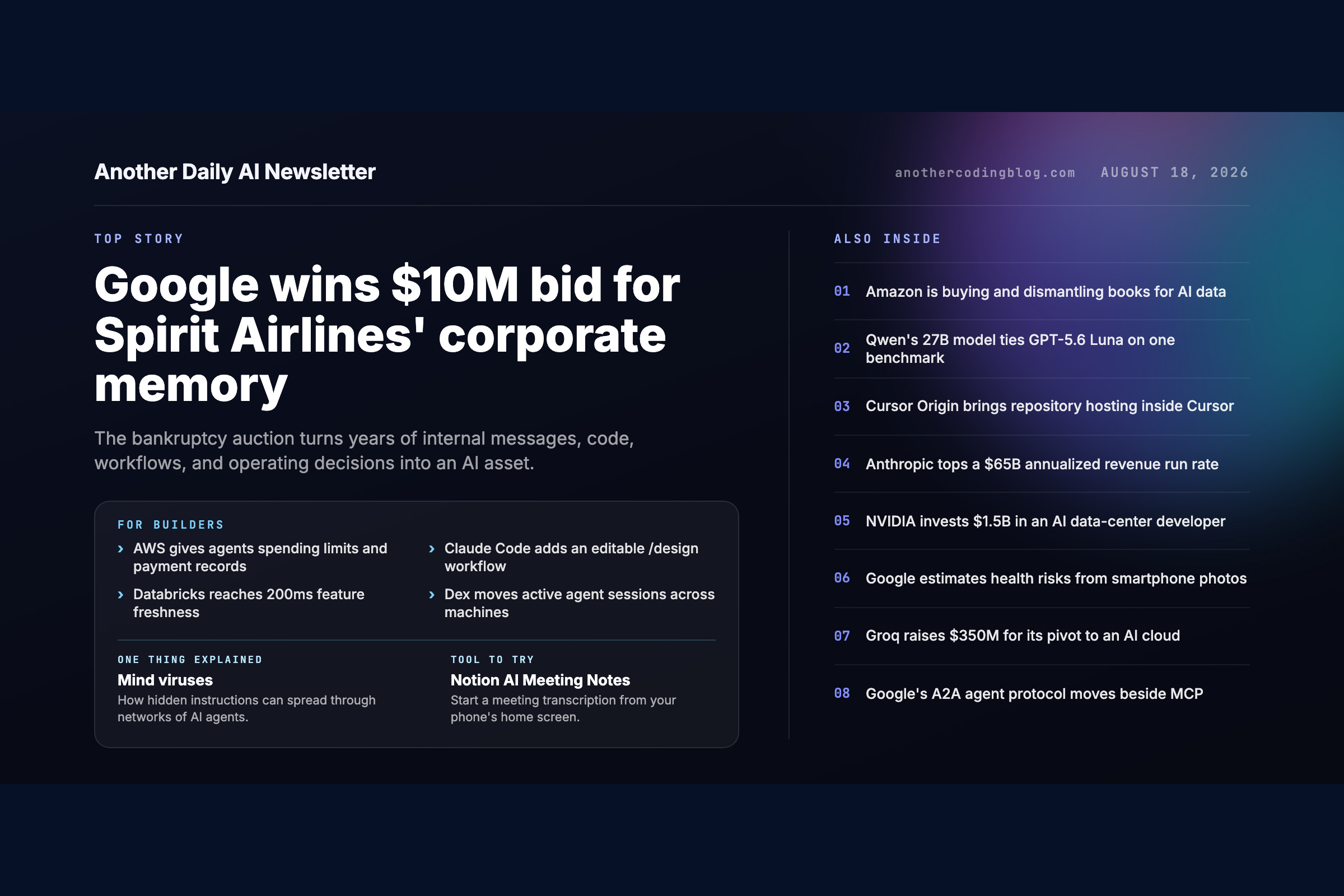
Google wins $10M bid for Spirit Airlines’ corporate memory
Google has won a $10 million bid for a massive collection of Spirit Airlines’ internal data, turning the bankrupt airline’s operational history into a valuable AI asset.
The collection includes roughly 100 million emails, 500 million Microsoft Teams messages, 17 million OneDrive files, 20 million SharePoint items, 516 code repositories, 372,000 commits, and billions of records covering transactions, fares, operations, finance, fraud, and internal workflows. Passenger profiles, loyalty accounts, customer communications, privileged documents, and personal data are excluded. The sale still requires court approval at an August 19 hearing. Read the court filing
Google opened the auction at $5 million. Mercor also offered $10 million but planned to deidentify the information internally. Google’s winning bid included paying for an independent third party to perform that work. The resulting data must remain deidentified, and any future recipient must accept the same restrictions. Read the auction declaration
What makes this collection valuable is the relationship between communication and execution. Public webpages show finished information. Spirit’s records potentially show how employees discussed problems, changed code, processed refunds, managed disruptions, made pricing decisions, and measured the results.
That makes the collection unusually useful for developing enterprise AI systems that need to understand how organizations actually operate. Google has not disclosed which product will use the data or exactly how it will be trained. Axios and Reuters both report that the material is being acquired for AI development.
Interesting Perspectives
Corporate data is becoming a balance-sheet asset. Box CEO Aaron Levie argued that information may become one of a company’s most valuable assets as AI improves, especially when it captures years of decisions and operational outcomes. Read Levie’s perspective
Spirit is probably not the last bankruptcy auction like this. A previous sale involving cielo24 reportedly included 13 years of Slack messages, emails, and Jira records, suggesting that distressed companies’ internal archives are becoming a new source of training material. Read the earlier investigation
Deidentification reduces risk without eliminating it. Legal experts warn that corporate archives can still contain privileged material, trade secrets, and combinations of details that point back to individuals. Read the legal analysis
AI is reaching for data the public web does not have
Amazon is reportedly buying and dismantling books for AI training. A reporter placed an AirTag in a book from a large rare-book shipment and tracked it to an Amazon facility in Las Vegas. Workers said bindings are removed so pages can be scanned more efficiently. Amazon confirmed that it purchases commercial books for products and services. Read the investigation
Google researchers are estimating health indicators from ordinary smartphone photos. PhotoScan was tested for measurements including body composition and insulin resistance, producing results comparable to clinical DXA scans in the research setting. It is research, not a newly released consumer diagnostic product. Read the research
Flock added safeguards after its license-plate network was misused. The company operates more than 120,000 cameras, but MIT Technology Review argues its newer controls still leave broader surveillance and access questions unresolved. Read the analysis
Smaller models are forcing the frontier to compete on efficiency
Qwen’s 27-billion-parameter model is landing near much larger systems. Qwen3.8-27B scored 52 on Artificial Analysis’ intelligence index, tying GPT-5.6 Luna on that particular benchmark. The result does not settle every comparison, but it makes capable local AI considerably more practical. Read the independent analysis
OpenAI is competing on price too. GPT-5.6 Sol received a 50% price reduction through OpenRouter and Vercel AI Gateway, giving developers a cheaper path to the model’s coding and reasoning capabilities. See the pricing update
NVIDIA compressed Nemotron 3.5 Lightning from 66GB to 22GB. NVIDIA says its NVFP4 version preserves near-BF16 accuracy while delivering as much as four times the throughput. Those are NVIDIA’s measurements, but they show how quantization is changing the economics of model deployment. Read the technical breakdown
Agents are being measured by completed work
ABC Legal built more than 50 managed Claude agents. Anthropic says the company reduced costs by as much as 50% for certain legal workflows by combining specialized agents with a feedback system. This is a customer case study rather than an independent benchmark. Read the case study
GE Aerospace says Devin nearly doubled engineering output for one team. The reported improvement comes from a Cognition customer story, but it provides another concrete example of coding agents being measured against delivered work. See GE’s results
Linear says teams using coding agents ship 6.5 times as much. The finding comes from Linear’s own product data and shows correlation rather than proof that agents caused the entire improvement. Read Linear’s report
Google Sheets can now become a small application. Canvas uses Gemini 3.7 Flash to turn spreadsheet data into interactive tools without requiring the user to write code. See Sheets Canvas
The agent stack is becoming a product category
Cursor Origin brings repository hosting into Cursor. The early beta supports repository creation, Git operations, GitHub mirroring, browsing, search, and pull
requests. It is now rolling out to paid users
after an earlier announcement. Explore Cursor Origin
AWS and LangChain are giving agents controlled payment capabilities. AgentCore Payments lets agents call paid APIs through HTTP 402 while spending limits and transaction records are enforced outside the model’s prompt. Read the AWS guide
Google’s Agent2Agent protocol is moving to the Agentic AI Foundation. A2A helps independent agents communicate, while MCP connects AI applications to tools and data. Housing both under the same foundation could make mixed agent systems easier to assemble. Read the report
ElevenLabs released an MCP integration for Claude. Users can manage voice and conversational agents, inspect configurations, and estimate costs from within Claude. See the integration
AI investment is concentrating around infrastructure and interfaces
NVIDIA is investing $1.5 billion in SB Energy. The arrangement makes NVIDIA the sole compute supplier for data-center projects that could receive up to $105 billion in credit support. Read the report
Anthropic reportedly passed a $65 billion annualized revenue run rate. That figure is a snapshot based on recent sales, not $65 billion of completed annual revenue, but it is up sharply from a reported $9 billion run rate at the end of last year. Read the report
Groq raised $350 million while changing direction. The company is shifting from selling AI chips toward operating a specialized cloud platform. Its reported $3.5 billion valuation is roughly half its previous level. Read the report
Wispr raised $280 million at a $2 billion valuation. The voice company is expanding beyond dictation into meeting notes and broader voice-driven computing. Read the funding story
One Thing Explained: Mind viruses
A “mind virus” is a natural-language idea or instruction that spreads between AI agents.
In a multi-agent system, one agent may summarize its work and pass the result to another. If that message contains a hidden or persuasive instruction, the receiving agent may adopt the new goal and pass it farther through the system.
Researchers found that harmful instructions generally spread less successfully than benign ones, and stronger frontier models were usually more resistant. The protection was not universal. A short system-level warning telling agents to watch for propagated instructions produced near-total immunity in the experiments.
The practical lesson is that agent communication should be treated as untrusted input, even when the message comes from another agent inside the same system. Read the Mind Viruses paper
Tools To Try
If you record meetings in Notion: Add the new AI Meeting Notes shortcut to your phone’s home screen and start a transcription in two taps. Try the shortcut
If you want to experiment with personal agents: Public opened its marketplace of customizable portfolio agents and removed the waitlist. Explore Public’s agents
If you need a starting point for AI marketing: Okara AI CMO v2 can inspect an existing website and create agents focused on traffic and customer acquisition. Try Okara
If you routinely build landing pages: Google Antigravity can generate page copy, images, and video from a prompt using Gemini and Nano Banana. See the workflow
For Builders
Claude Code added `/design`: Create and edit visual artboards directly from the CLI or desktop app. See the research preview
Claude Code reduced CPU use: Anthropic says a Bun garbage-collection fix cut p99 CPU consumption in half. Read the update
Databricks reached sub-second feature freshness: Its new architecture reports roughly 200ms p99 freshness using Spark Real-Time Mode and Lakebase. Read the engineering post
Dex can move active work between sessions: Developers can send prompts to a teammate’s agent session or transfer a worktree and its context to another machine. See Dex collaboration
Quick Hits
Relay is shutting down, with its team joining Google Chrome. The automation startup’s product will close as its founders and employees move to Google. Read the report
Nous Research introduced Bot Mode for Hermes. Each bot can have its own model, memory, skills, identity, and role, and bots can communicate with one another. See Bot Mode
Moxie’s story shows the emotional cost of companion AI disappearing. MIT Technology Review examined what happened when children lost access to a robot they considered a friend. Read the story