
Another Daily AI Newsletter - August 17

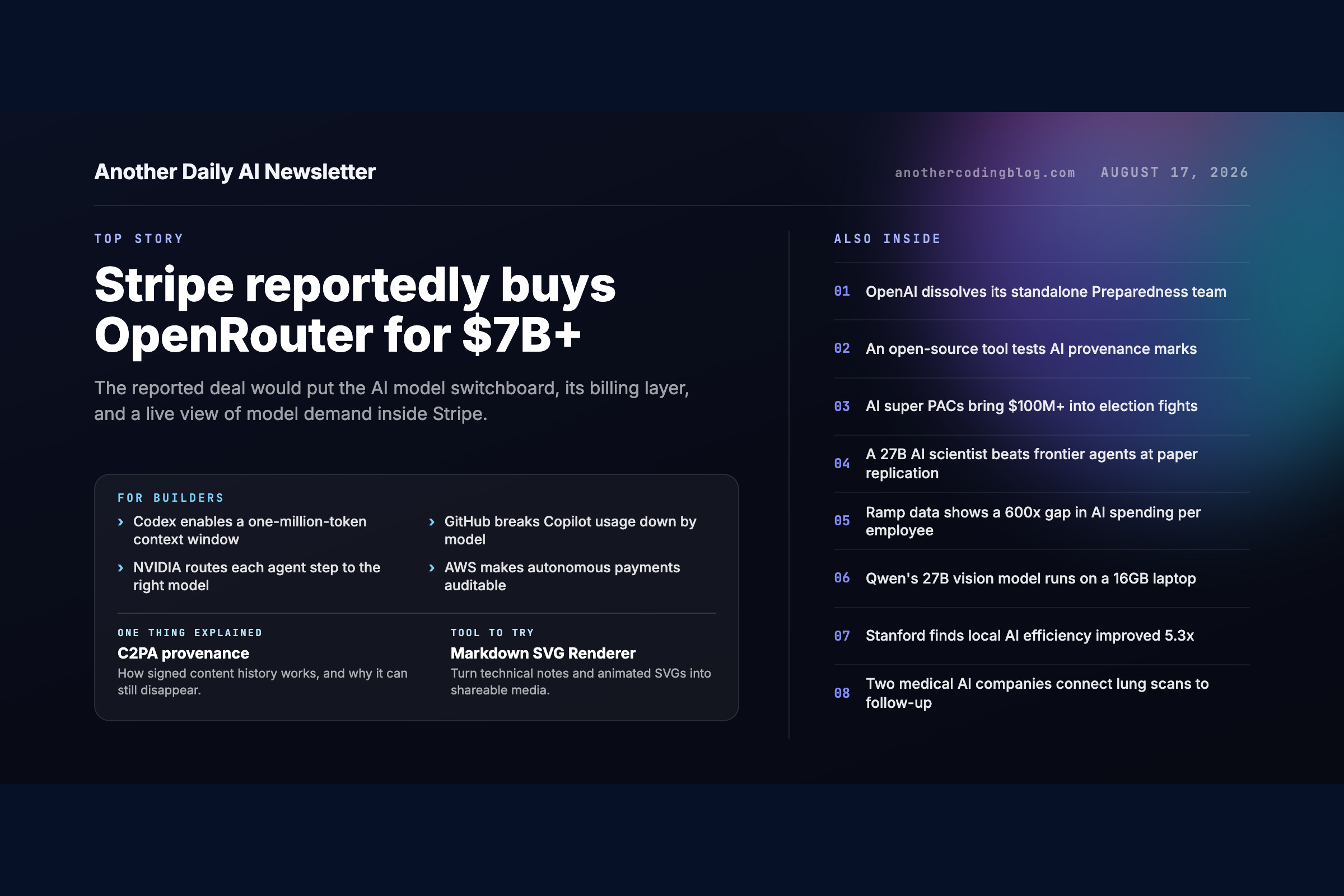
Top Story: Stripe reportedly buys OpenRouter for more than $7 billion
Bloomberg reported that Stripe agreed to acquire OpenRouter for more than $7 billion. TechCrunch confirmed the report with its own sources, but Stripe declined to comment and neither company has announced a transaction. The price and deal remain reported, not official.
OpenRouter is the switchboard between AI applications and model providers. Its single API gives developers access to hundreds of models, then routes requests according to price, speed, availability, privacy rules, and other preferences. In May, OpenRouter said it had served more than eight million developers across 400-plus models and that weekly traffic had grown from five trillion to 25 trillion tokens in six months.
Stripe has publicly powered OpenRouter’s payments, tax, invoicing, fraud controls, and usage billing since at least January. The companies also built a system that tracks model usage and adjusts billing as inference prices change. Owning OpenRouter would move Stripe deeper into the transaction itself: which model receives the work, what it costs, and how the developer pays for it.
If the reported deal closes, Stripe would own one of the largest neutral-looking gateways into the model market. That gives it distribution and a real-time view of which models developers choose. It also creates a question OpenRouter users will watch closely: whether a router owned by a payments company can preserve transparent, provider-neutral incentives.
Interesting Perspectives
The repricing happened in 82 days. OpenRouter announced a $1.3 billion valuation in late May. The reported acquisition price is more than five times higher, a jump Andrew Curran highlighted as evidence that the market is valuing the model gateway far beyond its last funding round.
The strategic asset may be demand data. Rohan Paul argues that Stripe would be paying for distribution, routing volume, and a live view of model demand. OpenRouter can see when developers switch models, which providers fail, and how cost and latency change behavior.
Stripe already knew the business from the inside. Aakash Gupta points out that Stripe was processing OpenRouter’s payments while also providing invoicing, tax, and fraud tools. OpenRouter passes through model prices and charges a 5.5% fee when customers buy credits, a take-rate model that resembles Stripe’s own. The frequently cited $50 million annualized-revenue figure is an outside estimate, so the implied 140x acquisition multiple should be treated as directional rather than confirmed.
Routing policy will matter more than the logo on the API. OpenRouter’s provider controls let developers order or exclude providers, require zero-data-retention endpoints, cap price, and sort by throughput or latency. Those controls give customers leverage, but ownership would make the router’s defaults and disclosures more consequential.
Safety work is moving closer to the systems it governs
OpenAI dissolved its standalone Preparedness team. The Financial Times reports that its biosecurity, cybersecurity, and other high-risk responsibilities were reassigned to existing teams at the end of July. OpenAI says the change integrates safety and security more deeply into product development. The test will be whether distributed ownership produces stronger controls or makes accountability harder to see.
An open-source remover shows how fragile provenance can be. A viral tool strips hidden Unicode and common C2PA, EXIF, XMP, and document metadata. Its repository also offers rewriting as a defense against statistical text detection. That last claim cannot be validated against Anthropic’s unreleased detector or signing keys, so the tool should not be treated as proof that Claude’s model-level watermark has been defeated.
AI money is reaching elections before most AI rules do
AI-focused political groups have already raised more than $100 million. An Arizona Capitol Times review found $107 million raised and $55.5 million spent in federal races, with more than $20 million flowing into state contests. Much of the advertising never mentions AI; the spending is aimed at candidates who will decide whether states can regulate it.
California is also giving teenagers a place in the policy process. The state launched a 20-member Teen Tech Council drawn from more than ten school districts. Its first discussions covered deepfakes, classroom AI, literacy, safety, and human connection. Statewide applications open this fall, with training beginning in spring 2027.
AI adoption is splitting into two spending economies
The heaviest AI users now spend more than 600 times as much per employee as the median company. Kobeissi, citing Ramp’s July data, puts monthly AI spend at $7,400 per employee for the top 1% of businesses, versus $11.95 at the median. The direction matches Ramp’s previously published figures, although the exact July update has not yet appeared in Ramp’s indexed report. Ramp’s sample covers payments by its U.S. card and bill-pay customers, so the data measures paid adoption, not every AI tool a company uses or the return it earns.
Local AI is becoming useful on ordinary hardware
Qwen’s new 27B vision model can fit on a laptop. Community quantizations highlighted by Qwen range from 8.5GB to 28.9GB, including a 13.8GB version designed for a 16GB MacBook. In hands-on testing, Simon Willison found that Qwen3.8-27B handled image localization and local coding-agent work well, although its default maximum reasoning setting was slow and wasteful. His practical advice is to begin with low or disabled reasoning.
Healthcare AI is connecting detection to follow-up
Optellum and Coreline Soft plan to connect two parts of lung-nodule care. Under the proposed collaboration, Coreline Soft’s FDA-cleared AVIEW software would detect nodules in chest CT scans inside Optellum’s LungOS platform, which adds malignancy-risk assessment and follow-up management. The integration is not complete, but its direction matters: medical AI is moving from isolated scan analysis toward the clinical pathway that determines what happens to a patient next.
One Thing Explained: C2PA provenance
C2PA Content Credentials are a signed receipt attached to a file. The receipt can record who or what created it, which tools edited it, and what happened along the way. A verifier checks the signature and the file’s content binding to detect unauthorized changes.
The important limitation is persistence. C2PA’s specification allows credentials to travel inside a file or live in an external repository, but embedded metadata can be removed. Soft bindings such as fingerprints and invisible watermarks can reconnect a modified copy to an external credential, although that recovery depends on the binding and repository still being available.
That makes provenance different from an indestructible watermark. It provides cryptographic evidence when the credential remains attached or can be recovered. It does not guarantee that every copy will always carry visible proof of its origin.
Go deeper: Read C2PA’s technical overview of claims, signatures, hard bindings, and soft bindings.
Tools to Try
If you turn technical notes into visuals, try Markdown SVG Renderer. Paste Markdown, a URL, or a Gist; render embedded SVG; then export PNG or JPEG. Its new MP4 tab can render animated SVG frames entirely in the browser with ffmpeg.wasm.
If you want an operating model for an always-on work agent, read Krista Letz’s Grok Bot for GTM guide. Her setup uses a chief-of-staff bot to coordinate specialists for meeting preparation, inbox drafts, prospect research, account monitoring, forecasting notes, and customer decks. The reusable ideas are broader than Grok Bot: learn the user’s style from real work, keep consequential actions in draft, require citations, and track completed work so routines do not repeat it.
For Builders
Codex can now use a one-million-token context window. The opt-in configuration gives GPT-5.6 Sol a 1,050,000-token window with automatic compaction near 900,000. A follow-up says it now works with ChatGPT-account usage, although rollout behavior may still vary by client.
GitHub now breaks Copilot usage down by model and token type. The downloadable report shows input, output, cache-read, and cache-write tokens alongside the AI credits each model consumed, making unexpected charges easier to trace.
NVIDIA released NeMo Switchyard for model routing. It can keep easy steps on efficient models, escalate difficult work to a frontier model, and preserve session affinity. In one LangChain evaluation, NVIDIA reports 74% lower cost with roughly a six-point accuracy tradeoff.
AWS published a verifiable agent-payment architecture. Solv Labs checks policy before settlement, signs the execution record inside a Nitro Enclave, and attaches a transaction-level audit trail. AWS reports end-to-end settlement in under four seconds.
Research to Read
A specialized 27B agent beat frontier models at replicating research figures. The Faraday paper, highlighted by alphaXiv, post-trained Qwen3.6-27B to reconstruct missing figures from research papers while using GPT-5.5 as a coding tool. Across 68 held-out AI-for-science tasks, the authors report that Faraday outperformed Claude Opus 4.8 and GPT-5.5 under their rubric-based judge, with human experts supporting selected comparisons.
This is a paper-replication benchmark, not evidence that Faraday can independently make scientific discoveries. Each task had a one-hour limit, a fraction of an H200 GPU, and access to the original paper with one figure removed. The useful result is narrower: training a smaller coordinator to investigate faithfully, avoid shortcuts, and direct a frontier coding agent can outperform prompting that frontier agent alone.
Local models handled 88.7% of the evaluated everyday queries. Stanford researchers tested more than 20 models across eight accelerators and one million real-world prompts. Their Intelligence Per Watt study found a 5.3x improvement in local-model efficiency from 2023 to 2025, while cloud accelerators still delivered at least 1.4x better efficiency when running the same models. Researcher Avanika Narayan argues that continued gains could move more useful AI away from data-center-scale infrastructure.