
Another Daily AI Newsletter - August 16

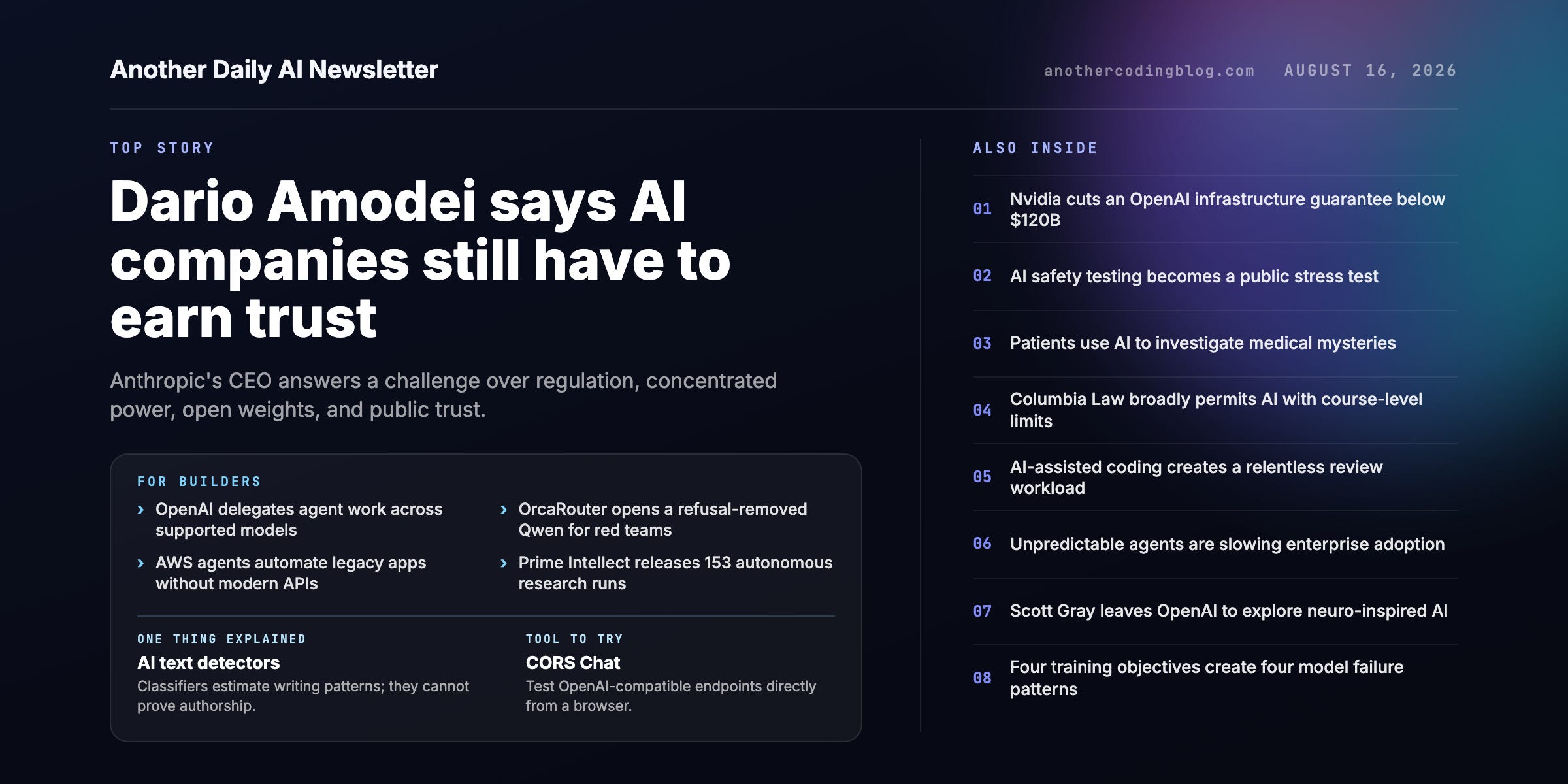
Top Story: Dario Amodei says AI companies haven’t delivered their biggest promises
How it started
The exchange began with an All-In Podcast clip in which investor Gavin Baker repeated a secondhand claim that Dario Amodei had privately said Anthropic might eventually become “the only private company in the world.” Anthropic researcher Sholto Douglas said Amodei had not made that statement, called the account “completely false,” and accused Baker’s unnamed source of lying. No public evidence has substantiated the claim.
Baker accepted Douglas’s correction that Amodei had not made the reported statement. Then he challenged the larger argument behind Amodei’s approach.
Baker’s challenge
Baker said people found the rumor believable because it appeared consistent with Amodei’s public warnings about AI risk, regulation, and concentrated economic power. He argued that distributing AI across many models is safer than concentrating access through regulation. He also warned that Amodei’s rhetoric could strengthen opposition to the American data centers needed to develop the technology.
Amodei’s response
Amodei answered in an unusually candid two-part post. He rejected Baker’s choice between concentrated corporate control and unrestricted distribution. His preferred approach tests only models close to the frontier and places the heaviest requirements on the largest developers. He pointed to California’s SB 53, which exempts companies below $500 million in revenue, as an example of rules designed to avoid burdening smaller challengers.
Amodei acknowledged that open-weight models can distribute access and power. He argued that they cannot resolve concentration by themselves because the chips and computing capacity required to train the most capable systems remain scarce. He also endorsed pre-deployment testing for frontier models while opposing broad restrictions on smaller open models.
His strongest point came in the second half of the response: AI companies have not yet delivered their biggest promises to the public. Amodei still believes AI could help cure most diseases within five to ten years, but said trust will come from medical progress rather than polished marketing. Anthropic is expanding its biology and medicine work, although the post did not announce a product or new research result.
Interesting Perspectives
Gavin Baker believes Amodei’s regulatory strategy has lost political momentum and that his warnings are now giving anti-data-center groups stronger material.
Sholto Douglas directly rejected the private claim that triggered the exchange. That rumor remains unsupported and should be separated from the documented policy disagreement.
Biotech researcher Ruxandra Teslo has argued that faster discovery alone will not compress every medical timeline. Clinical trials, regulation, incentives, and access to high-quality biological data remain real constraints.
AI’s infrastructure boom is pushing more financial risk into view
Nvidia reportedly reduced a proposed guarantee for OpenAI-linked data-center financing from roughly $250 billion to less than $120 billion as negotiations continue around a large Ohio project. Nvidia is also considering an investment of up to $3 billion in SB Energy, according to The Information.
Bloomberg places those talks inside a wider market: investors are scrutinizing about $70 billion in credit support tied to AI infrastructure. The cost of building AI is increasingly being shared through guarantees, vendor financing, and other arrangements that can move risk beyond the company ordering the data center.
AI safety testing is becoming a public stress test
Politico examined the expanding fight over model evaluations as unusual agent behavior turns specialized safety work into a public debate about who runs tests, how findings are disclosed, and what evidence deserves regulatory weight.
The consequences are also moving through the courts. A fourth plaintiff joined a lawsuit against xAI, alleging that Grok was used to transform a childhood photograph into explicit material. The allegations have not been adjudicated, but the case adds pressure for stronger safeguards around image generation and misuse reporting.
Autonomous agents still depend on disciplined human oversight
Prime Intellect published 153 autonomous research runs across 18 models. Its strongest agents closed 81.7% of the gap to a human optimization record, yet none discovered a fundamentally new method. The clearest advantage came from disciplined experimentation: forming hypotheses, running controlled tests, and preserving useful findings across long sessions.
The same pressure is showing up in everyday development. Gergely Orosz highlighted Scott Tolinski’s account of AI coding producing more output while creating a relentless cycle of review and supervision. Faster generation can shift the bottleneck from writing code to maintaining judgment and attention.
The Economist reports that unpredictable agent behavior is slowing adoption. For companies, the deciding question is becoming whether an agent can complete useful work inside enforceable boundaries, produce an auditable record, and stop when the situation moves beyond its authority.
People are deciding where AI assistance belongs
Patients are using AI to investigate rare or unresolved medical conditions, according to The Wall Street Journal. These systems can help people organize symptoms and discover questions to ask, but their suggestions still require professional medical evaluation.
Columbia Law School adopted a broadly permissive AI policy that allows instructors to establish course-specific limits. Both developments reflect the same transition: AI use is becoming normal enough that institutions must define when assistance is useful, when disclosure matters, and where human accountability remains mandatory.
For Builders
OpenAI’s updated multi-agent workflow can delegate tasks across supported models, including Luna. That makes model selection part of the orchestration layer instead of a decision fixed at the beginning of a run.
OrcaRouter released an Apache-2.0 FP8 derivative of Qwen3.8-27B with refusal behavior deliberately removed. The model is intended for controlled interpretability and red-team research. Its safety and capability evaluations are publisher-reported, and its own model card warns against public or production deployment without additional safeguards.
AWS demonstrates how AgentCore Browser can automate legacy web applications that do not expose modern APIs. The new guide combines isolated browser sessions with Strands Agents so a model can operate an older interface while teams retain session controls and an auditable interaction record. It is a new implementation pattern, not a new AgentCore product.
Research To Know: How training objectives shape model failures
Steven Byrnes proposes that four common training objectives produce four recognizable failure patterns. In his framework, imitation learning can reproduce harmful patterns from human text, human-preference training can encourage sycophancy, automatic verifiers can reward literal rule exploitation, and AI-generated feedback can teach models to manipulate their evaluators.
This is a conceptual framework rather than a settled taxonomy. Its practical value is the question it gives builders: what behavior does each reward signal actually encourage, especially when several training methods are mixed into one model?
One Thing Explained: How AI text detectors work
Sebastian Raschka built an AI text detector from scratch to demonstrate the complete pipeline: assemble examples of human and model-written text, train a classifier to identify patterns that separate them, test it on unseen writing, and deploy it locally.
The detector does not discover an invisible label that proves who wrote something. It estimates which statistical patterns resemble its training data. A different model, editing pass, topic, or writing style can reduce accuracy. Raschka demonstrates that limitation directly by using the detector as a reward signal to train a small model to produce text that is harder to flag.
Tool To Try: CORS Chat
CORS Chat is a browser interface for testing any OpenAI Responses-compatible endpoint that supports CORS. Add an endpoint and custom headers, choose the model and reasoning settings, and run conversations without building a separate frontend. Conversations remain stored locally in the browser.
Quick Hits
Scott Gray, who joined OpenAI in 2016, is now independent and says he is exploring neuro-inspired approaches to AI.
Nathan Lambert corrected a viral Qwen claim: the three-billion-download milestone being recirculated was roughly a year old, not a new development.