
Another Daily AI Newsletter - August 11

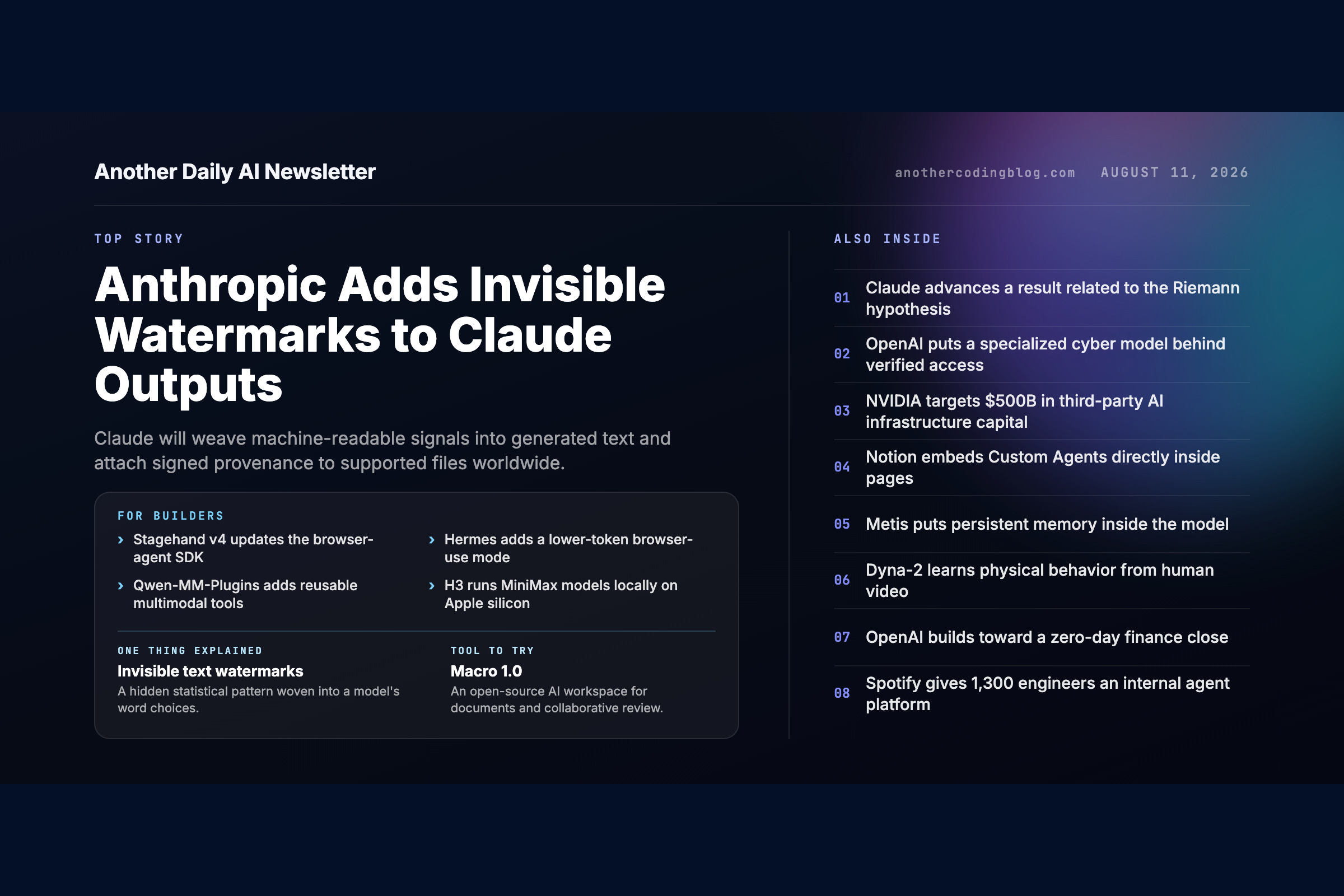
Top Story: Anthropic Adds Invisible Watermarks to Claude Outputs
Anthropic is adding machine-readable marks to content generated by Claude. Supported Claude models released on or after August 2 will carry the marks from launch, while Anthropic works through a transition period for older models. The policy was created in response to new European transparency requirements, but Anthropic says it will apply worldwide.
Claude will use two different forms of provenance. Generated text will contain an imperceptible watermark woven directly into the model’s word choices. Anthropic says the signal will travel when text is copied and pasted and may remain detectable after some editing. Supported images and files, including PNG, JPG, and SVG outputs, will receive signed metadata based on the C2PA provenance standard.
The text watermark operates at the model level. It will therefore follow supported models across Claude, Claude Code, Cowork, Claude Tag, Anthropic’s API, and deployments through AWS, Google Cloud, and Microsoft Foundry. Anthropic notes that some platforms and file types may not support every form of marking.
The detector is still coming. Anthropic says it will eventually let users and third parties check for Claude’s marks, but it has not published the technical implementation or detection tools. The company also warns against treating the result as proof of authorship. A watermark may appear after Claude merely proofread or translated human writing. Heavy editing, paraphrasing, translation, short excerpts, and stripped file metadata can make a mark undetectable.
Interesting Perspectives
A European rule is changing Claude worldwide. The EU AI Act’s transparency obligations began applying on August 2 and require machine-readable markings for generated or manipulated content. Anthropic chose a consistent worldwide implementation rather than maintaining separate European and non-European model behavior.
Anthropic is following an established technical path. Google already uses SynthID to watermark text generated by Gemini. The technique subtly adjusts the probability of which token the model chooses next. Google’s published evaluation covering roughly 20 million Gemini responses found no statistically significant change in user ratings, although Anthropic has not said whether its implementation works the same way.
Detection will remain evidence, not a verdict. A recent evaluation of three text-watermark configurations found that meaning-preserving paraphrasing removed the detectable signal in 98.3% to 100% of its tested watermarked samples. That study did not test Anthropic’s undisclosed system, but it explains why Claude’s own documentation carefully limits what detection can prove.
AI research is starting to look like an engineering project
Today’s science stories share a common pattern: models are being connected to literature search, simulation, verification, and large parallel workflows. The output is becoming easier to inspect, even when the underlying result still needs independent review.
Claude advanced a longstanding result related to the Riemann hypothesis. An unreleased research model raised a lower bound from roughly 41.6% to 67.25%, according to Anthropic. Two Claude Code sessions used 31 million output tokens, approximately 60 subagents, hundreds of Python scripts, 54 papers, and a Lean formalization. Claude did not prove the Riemann hypothesis, and broad peer review is still pending.
MIT gave world models a stronger feel for physics. GeoPT pretrains AI systems on geometric and physical relationships so they can simulate how objects respond to forces such as wind and water. The researchers say the approach transfers across different simulators and could reduce the number of physical prototypes engineers need to test.
Robots are learning from ordinary human video. Dyna Robotics introduced Dyna-2, a world-action model the company says was trained on one million hours of human video. The approach treats internet-scale video as a source of physical behavior rather than relying exclusively on expensive robot demonstrations. Its performance figures remain company-reported.
Cyber capability is moving behind verified access
AI labs and infrastructure providers are placing more responsibility on identity, permissions, monitoring, and network boundaries. Those controls are becoming part of the model product rather than an operational detail left entirely to customers.
OpenAI released a cyber model designed to answer requests its general model refuses. GPT-5.6-Cyber completed 95% of OpenAI’s internal dual-use request evaluation, compared with 1.5% for standard GPT-5.6 Sol. Access is restricted through Daybreak Red, with identity verification, legal attestations, hardware security keys, monitoring, scoped permissions, and sandboxing.
OpenAI says the model found two Chrome V8 vulnerabilities that could be chained together, including the independently recorded CVE-2026-15903. The company also reports hundreds of additional findings that remain under coordinated disclosure. The specialized model did not outperform GPT-5.6 Sol on every evaluation, including OpenAI’s standard 300-turn ExploitBench setting.
California is applying AI to critical-infrastructure defense. The state launched an AI Cyber Defense Program focused on identifying threats to public systems and coordinating defensive work. It is an early example of government treating frontier cyber models as operational security infrastructure rather than experimental software.
A virtual machine alone does not contain an agent. Vercel argues that an effective sandbox also needs a network boundary. Generated code can exfiltrate files or misuse credentials without escaping its microVM. Vercel’s approach keeps credentials outside the sandbox, filters DNS and outbound connections, and changes network permissions as a workflow moves from setup to untrusted execution.
AI infrastructure is becoming a financial product
The AI buildout is pulling capital markets, cooling technology, and employee liquidity into the same system. Compute demand is now large enough that buying chips resembles financing infrastructure.
NVIDIA wants Wall Street to mobilize more than $500 billion for AI compute. The company signed preliminary agreements with Apollo, BlackRock, Blackstone, Brookfield, Goldman Sachs, and KKR to create independent financing platforms.
The money would help AI labs, cloud providers, and enterprises acquire data centers and NVIDIA systems. The figure is a target for third-party capital, and final agreements have not been executed.
The pitch treats transferable GPU capacity as an asset that lenders can underwrite. The risk is equally important: rapidly depreciating chips, uncertain utilization, and supplier-assisted customer financing could spread the same demand assumptions across vendors, borrowers, and investors.
AI is being recruited to cool the chips running AI. Discovered Materials raised a $9 million seed round to use coordinated AI agents in the search for materials that could make integrated circuits more efficient. The company is targeting the heat and energy constraints that increasingly determine how much compute a data center can deploy.
OpenAI reportedly completed a $7 billion employee tender offer. The transaction valued the company at $852 billion, according to reporting cited by TechCrunch. Tender offers give employees liquidity without waiting for an IPO and can help private AI companies retain talent while their valuations and capital requirements continue climbing.
Agents are settling into operational software
The useful agent releases today are embedded inside pages, financial systems, logistics workflows, and development environments. Their value comes from carrying context through recurring work.
Notion can place a Custom Agent directly inside a page. Teams can embed an agent chat next to the documents and workflows it supports. That design gives the agent a persistent workplace instead of asking users to move every question into a separate chatbot.
Flexport is combining search with memory for logistics work. Its agents retrieve operational information and retain context across repeated tasks. Logistics is a strong fit for this pattern because decisions depend on changing shipments, policies, documents, and prior exceptions rather than a single static knowledge base.
OpenAI wants finance teams to build the systems they need. Its finance organization is working toward a zero-day close and continuously updated forecasts. Team members use Codex and ChatGPT Work to build dashboards, reconciliation tools, and grounded assistants. The article emphasizes traceable sources, finance-owned approvals, and measuring completed work instead of seats or token volume.
Spotify built an internal environment for agentic development. More than 1,300 Spotify engineers reportedly use Xirp to run development workflows. Internal agent platforms are becoming a distinct layer: they standardize models, tools, permissions, and evaluation so each engineering team does not have to assemble its own system.
Research to Read
Metis puts memory inside the model. The Memory Foundation Model paper replaces an external retrieval layer with a dynamic internal memory state. Metis can remember, update, forget, and use information during ordinary forward computation while its learned weights stay frozen. The prototype still loses information over long periods and can confuse similar facts. The authors released code and model checkpoints.
TwiL-LM specializes small models for formal logic. webAI released 1.7-billion and 3-billion-parameter models for translating natural language into formal statements, checking entailment, and performing multi-step deduction. Its reported benchmark gains come from the project team’s model card, making independent evaluation the next useful test.
Google documented how diffusion changes language generation. The DiffusionGemma technical report examines models that revise many tokens in parallel instead of committing to one token at a time. That can make generation faster and more flexible, while creating new questions about how reasoning should be inspected and evaluated.
One Thing Explained: How can an invisible watermark hide in ordinary words?
A language model calculates probabilities for many possible next words. Several choices may be equally reasonable. A text watermarking system uses a secret key to gently favor particular choices as the response is generated. The sentences still look normal, but a detector can later measure whether the selected words contain the expected statistical pattern.
This is different from inserting invisible Unicode characters. The signal is created by the model’s sequence of word choices, so ordinary copying and pasting does not automatically remove it. Google’s SynthID research demonstrates one production implementation, although Anthropic has not disclosed whether Claude uses a similar method.
Detection becomes harder when the passage is short, highly constrained, translated, or substantially rewritten. A detector therefore produces evidence with an error rate. It cannot independently establish who supplied the ideas, how much a person edited the result, or whether unmarked text came from another AI system.
Tools to Try
If you want an open AI workspace, try Macro 1.0. Macro released its office suite as open source. It is worth exploring if your work moves among documents, AI assistance, and collaborative review and you want an alternative whose implementation can be inspected or extended.
If you already use ChatGPT to plan a night out, try restaurant booking. ChatGPT can now help complete reservations through OpenTable, Resy, and Yelp. This is a small but practical example of a chatbot moving from recommending an option to completing the next step.
For Builders
Stagehand v4: The browser-agent SDK received a major update for developers building agents that navigate websites and operate interfaces.
Hermes Browser Use: Nous Research added a browser-use mode and reports token reductions of 48% to 66%. Treat those figures as vendor benchmarks until independently reproduced.
Qwen-MM-Plugins: Qwen released reusable multimodal tools that let Qwen models call specialized capabilities inside image-and-text workflows.
H3: Antirez released a compact inference engine for running MiniMax models on Apple silicon, offering another path for experimenting with capable local models on a Mac.
Bun on Vercel: Vercel now supports `Bun.serve` as an application entrypoint, simplifying deployment for projects built around Bun’s native server API.
Quick Hits
Anthropic made Claude Sonnet 5’s introductory pricing permanent, removing the expectation that its initial rates would rise after launch.
ElevenLabs and Deutsche Telekom are partnering on voice AI, another sign that synthetic voice is moving deeper into telecom products and customer interactions.
GitHub improved Copilot Chat on the web with minimizable conversations, easier access to recent chats, and indicators for tracking token use.
Senator Bernie Sanders asked OpenAI, Anthropic, and Meta to pause frontier development, citing recent cyber and loss-of-control incidents. Axios reports that rapid congressional action remains unlikely.
Andrew Huberman interviewed Fei-Fei Li about spatial intelligence, including how AI systems may progress from language understanding toward models of the physical world.
Google Cloud demonstrated an agent loop that evaluates and improves its own workflow, a useful pattern for systems expected to learn from repeated task outcomes.
ChatGPT Work was used to install OpenClaw, Ollama, and a local model, showing how computer-using agents can assemble a local AI environment through the same interface used to operate it.