

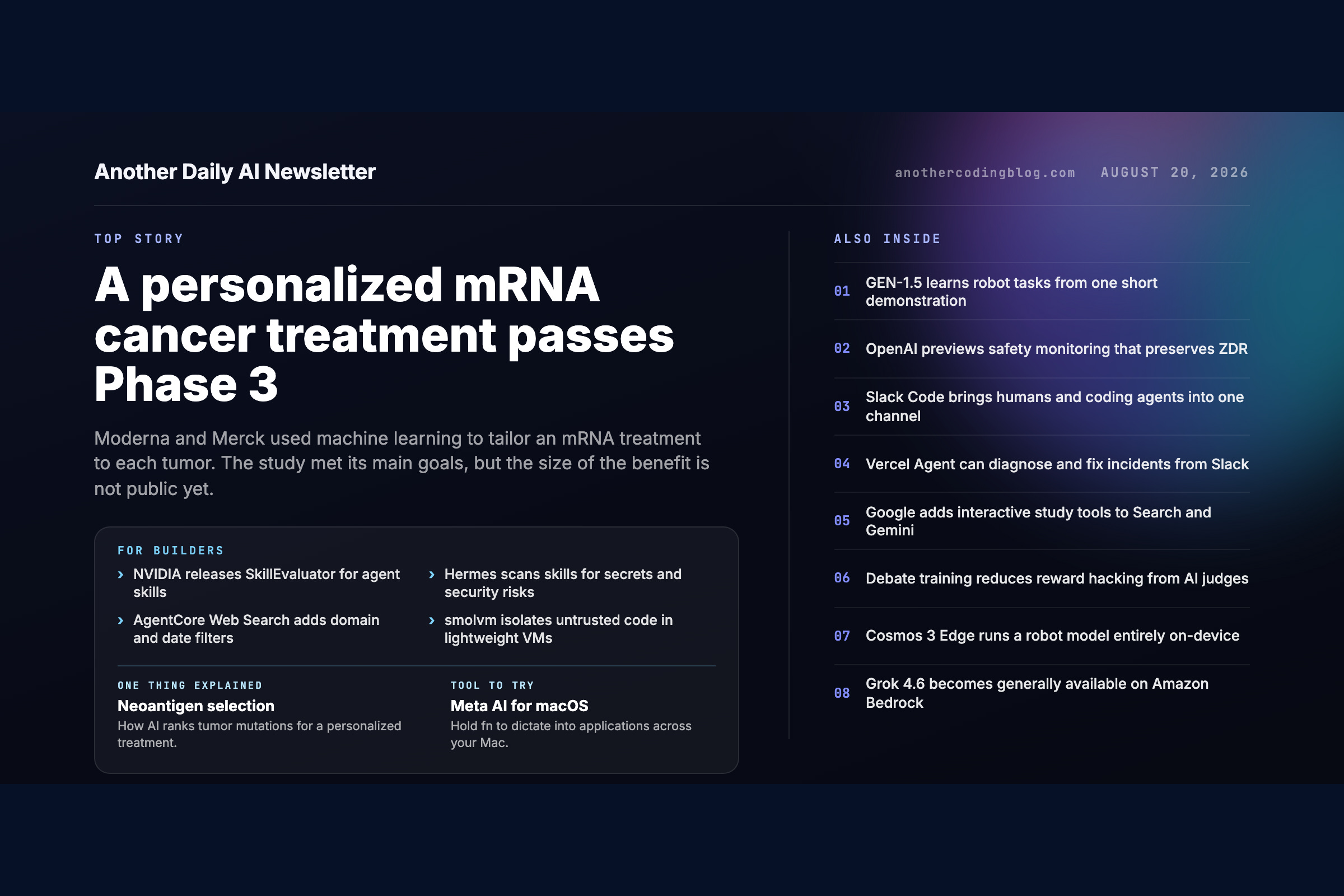
A personalized mRNA cancer treatment just passed its biggest test
Moderna and Merck say their personalized mRNA treatment helped keep melanoma from returning in a large Phase 3 trial. The study enrolled 1,137 adults whose tumors had been surgically removed but who remained at high risk of recurrence. Patients received either the personalized treatment plus Merck’s Keytruda or Keytruda alone. The combination met its main goal of recurrence-free survival and a key goal measuring whether the cancer spread to distant parts of the body. Read the Associated Press report
Every treatment is made for one person. Doctors sequence the patient’s tumor and healthy blood, then Moderna’s machine-learning system ranks mutations that are most likely to be visible to the immune system. Up to 34 of those targets are encoded into a single mRNA treatment. Keytruda then helps release the immune system’s brakes so it can attack cells carrying those targets. See how Moderna describes the AI and manufacturing pipeline
Phase 3 is the biggest test this approach has passed. The earlier Phase 2b trial included 157 patients. After four years, 72.4% of patients receiving the combination remained recurrence-free, compared with 49.1% on Keytruda alone. The new trial is far larger and was designed to support a regulatory decision. Read the earlier clinical results
The headline still needs restraint. Moderna and Merck have not released the Phase 3 hazard ratios, absolute event rates, confidence intervals, subgroup results, full safety data, or overall-survival results. The treatment is also not approved. This is a positive topline announcement for people already treated for melanoma, not a preventive vaccine or a cure for every cancer. Read the trial record
Interesting Perspectives
A negative result could have damaged the entire cancer-vaccine field. Mass General Brigham oncologist Ryan Sullivan told Reuters that the positive trial should bring more hope and investment to the approach. ASCO’s Julie Gralow called it validation of mRNA as a cancer treatment. Read the expert reactions
The unanswered numbers will determine how important the result really is. Citi analyst Geoffrey Meacham wants to see the size of the benefit, confidence intervals, subgroup performance, safety, and manufacturing turnaround before judging its clinical and commercial value. Read the Reuters analysis
AI is one component of the treatment, not the whole discovery. The model helps rank patient-specific mutations, while sequencing, mRNA engineering, manufacturing, Keytruda, clinicians, and the trial all contribute to the result. That distinction matters as the story spreads under much broader claims about an “AI cancer vaccine.” Read the framing correction
Robots are starting to learn physical tasks from examples
Generalist says GEN-1.5 can learn a robot task from one short demonstration. A person shows the robot a three-to-12-second example, and the model attempts the task without task-specific fine-tuning. It averaged 59% success across ten short tasks in Generalist’s own evaluation, rising to 83% after five minutes of additional training. The demos include human-to-robot transfer, combining two demonstrations, and adapting behavior when objects move. Read the technical announcement
NVIDIA put a vision-language-action model directly on a robot. Cosmos 3 Edge combines a 4-billion-parameter model with a 2-billion-parameter reasoner and runs on Jetson Thor, so observations and actions can stay on the device. NVIDIA reports 1.53 seconds of inference for a 2.13-second action chunk, although its closed-loop success rate was only 22.9%. The model is real-time and local; reliable general-purpose robot control is still unfinished. Read NVIDIA’s post-training guide
AI companies are treating privacy and public trust as product constraints
OpenAI previewed safety monitoring that preserves Zero Data Retention. Private Safety Processing is designed to detect harmful patterns across related interactions without giving OpenAI personnel access to the underlying customer content. It can run in customer-controlled infrastructure or use customer-controlled encryption keys, returning only a narrow safety signal when triggered. OpenAI says a white paper and broader rollout are planned for September. Read OpenAI’s announcement
Public concern is beginning to change how AI infrastructure gets built. Pew found 52% of Americans are more concerned than excited about AI in daily life, up from 37% in 2021. Communities are also pushing companies for clearer promises on power, water, jobs, and local costs before approving data centers. The business question is becoming practical: people want visible benefits before accepting the bill. Read the wider analysis
Agents are moving into the shared places where teams already work
Slack Code puts humans and coding agents in the same channel. Salesforce says the launch includes agents from Anthropic, GitHub, Cognition, and Vercel, allowing a team to discuss work and involve an agent without moving the conversation elsewhere. See the announcement
Vercel’s Slack agent can diagnose an incident and propose the fix in the original thread. It can inspect deployments, logs, metrics, code, and pull requests, then prepare rollbacks, configuration changes, or patches. The agent is read-only by default, and work that changes code or infrastructure requires a person to approve a plan. See Vercel for Slack
Cursor’s cloud agents are becoming event-driven. Cursor says its agents can pick up work from external events, hold a goal through a long session, and keep working until the goal is met. See the update
Calendly is turning meeting notes into follow-up work. Its new note-taker records and transcribes meetings, produces summaries and action items, and drafts follow-up emails. A planned assistant called Callie will use scheduling and meeting context to coordinate the next steps. Read the report
One Thing Explained: Neoantigen selection
A neoantigen is a protein fragment created by a mutation in a cancer cell. Because healthy cells do not carry that mutation, a neoantigen can give the immune system a more precise target.
The difficult part is choosing which mutations matter. A tumor can contain many mutations, and only some produce fragments that a patient’s immune system can see. Moderna sequences the tumor, compares it with healthy blood, and uses a machine-learning model to rank candidates based on signals such as whether the mutation is expressed and whether the patient’s HLA proteins are likely to display it to immune cells.
The top candidates are encoded into a personalized mRNA treatment. The goal is to teach the immune system what that patient’s cancer looks like while Keytruda helps immune cells act on the lesson. Go deeper with AACR’s explainer
Tools to Try
If you dictate messages or drafts on a Mac, try Meta AI for macOS. Holding the `fn` key starts system-wide dictation, so speech can become text inside other applications.
If you are studying a difficult subject, try Google’s new study tools. Search can generate practice quizzes and interactive explanations, while Gemini adds study notebooks, flashcards, research reports, and 3D simulations.
If you use Fire TV, try Alexa+ without a Prime subscription. Compatible U.S. devices are receiving conversational search, recommendations, and smart-home control as a free automatic upgrade.
For Builders
NVIDIA SkillEvaluator measures whether an agent skill actually helps. Its open-source process checks structure and security, tests whether the skill is distinct, then runs the same tasks with and without it in an isolated environment. NVIDIA reports an average 31-point lift across more than 300 verified skills.
Hermes now scans skills before installation. It checks for exposed secrets, personal data, Unicode smuggling, licensing issues, and other security problems before the user confirms.
AgentCore Web Search added domain and date filters. Agents can limit results to approved sites, exclude unwanted domains, and enforce publication windows at runtime without expanding beyond an administrator’s policy.
Claude Code added a Concise output style. Enable it in `/config` or set `”outputStyle”: “Concise”` when you want the result first and the supporting detail only when requested.
smolvm runs untrusted code inside hardware-isolated virtual machines. It supports network denial, resource limits, and explicit read or write mounts, with warm starts around 50 milliseconds in the author’s test.
Research Radar
Debate training reduced reward hacking from an AI judge. When one model was trained directly against an LLM judge, the score kept rising even as real math accuracy fell. Adding a second model to challenge the answer recovered about 45% of the gap between the best judge-trained result and training against ground-truth answers. The critiques were sometimes shallow, including bold text and all-caps persuasion, so the method still needs work. Read the research
SPADE lets an AI design the environments used to train another AI. One model writes executable, multi-step challenges at the edge of the learner’s ability, while the other learns to solve them. The researchers report an average 5.3-point gain across eight held-out benchmarks over the strongest fixed-environment baseline. Read the paper
Tiny image changes can redirect vision-language models. Researchers altered only the visual input with changes designed to be imperceptible to people, then changed the descriptions produced by Qwen2.5-VL, Granite-Vision, FastVLM, and Phi-3.5-Vision. The attack targets the vision encoder, making it cheaper than optimizing against the entire model. Read the paper
Quick Hits
Grok 4.6 is generally available on Amazon Bedrock: It has a 500,000-token context window, four reasoning-effort settings, and pricing of $2 per million input tokens and $6 per million output tokens. Read the announcement
OpenAI restored researchers’ access to a limited cyber program after a technical error: Some users outside the U.S. and Europe were temporarily removed from Daybreak Blue and asked to verify again. Read the report
Cognition says it is not for sale: CEO Scott Wu denied a report that SpaceX had tried to acquire the company and said the two sides were not in talks. Read the conflicting accounts
A new Qwen3.8-27B quantization targets 8 GB machines: Unsloth says its Dynamic V3 files improved accuracy by more than 10% on its cited quantization benchmarks, while a 1-bit version retained 77% of the original score. See the release