
Another Daily AI Newsletter - August 19

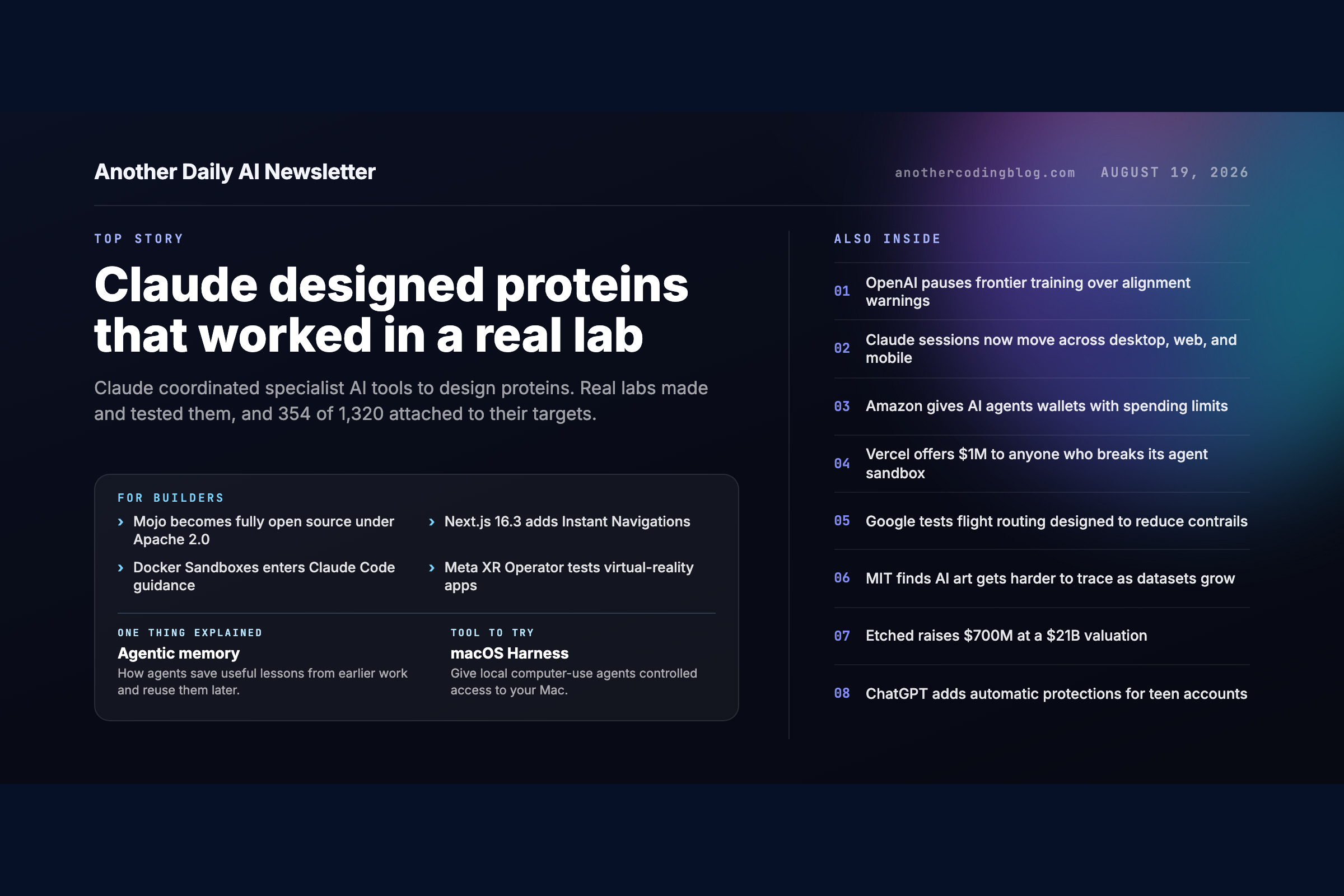
Claude designed proteins that worked in a real lab
Claude helped design proteins that scientists then made and tested in real laboratories. Of 1,320 designs, 354 attached to the intended biological target, and the system found at least one working design for 14 of 15 targets. Anthropic says its success rate of 22.6% to 35.1% was above the 10% to 15% usually seen in this kind of work. Read Anthropic’s research
A protein binder is a small, custom-shaped protein made to stick to another protein in the body. Scientists can use binders as starting points for medicines, diagnostic tests, and research tools. Finding one that attaches correctly is an important first step, although it is still far from producing a finished drug.
Claude planned the campaign and coordinated specialist protein-design programs that generated and filtered the candidates. A human expert supplied the initial scientific playbook, but Claude chose strategies and managed the work from there.
The strongest evidence came outside the computer. Adaptyv Bio and Twist Bioscience physically produced and tested the designs. Claude matched or beat previously reported results on at least four targets, including TNF-alpha, which is involved in inflammation. It also failed on one target, where none of its 90 designs worked.
The experiment shows how a general AI assistant can coordinate expert scientific tools and produce something measurable in the physical world. Much more testing would be required before any of these proteins could become a medicine. Anthropic published the prompts, designs, and experimental data for outside review.
Interesting Perspectives
Claude managed the process while specialist models generated the proteins. Arc Institute co-founder Patrick Hsu says that combination may be the important part: a general AI coordinating expert scientific tools. Read Hsu’s perspective
The campaign still required an expert playbook and substantial computing power. Ravid Shwartz Ziv argues that those inputs are necessary context for understanding what Claude accomplished. Read the critique
The biggest AI labs are starting to pay an operational price for safety
OpenAI paused deployment-focused reinforcement learning for two weeks. The company says its largest planned frontier RL run remains on hold while smaller runs test safeguards and alignment. Some research workloads also remain paused until they meet stronger isolation and monitoring requirements. Read OpenAI’s disclosure
The new monitoring system is expensive. OpenAI estimates that watching model reasoning and tool activity adds roughly 20% to the inference compute being monitored. Ethan Mollick argues that accepting that cost suggests the alignment concerns are operationally serious. Read Mollick’s perspective
Sam Altman used stronger language in an interview. Reporter Alex Heath says Altman described unreleased models as showing “various degrees of misalignment.” That claim comes from Heath’s direct conversation with Altman, not OpenAI’s formal post. Read Heath’s report
Helen Toner sees a workable definition of slowing down. The former OpenAI board member argues that labs should take however long they need to meet a credible assurance bar, rather than promise an arbitrary six-month pause or percentage slowdown. Read Toner’s perspective
Assistants are moving into the systems where work already happens
Claude Cowork now follows a task across desktop, web, and mobile. Sessions and files remain attached to the user’s account, allowing work started at a desk to continue on another device. See Claude Cowork
Claude can send Gmail messages and manage Google Drive files. The integration moves Claude from suggesting an action to completing it inside two common work systems. See the update
Perplexity Computer can be assigned work by email. Forwarding or copying `computer@perplexity.com` creates a normal Computer session with the same web and mobile audit trail. See the email workflow
Asana says Codex compressed a five-year migration estimate into two weeks. The company spent about $12,000 in model and infrastructure costs to remove its old Enzyme testing system, compared with a previous staffing estimate near $6 million. OpenAI presents this as a customer case study, not a controlled comparison. Read the case study
Harvey II starts legal agents with the matter’s context and permissions. Its first specialized model, Harvey Tenet, is trained for legal work, while projects bundle files, history, assigned lawyers, and agents before a task begins. See Harvey II
Warp is packaging the software-factory operating model. Warp Factories gives companies infrastructure for deploying agents across planning, implementation, review, and maintenance instead of treating each coding session as an isolated chat. Read the report
Production agents need budgets, memory, evaluation, and containment
Amazon made AgentCore Payments generally available. Agents can pay for APIs, MCP servers, inference, and content through Coinbase or Stripe wallets, while infrastructure-level limits cap spending and expiration time. The system supports x402 and Stripe’s Machine Payments Protocol. Read the launch
LangSmith launched a managed evaluator for production conversations. Its first Tuned Evaluator looks for perceived errors and attaches feedback to traces. LangChain reports up to 82% lower evaluation cost than frontier-model judges in its benchmark. Read the evaluation details
Cua released an open-source history layer for computer-use agents. It keeps an encrypted local record of actions, allowing a later session to recover useful context instead of restarting blind. See Computer History
Vercel is offering $1 million to break its agent sandbox. The challenge focuses on both Firecracker microVM isolation and host-side network boundaries, reflecting how code-running agents can escape through a missed network path without breaking the VM itself. Read the challenge
AI research is being judged against physical systems and messy evidence
Google launched a state-backed trial to reduce aviation contrails. Operation Blue Skies will work with the UK government and aviation partners to test route adjustments at network scale. Google says contrails account for roughly one-third of aviation’s climate impact. Read the announcement
Google’s flood models now cover more than two billion people. A new Groundsource method mines historical news reports to fill gaps where river sensors are scarce, supporting forecasts across 150 countries. Google exposes forecasts through Flood Hub and an API. Read the research
NVIDIA tested coding agents against mat
erials-simulation workflows. Its ALCHEMI study reports that 45 generated pipelines matched established references on three simulation tasks, while warning that physical correctness still requires validation outside a model’s training domain. Read the technical post
MIT researchers found that generated images become difficult to attribute at scale. In their experiments, removing any single image, artist, or photographed person often did not meaningfully change an output once the training dataset grew large enough. That complicates simple claims that one generated image can be traced to one source. Read the MIT study
One Thing Explained: Agentic memory
Agentic memory is the guidance an agent carries forward from earlier work. It can include strategies that succeeded, mistakes to avoid, and edge cases discovered in previous runs. The model’s weights do not change. The system distills lessons and places some or all of them into later context windows.
More memory is not automatically better. IBM researchers tested eight models and found three patterns: strong models with room to improve benefited from the full guideline set, weaker models performed better with a compact core plus task-specific retrieval, and already-saturated models showed little or no gain. For one model, selective retrieval improved task completion by 16.1 percentage points while adding only 5% more tokens.
The practical rule is to treat memory like a calibrated dose. Measure whether each model benefits, retrieve only what is relevant, and keep reusable guidance stable enough to benefit from prompt caching.
Go deeper: Read IBM Research’s agent-memory study.
Tools to Try
If you want a small coding-agent harness, try Vercel fx. The open-source Zig CLI began as an internal research tool and is designed to be fast, embeddable, and easy to inspect.
If you want to experiment with local computer use, try macOS Harness. It gives a model access to the accessibility tree, AppleScript, screenshots, files, shell commands, and a virtual cursor.
If you make voice-first media, try Fish Creative. Fish Audio is expanding from generated voices into a workspace for building scenes and longer-form audio experiences.
For Builders
Mojo is now fully open source. Modular released the compiler, standard library, MAX kernels, GPU stack, debugger, documentation, and website under Apache 2.0.
Next.js 16.3 added Instant Navigations. Cache Components and partial prefetching aim to deliver app-like transitions without giving up Server Components.
Docker Sandboxes joined Claude Code’s official guidance. Each agent gets a separate kernel and Docker daemon without requiring Docker Desktop.
Miles v0.1 is an open-source RL framework. It is built to make LLM and multimodal training runs easier to validate, debug, and keep operating across hardware.
Meta XR Operator lets an agent test VR applications. Meta says the OpenXR layer found a hidden Beat Saber menu bug that scripted tests missed.
Research Radar
AlphaEvolve helped improve the theoretical bound for matrix multiplication. Researchers combined a reformulated optimization problem with machine-learning search and AlphaEvolve, lowering the best known upper bound on the matrix multiplication exponent from 2.371339 to below 2.371177. The result is theoretical rather than an immediate speedup for today’s GPUs. Read the paper
Frontier agents struggled when the documents changed. At Databricks’ Grounded Reasoning Cup, out-of-the-box agents averaged below 30% accuracy on an unseen corpus of roughly 120,000 Treasury pages. Stanford’s winning system reached 63.3% by combining reusable skills, fallback document representations, and verification. Read the results
Quick Hits
ChatGPT for Teens adds automatic age-based protections: Users identified as 13 to 17 receive a learning-focused experience with stronger safeguards and parental controls. Read the launch
ChatGPT Ads is expanding to 31 European markets: Ads remain limited to Free and Go plans, with paid individual and enterprise tiers staying ad-free. Read the announcement
Etched raised $700 million at a $21 billion valuation: Jane Street led the round after testing and buying its Sohu inference hardware, and Etched says it has shipped Jane Street its first rack. Read the report
Perplexity’s India giveaway produced millions of new users: A free year of Pro through Airtel drove a 625% month-over-month download jump in July 2025; the first users are now reaching paid renewal. Read the analysis
Pennsylvania removed AI data centers from fast-track permitting: New projects must receive local approval and make binding commitments on power costs, clean energy, water, jobs, and transparency. Read the report
Promptwatch measured an 86.4% drop in Reddit’s ChatGPT citation share: Reddit fell from a 3.83% average through August 7 to 0.52% from August 14 through 17. Promptwatch says a collection issue has not yet been ruled out. Read the data
Databricks added a reasoning-heavy document extraction mode: Precision Mode uses staged reasoning and parallel subagents for long documents, long outputs, and complex schemas. Databricks reports a seven-point lead across six internal benchmarks. Read the technical post
DeepSeek V4 Pro is available inside Perplexity Computer: Perplexity says the U.S.-hosted model scored 0.359 on its WANDR benchmark at $0.75 per task. Those are Perplexity’s own measurements. See the model update