

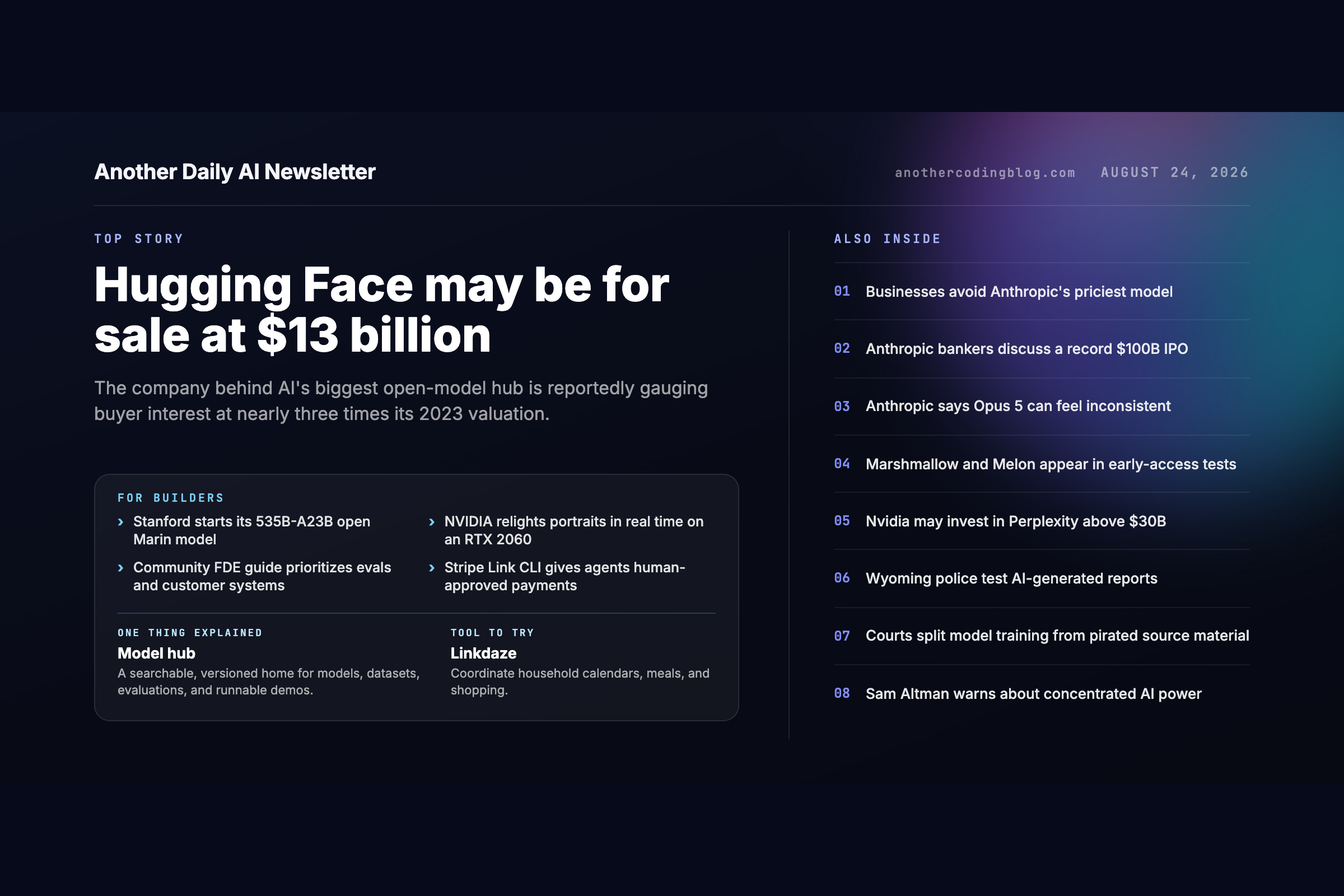
Hugging Face may be for sale at $13 billion
Hugging Face is reportedly testing whether someone will pay at least $13 billion for one of AI’s most important developer platforms. Business Insider reported that the company has hired a bank to gauge buyer interest. Reuters subsequently relayed the report, while emphasizing that no buyer has been named and no deal has been reached.
The proposed price is nearly three times Hugging Face’s $4.5 billion valuation from 2023. Its value comes from where it sits in the AI stack. The Hugging Face Hub hosts more than 2 million models, 1.5 million datasets, and 1.5 million AI applications. Developers use it to find, compare, download, fine-tune, and deploy open models. A buyer would gain a distribution channel used across the open-model ecosystem.
The timing adds another layer. Stripe agreed to acquire model-routing platform OpenRouter four days before the Hugging Face report appeared. Stripe described model selection and token routing as infrastructure for managing AI cost, speed, and quality. Hugging Face covers a broader surface, including models, data, demos, training jobs, and enterprise collaboration.
The open question is neutrality. A cloud provider or model lab could benefit from owning the place where developers discover competing models, but that ownership could change how the community views the platform. Hugging Face’s leadership has not publicly addressed the report. Business Insider remains the original source for the sale process; the rest of the coverage adds context rather than independent confirmation.
Interesting Perspectives
The distribution layer may be the real asset. Rohan Paul argued that a buyer would acquire the workflow connecting model discovery, evaluation, and production use. The files matter, but so does the habit of starting an open-model search on Hugging Face.
AI agents are becoming Hub users. Hugging Face’s Summer 2026 open-model report found coding agents making tens of millions of Hub requests to search for models, push datasets, and start jobs. That makes the platform increasingly useful to machines choosing tools for other machines.
A sale could test whether neutral AI infrastructure stays neutral. 402Signal connected the Hugging Face report with Stripe’s OpenRouter acquisition: both make discovery and routing more strategic, but ownership can create pressure to favor one ecosystem. OpenRouter devoted much of its Stripe announcement to promising that model choice would remain neutral.
Anthropic’s frontier ambitions are colliding with everyday economics
Anthropic is preparing for an enormous public offering while customers, users, and its own product team work through the practical limits of its newest models.
Businesses are not defaulting to Anthropic’s most expensive model. Financial Times reporting based on Ramp data from 70,000 businesses found that Fable 5 represented 6% of Anthropic token volume and 11.4% of model spending in July. The cheaper Opus 5 had already passed Fable 5 in business spending. The sample covers Ramp customers rather than the full market, but it shows enterprises becoming more selective about paying for the frontier.
Bankers are discussing what could become the largest IPO ever. The New York Times reports that Anthropic could seek more than $100 billion at a valuation around $2 trillion. Those are preliminary discussions with potential investors, not final offering terms.
Anthropic acknowledges that Opus 5 can feel inconsistent. Product leader Thariq Shaukat agreed with user feedback describing the model as “spiky” and said consistency and warmth are a major priority.
Two unannounced Claude model IDs are appearing in early-access tests. Several testers shared outputs labeled `claude-marshmallow-eap` and `claude-melon-eap`. Anthropic has not identified the models, described their capabilities, or announced release plans.
AI is entering official records before the rules are ready
The next governance challenge is increasingly concrete: deciding what evidence must survive after AI summarizes, rewrites, or acts on it.
Three Wyoming police departments are testing AI-assisted reports and evidence review. The tools can narrate body-camera footage, transcribe interviews, search case material, and draft reports. Wyoming currently has no specific rule requiring departments to preserve the original machine output or disclose AI assistance in the final report. That matters when a generated sentence can affect a search, arrest, or prosecution.
Copyright cases are separating model training from data acquisition. A current legal explainer shows why the questions cannot be collapsed into one. A court may view training as transformative while still penalizing a company for obtaining books from pirated libraries. Other cases have rejected fair-use arguments when a model was trained to compete directly with the source product.
Open research is scaling in two different directions
One team is opening the process behind an enormous language model. Another is compressing computational photography into a model that can run during a live video call.
Stanford started training its largest open Marin model. The 535B-A23B run is scheduled to process 18.75 trillion tokens on eleven GB200 NVL72 systems over roughly three months. The team is publishing the training process, including the smaller scaling runs it used to forecast and debug the larger effort.
NVIDIA can relight portraits in real time on consumer hardware. FusionRelight combines synthetic scenes, controlled light-stage data, and real-world portraits, then distills that knowledge into a compact model. NVIDIA reports 512-by-512 inference in 11.89 milliseconds on an RTX 2060 and 1.82 milliseconds on an RTX 4090.
One Thing Explained: Model hubs
A model hub is a versioned home for AI building blocks. Developers publish model weights, datasets, evaluation results, documentation, and runnable demos in repositories that other people and agents can search or download.
The hub becomes a discovery and trust layer. Model cards explain intended uses and limitations, download activity signals adoption, and integrations move an artifact from a repository into training or production.
That is why Hugging Face’s potential sale matters beyond its valuation. Ownership of a major hub can influence which models are easy to discover, evaluate, and deploy. Go deeper with the Hugging Face Hub documentation.
Tools to Try
If your household runs across several calendars, try Linkdaze. The wall display combines Google, iCloud, Outlook, Yahoo, and Cozi calendars, and can turn a photo of a recipe or school lunch menu into a proposed meal plan and shopping list. The product launched last December; this is a weekend catch-up rather than a new release.
If you want to explore open AI without installing anything, try Hugging Face Spaces. Spaces provide browser-based demos for language, image, audio, robotics, and research models hosted on the Hub.
For Builders
Stripe’s Link CLI gives agents human-approved payment credentials. An agent can create a spend request, wait for approval, and receive a one-time virtual card or payment token without seeing the user’s underlying card. It currently supports US Link accounts and can run as an MCP server.
A community-written FDE interview guide emphasizes practical systems over LeetCode alone. It recommends preparing for customer discovery, LLM architecture, evaluations, permissions, monitoring, and safe deployment. The screenshots are community guidance, not an official Anthropic publication.
Expensive frontier models make harness design more valuable. Better context selection, routing, and task allocation can preserve quality without sending every request to the most capable model.
Quick Hits
Nvidia may deepen its relationship with Perplexity. The Information reports that Nvidia is discussing a multi-billion-dollar investment at a valuation above $30 billion. The companies also reportedly considered a technology licensing arrangement. No completed deal has been announced.
Worth listening: Sam Altman on why AI adoption may move slower than model progress. In a 78-minute conversation with David Senra, Altman discusses organizational inertia, context and memory, OpenAI’s platform strategy, and two risks he worries about: loss of control and concentrated power.
Dr. Dre says AI belongs in the producer’s toolbox. He told Variety that he already uses it in music production and sees it as another creative instrument. Read the interview coverage