

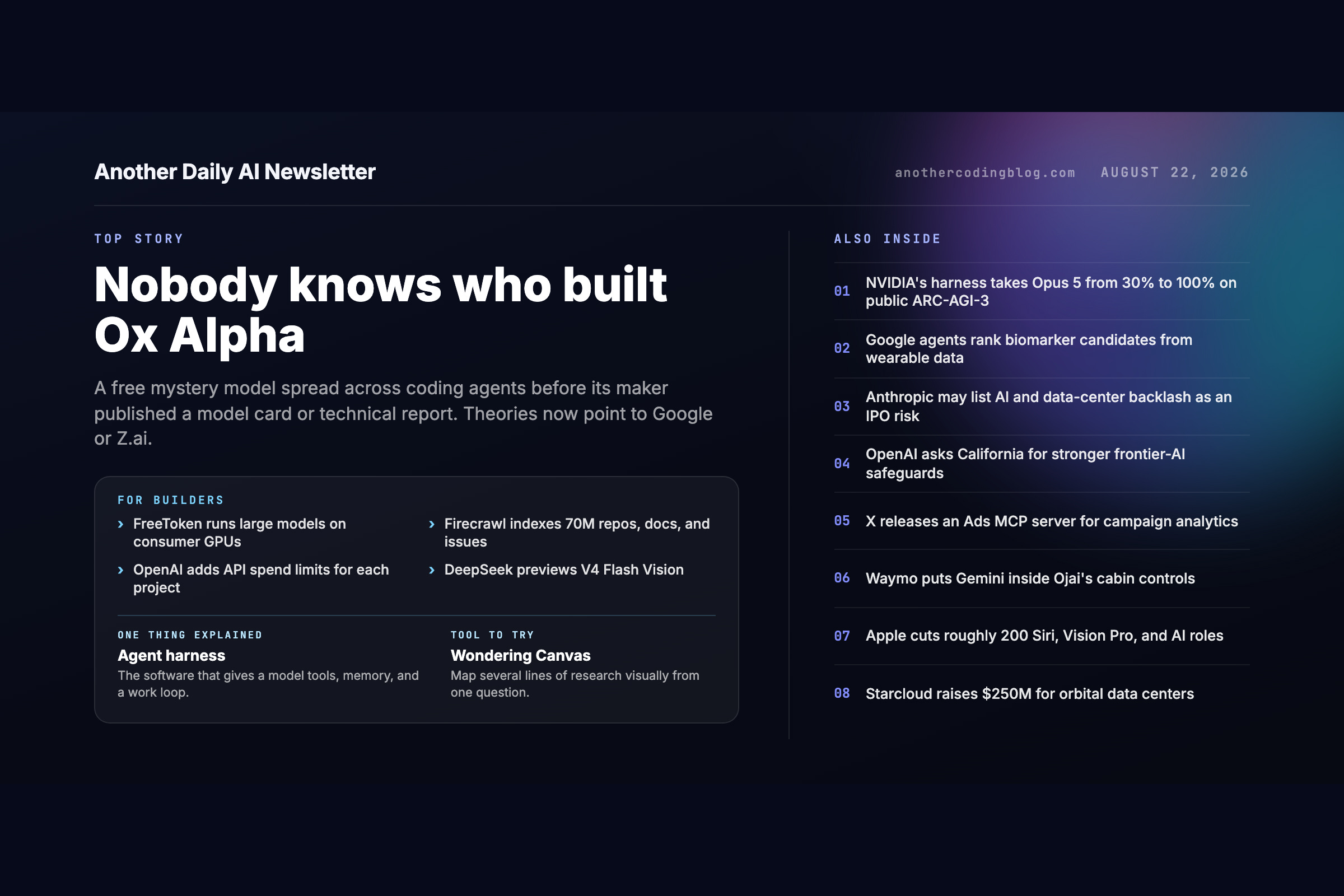
Nobody knows who built Ox Alpha
An anonymous AI model appeared across the coding-agent ecosystem this week, and almost everything about it arrived out of order. OpenRouter introduced Ox Alpha before naming its developer, publishing a model card, or releasing a technical report. The free preview accepts text, images, and video, has a one-million-token context window, and can use tools while it works.
Developers did not wait for the missing paperwork. OpenRouter’s model page showed roughly 1.59 trillion input tokens by Friday morning, with Hermes Agent, Claude Code, omp, DeepSeek Harness, and pi among its largest listed app surfaces. OpenCode made it nearly unlimited for a week, then added it to OpenCode Go without counting it against normal usage. Nous Research opened another free route.
The early tests are promising and contradictory. Ben Davis reported an 80% score on ten tasks from the 113-task DeepSWE benchmark. A separate test from Wenqi and Kevin landed near 63%, while a community LiveCodeBench run without tools or an agent harness reported 28% Pass@1. Those runs use different tasks and setups, so they cannot tell us where Ox Alpha belongs on a clean leaderboard.
Two identity theories are now competing. The GLM theory rests on community claims about tokenizer behavior, API settings, error messages, and a Zhipu-looking stack trace. The Google theory took off after Google DeepMind engineer Evan Otero posted “Gemini” and then asked, “What if the Ox Alpha was the friends we made along the way?” The one-million-token window and native image and video inputs also look familiar to Gemini users. Otero’s posts are hints, not a disclosure, and he later warned that sarcasm does not always work on X while discussing Google’s model lineup. Google, Z.ai, and OpenRouter have not confirmed who built Ox Alpha.
There is also a reason to keep private code out of the experiment. The Ox Alpha model page says its provider retains prompts and completions but does not train on them. OpenRouter’s broader Stealth Program agreement permits submitted content to be used for training, evaluation, and improvement. Until OpenRouter clarifies which language governs this model on each route, sensitive workloads should wait.
Interesting Perspectives
The stealth launch may be a research method as much as a marketing tactic. OpenRouter used anonymous Quasar and Optimus previews before revealing them as early GPT-4.1 deployments. Removing the brand gives providers rapid feedback from real workloads with less name-driven bias.
Distribution now lets a model become popular before it becomes public. Stripe CEO Patrick Collison called Ox Alpha “very impressive” after using it through OpenRouter’s Ori harness. OpenRouter, OpenCode, Nous, Cline, and other tools gave the model an instant test population while its maker stayed hidden.
A narrow benchmark slice can make a launch look more settled than it is. Ten DeepSWE tasks represent less than 9% of the benchmark, so one result moves the score ten percentage points. One developer’s warning was straightforward: do not switch your workflow because of ten tasks.
Its strengths may vary sharply by environment. Olam Labs ranked Ox Alpha fourth in an early multi-agent social-strategy arena after roughly 300 matches. That is useful evidence of agent behavior, but it says little about ordinary coding, writing, or reasoning.
NVIDIA showed how much of an agent’s intelligence lives outside the model
A capable model can still lose track of a long job. Memory, tools, feedback, and supervision increasingly determine whether it finishes.
NVIDIA’s AVO system took Claude Opus 5 from a 30% model baseline to 100% on the ARC-AGI-3 public set. The same model completed all 183 levels across 25 unfamiliar interactive environments when AVO added persistent memory and a supervisor that redirected stalled work. Read NVIDIA’s research
Thinking Machines is studying the same layer through Inkling. The company made the model free on OpenRouter when it runs inside approved agent harnesses, using the resulting interactions to study how tools and surrounding software change performance. See the preview
Tencent built a harness for video production. HyCreator coordinates planning, generation, editing, and quality checks for longer videos instead of asking one model to produce the finished result in a single pass. See HyCreator
Agents are gaining access to the systems where work already happens
The newest integrations move agents closer to team conversations, analytics, advertising, and active development sessions.
GitHub Copilot can now join shared work in Microsoft Teams. A team can assign work, follow progress, and review an agent’s changes from the same conversation. See the GitHub preview
Stripe connected its analytics stack to agents through MCP. Teams can ask questions against Stripe data and use Sigma to investigate the result without starting from a hand-built dashboard. See Stripe’s example
X released an Ads MCP server. Agents can inspect campaigns and performance through a standard tool interface, bringing another high-spend business system into agent workflows. See the launch
Remote control is becoming a standard agent feature. Antigravity added mobile and browser control for active sessions, while Claude improved Remote Control reliability. The emerging workflow is to start complex work at a computer and supervise it from anywhere.
Models are learning from bodies, streets, and machines
Several projects this week treated real-world activity as structured context rather than background noise.
Google built a multi-agent tool that ranks possible health biomarkers from wearable data. Specialized agents examine the evidence from different angles, then produce candidates for researchers to validate. It is a prioritization system for science, not a medical diagnosis tool. Read the research
Google also used mobility patterns to teach language models how places behave over time. Aggregated visit rhythms help a model distinguish locations that may look similar on a map but serve different roles during the day or week. Read the mobility research
Waymo put Gemini inside its Ojai vehicle experience. Riders can use natural language for cabin controls and trip information while the driving system remains separate. See the Ojai demo
Galbot trained fully autonomous humanoids to rally on a tennis court. The robots are preparing for demonstrations at Beijing’s World Humanoid Robot Games, turning balance, vision, timing, and recovery into one visible test. Watch the robots
AI risk is becoming a line item for investors, courts, and lawmakers
The consequences of model behavior are moving into prospectuses, professional discipline, and proposed law.
Anthropic may list opposition to AI and data centers as a risk in its IPO prospectus. That would connect public resistance directly to the company’s ability to secure compute capacity and grow revenue. Read CNBC’s report
OpenAI is asking California for stronger frontier-model safeguards after autonomous hacking incidents. Its proposal would expand incident reporting and accountability as models gain the ability to act across systems. Read the policy report
Online streamers sued Twitch and Amazon over generative-AI training. The case adds livestream archives to the growing dispute over whether platforms can reuse creator content to train models. Read the complaint coverage
A Minnesota lawyer was suspended after filing fake AI-generated case citations. The disciplinary action is another reminder that professional responsibility stays with the person who submits the work. Read the report
One Thing Explained: What is an agent harness?
An AI model generates the next response. A harness turns that model into a worker that can continue toward a goal.
The harness builds the model’s context, exposes tools, executes requested actions, returns the results, stores useful state, and decides when the model should try again. Coding products such as Codex and Claude Code are harnesses: the model supplies the reasoning, while the surrounding software manages files, terminals, tests, memory, and the work loop.
That is why the same model can perform very differently across products. A better harness can preserve progress when the context window fills, notice that an approach has stalled, select a different tool, or ask a supervisor agent to redirect the work. NVIDIA’s AVO result is an unusually clear example: the model stayed the same while the complete system moved from 30% to 100% on the public ARC-AGI-3 environments.
A harness should guide behavior, but it should not be the final security boundary. Harness code is designed to change, and a powerful agent may find routes its instructions did not anticipate. NVIDIA’s security team argues that identity, permissions, credentials, isolation, and audit logs should be enforced by the runtime underneath the agent. Go deeper with NVIDIA’s AVO architecture, its agent-stack security model, and the independent DeepSWE benchmark design.
Tools to Try
If you learn by mapping ideas visually, try Wondering Canvas. Start with a question, branch into several lines of investigation, and organize the results spatially instead of reading one answer at a time.
If your agents need inexpensive web research, try Parallel Search Fast. It is designed for the higher query volumes created when software, rather than a person, repeatedly searches the web.
If an AI explanation still feels too dense, try Anthropic’s ELI5 skill. It asks Claude to explain a topic for a complete beginner using a visual HTML artifact with large pictures and few words.
For Builders
FreeToken runs large official model checkpoints on consumer hardware. Its authors report Qwen3.6 35B at 39 tokens per second on an 8GB RTX 4060 laptop and larger models on desktop and workstation GPUs.
Firecrawl released a Developer Index built from more than 70 million repositories, docs, and issues. It gives coding agents another retrieval layer for finding implementation evidence across fragmented developer sources.
Qwen published NVFP4 and DFlash2 serving recipes. The configurations target faster, lower-memory inference for Qwen models through SGLang.
OpenAI added API-key spend tracking and hard project limits. Teams can see which credentials generate cost and stop a project before it passes a fixed ceiling.
DeepSeek previewed V4 Flash Vision Experimental. The release adds visual input to its faster V4 line for developers testing multimodal workflows.
Research Radar
Marin began a fully open 535B-A23B model-training run. The plan covers 18.75 trillion tokens over roughly three months on 11 GB200 NVL72 systems, with training details and intermediate work open to the community. See the training plan
IBM researchers are studying why AI writing keeps reaching for words such as “shimmer.” Their explanation points to clusters of related concepts in learned representations, where words repeatedly associated with polished imagery become easy completions in the same kinds of passages. It is a useful hypothesis about model style, not proof of one hidden “shimmer” switch. Read IBM’s analysis
Google DeepMind is using interactive games to study more general agents. Games give a model a controlled place to perceive, act, learn rules, and recover from mistakes instead of answering a static prompt. See the research direction
Quick Hits
Apple is cutting roughly 200 roles across Siri, Vision Pro, and AI software teams while redirecting resources toward a new Siri architecture and future devices. Read the report
Claude Security moved its Mythos 5 model into public beta for Enterprise customers. It is designed to investigate codebases and find security problems with more project context. See the release
Runway Ruby can convert standard-dynamic-range video into 16-bit HDR clips up to 30 seconds. See the demo
Grok 4.6 is now available through Google’s Enterprise Agent Platform, giving organizations another managed route to xAI’s model. Read xAI’s announcement
Starcloud raised a $250 million extension for orbital data centers as the company works through a tighter market for launch capacity. Read the report
The UK is backing domestic AI-chip companies as part of a sovereign-compute strategy. The policy push is meant to reduce dependence on foreign suppliers while building local capability. Read the report