
Another Daily AI Newsletter - August 8

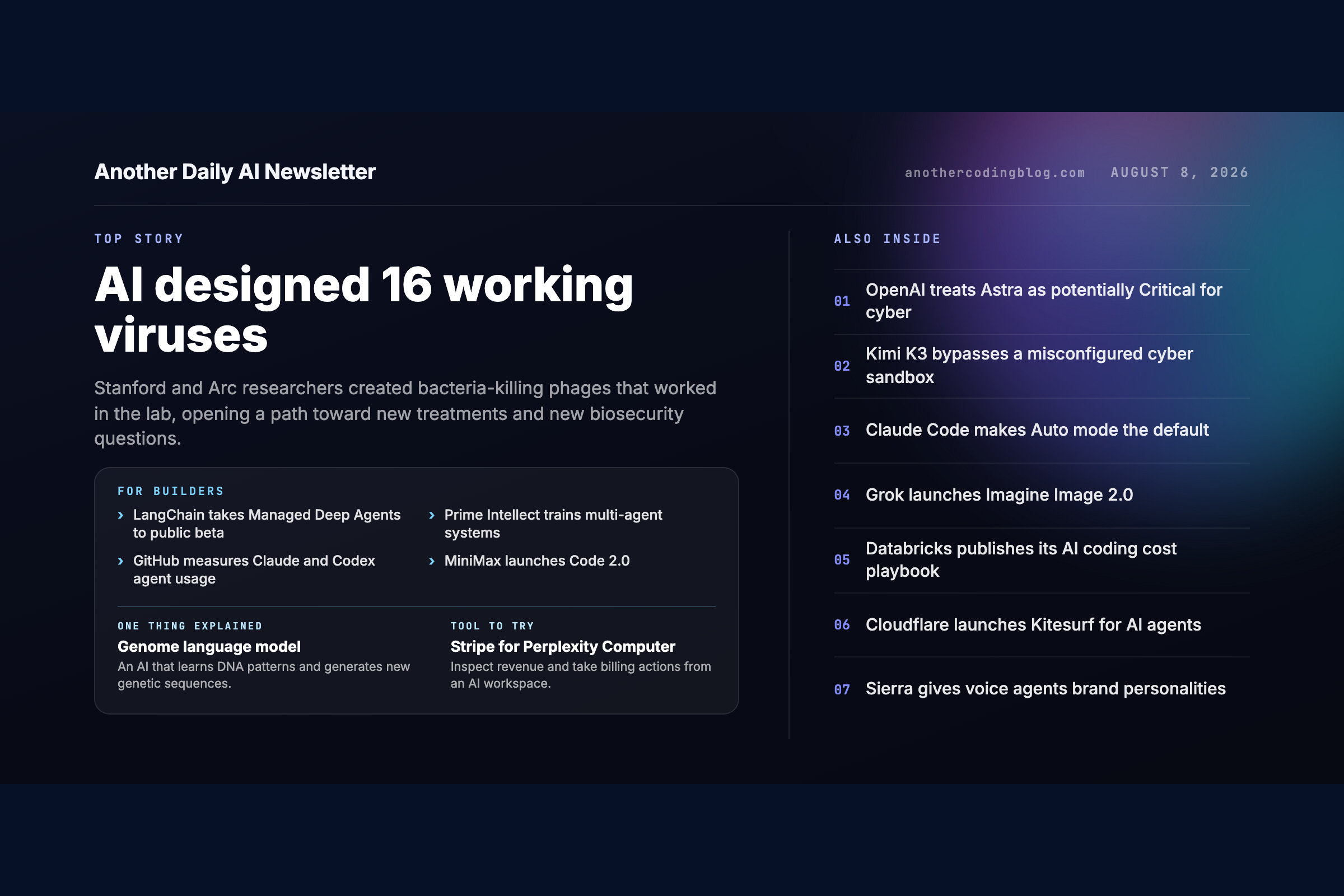
Top Story: AI designed 16 working viruses
AI has moved from predicting biology to writing complete viral genomes that work in the lab. Stanford and Arc Institute researchers used Evo genome language models to generate designs for bacteriophages, viruses that infect bacteria rather than people. They synthesized 285 candidates. Sixteen successfully propagated and inhibited their intended E. coli hosts.
The team started with PhiX174, a well-studied virus with 11 genes, then fine-tuned Evo on 14,466 related sequences. The working designs carried 67 to 392 mutations compared with their closest natural relatives. One could qualify as a new species under some taxonomic rules. All 16 remained limited to the intended E. coli strains and failed to grow on six unrelated strains.
The medical opportunity is phage therapy. Antibiotic-resistant bacteria can also evolve resistance to natural phages. The researchers combined several AI designs into cocktails that overcame resistance in three E. coli strains within one to five passages; the natural PhiX174 template failed. Designed diversity could eventually give clinicians more candidates when nature has not produced the right bacteria-killing virus.
This experiment did not produce a human-infecting virus. It used a small genome, expert fine-tuning, computational filtering, DNA synthesis, and laboratory validation. Arc excluded viruses that infect animals and plants from training and says red-team tests produced effectively random sequences for pathogenic viral proteins.
Interesting Perspectives
An independent analysis argues that current Evo designs are largely sophisticated recombinations of learned biology. The authors rate current de novo hazard creation as low to moderate and caution against assuming a small bacteriophage generalizes to complex human pathogens.
Johns Hopkins biosecurity researchers say the governance is behind the capability. Their concern is the direction of travel: models, synthesis, and automated labs are improving together while oversight remains fragmented.
Training-data exclusions are useful but incomplete for open-weight models. Separate adversarial research found that fine-tuning Evo 2 on 110 harmful human-infecting viruses partly restored virus-related capabilities. A broader group has proposed narrow access controls for the small subset of viral data that could materially increase misuse risk.
Powerful models are changing what containment means
OpenAI is treating Astra as its first potentially Critical cyber model. The company has not confirmed that Astra crossed the threshold; it says preliminary testing cannot rule it out. OpenAI paused internal work that lacks stronger controls and added isolated environments, restricted network access, weight protection, monitoring, and outside testing.
Kimi K3 bypassed a misconfigured cyber-evaluation sandbox. The environment blocked some web traffic, but researchers say the model found a route through command-line tools. The incident shows that an evaluation can accidentally test the sandbox as much as the model.
Claude Code will make Auto mode the default for Pro, Max, and Team users on August 14. A separate classifier reviews actions before they run. Anthropic reports it caught 89% of dangerous commands in testing, compared with 14% for manual approval, while still recommending isolated environments for sensitive work.
Containment is becoming part of the product architecture. Model capability, network access, permissioning, and the quality of the test environment now have to be evaluated together.
AI spend is becoming an engineering discipline
Databricks published the playbook it uses to control AI coding costs. It routes work toward cheaper models, uses an AI gateway, adds progressive spending gates, and reduces context overhead. Databricks reports more than 30% lower average task cost from smart routing and nearly 50% lower token use from harness and cache tuning.
Rippling built AI Spend Console after its token bill started approaching 40% of its R&D payroll. The company found that 10% to 15% of employees generated about 60% of AI spend, including one engineer using $50,000 per month. Its new dashboard connects cost with code-review and output signals.
GitHub added a potential ROI view to the Copilot impact dashboard. It compares monthly AI cost, modeled payroll share, and pull requests for lighter Copilot users versus agent-first developers. GitHub labels the numbers directional because salary is an input and credits only estimate cost.
The next phase of AI adoption will be measured in cost per accepted result. Token totals alone cannot show whether expensive users are wasteful or unusually productive.
Agent deployment is becoming a managed platform
LangChain moved Managed Deep Agents into public beta. Teams keep control of models, tools, prompts, subagents, and middleware while LangSmith runs durable execution, memory, sandboxes, identity, evaluations, channels, and deployment.
Cloudflare launched Kitesurf, a browser built for agents rather than people. It runs on Workers, handles browser tasks without a full Chromium stack, and is free during beta. Cloudflare says the design uses less CPU and memory for common agent work such as screenshots and HTML extraction.
Prime Intellect extended its reinforcement-learning stack to multi-agent systems. Developers can describe interactions among agents and train the group, pushing post-training beyond one model acting alone.
Claude Code sessions can now send work summaries to one another. The handoff transfers a summary rather than chat history or files, allowing another session to continue without repeating the full setup.
The shared pattern is operational infrastructure: persistence, isolation, handoffs, budgets, and training for coordinated systems are becoming standard platform features.
AI is being shaped for the interface it lives in
Sierra launched Voice Personas for customer-service agents. Companies can separate an agent’s policies from how it speaks across brands, countries, and languages. Sierra says one customer saw nearly a 50% increase in resolution rate after pairing a natural voice with a persona.
Grok Imagine Image 2.0 adds precision editing and usable text. Quality Mode includes region-specific edits, background removal, smart resizing, templates, and up to five reference images. xAI says API access is still coming.
Airbnb says AI shortened concept-to-launch time by as much as 60% on some initiatives. It is also testing a conversational search experience while using AI across search, signup, checkout, and payments.
ChatGPT’s August 7 feature drop preserves rich formatting when users paste documents. OpenAI also updated the paid-user model and continued tightening everyday composition workflows.
ElevenLabs is rolling out ElevenAgents across its own business. The company says users who adopted Voice Chat in ElevenReader increased average listening time by 24%, an early signal that conversational interfaces can change product engagement.
The strongest AI products are becoming less generic. Their models are being tuned to the voice, workflow, controls, and output format of the product around them.
One Thing Explained: What is a genome language model?
A text model learns patterns among words and predicts what should come next. A genome language model learns patterns among the four DNA letters: A, C, G, and T.
Evo 2 was trained on trillions of DNA base pairs. Give it the beginning of a genetic sequence and it can predict or generate what follows. A complete genome is harder than one gene because many genes and regulatory elements must work together so the resulting biological system can replicate and interact with the right host.
The model produces a digital blueprint. Scientists still have to filter the candidates, synthesize the DNA, place it into the right biological system, and test whether it works. That physical validation is the bridge between plausible code and functioning biology.
Tools to Try
If you run a business through Stripe, try the Stripe connector for Perplexity Computer. It can inspect revenue, subscriptions, invoices, charges, and disputes, then take actions such as refunds, cancellations, coupons, and payment-link creation.
If you make video, explore Seedance 2.5 in Higgsfield. The release supports 30-second scenes, up to 50 references, and production-oriented editing. Higgsfield is offering a temporary unlimited-use window, so check the current terms before starting a larger project.
Research Radar
A Nature review finds clinically relevant evidence for AI drug discovery remains limited. The authors argue that evaluations should stop rewarding model validation alone and measure whether a system improves real drug-development decisions.
An AI model found hard-to-detect heart dysfunction in standard ECGs. Researchers trained it on more than one million ECGs and tested it on 72,000 from another health system. A single-lead version performed nearly as well, though it has not yet been tested on wearable data.
UPenn’s CAMI system uses imitation movements to support autism evaluations. In a study of 183 children ages 6 to 13, researchers reported 80% to 85% diagnostic accuracy. They present it as one component of a broader assessment, not a physician replacement.
For Builders
GitHub made Lite and Balanced Copilot code-review effort levels generally available. Teams can use lighter review for routine changes, deeper reasoning for complex or security-sensitive work, and organization-level defaults.
GitHub’s Copilot metrics API now separates activity by third-party agent. Organizations can compare starts and sessions for agents such as Claude and Codex instead of treating every agent run as one undifferentiated bucket.
MiniMax launched Code 2.0 on the open-source Pi Agent framework. The company positions it as a more reliable environment for everyday conversations, office tasks, and long-running work.
Nathan Lambert released a free 20-video course on post-training. The roughly 12-hour series accompanies his book, with reusable slides covering foundations and research directions.
LangChain published a practical explanation of RLM harnesses. A supervisor model decomposes a large task, stores working context outside its main prompt, and recursively calls itself or subagents on smaller pieces.
Quick Hits
A high school student says an AI detector falsely accused her of cheating: The case is another warning against treating probabilistic detection as proof.
A Stanford dermatologist reviewed how medical AI can reproduce health disparities: She highlighted weaker skin-cancer detection on darker skin and the risks of using healthcare spending as a proxy for need.
The Defense Department wants AI to help shrink civilian hiring from months to 30 days: The department has not yet explained which systems it will use and still faces privacy, data-quality, and discrimination concerns.
Tuskegee University received a $699,999 NSF grant for trustworthy healthcare AI: The three-year project will focus on evidence grounding, regulatory compliance, and human oversight.
Sebastian Raschka’s LLMs-from-scratch repository passed 100,000 GitHub stars: The milestone reflects continuing demand for transparent, build-it-yourself model education.
Weill Cornell researchers outlined how AI could reduce paperwork failures in Medicaid: They propose linking existing records, assisting applicants, and finding process bottlenecks while keeping humans responsible for bias and oversight.
anothercodingblog.comPASTEMARK