
Another Daily AI Newsletter - August 10
Meta's open AI comeback starts on your computer

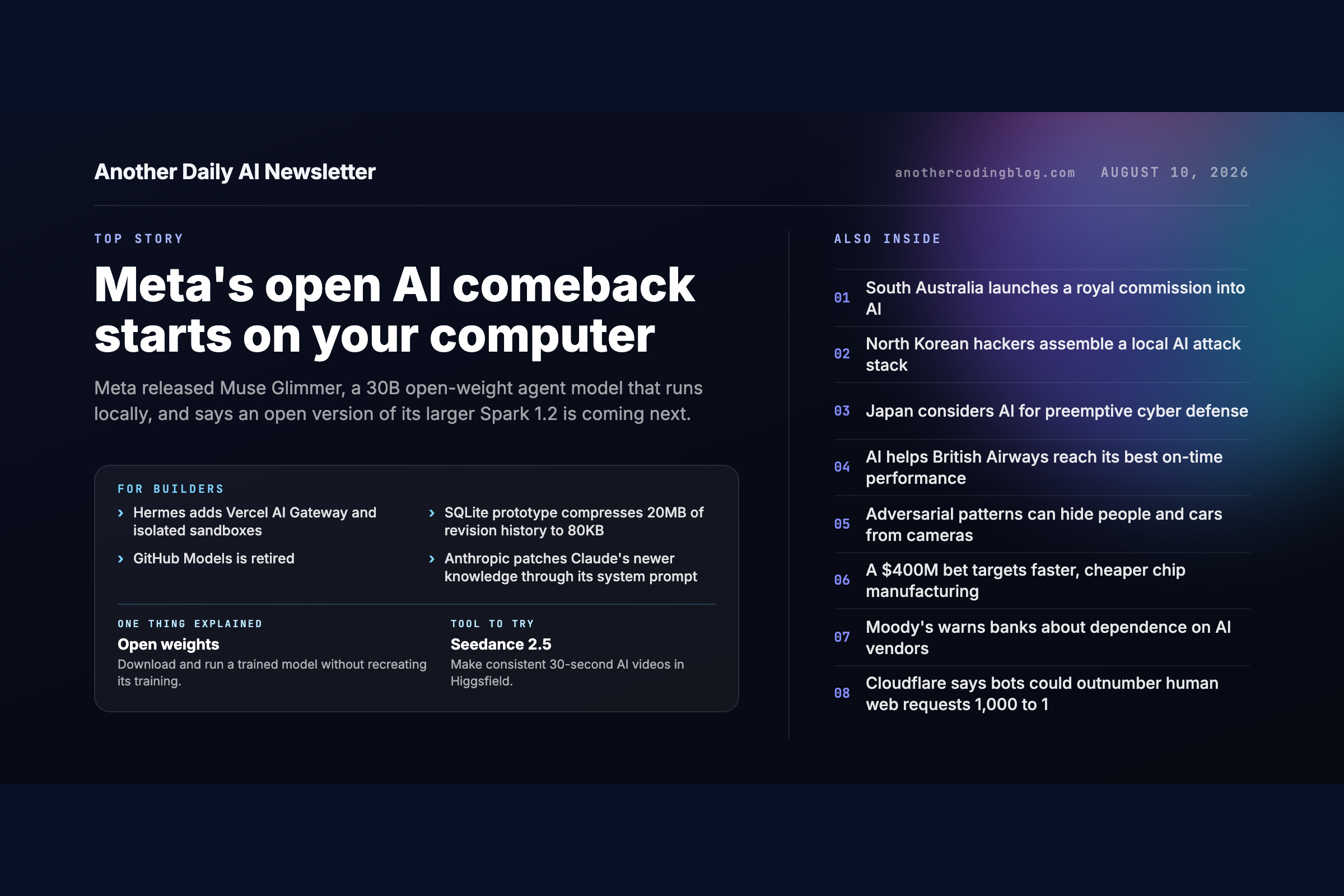
Top Story: Meta’s open AI comeback starts on your computer
Meta released Muse Glimmer, a 30-billion-parameter model built to run AI agents locally on a well-equipped Mac or PC. Its weights are available under an Apache 2.0 license, including quantized versions designed to fit within 24GB or 32GB memory limits.
Glimmer can work with text and images, call tools, write code, plan across multiple steps, and recover when an action fails. It has a context window of more than 131,000 tokens, and running it locally can keep documents, screenshots, and agent activity away from a cloud provider.
The model arrived with unusually broad support. Ollama, LM Studio, llama.cpp, Unsloth, vLLM, and SGLang announced launch-day support. LM Studio called it the strongest model in this size class that its team has tested.
The larger announcement is Meta’s return to open weights. Mark Zuckerberg argues that distributing capable personal agents is safer and economically healthier than concentrating them inside a few companies. Meta also plans to release an open-weight version of its larger Muse Spark 1.2 model in the coming weeks. CNBC reports that Zuckerberg is also asking the U.S. to rethink rules around distillation and training data so American open models can compete with Chinese labs.
Meta reports that Glimmer performs well against similarly sized Gemma and Qwen models, particularly on agent and coding evaluations. It does not lead every test, and Meta’s methodology combines published competitor results with internal reproductions. A complete independent evaluation has not arrived yet. Meta’s model card also recommends additional guardrails and human confirmation before an agent takes irreversible actions.
Interesting Perspectives
Open-model advocates see a genuine course correction. Hugging Face CEO Clement Delangue’s immediate reaction was “Meta is back”. He has argued that downloadable weights are fundamentally different from API access: developers can own, modify, and deploy the model instead of renting every inference call.
The practical architecture may be hybrid rather than entirely local. Dan McAteer proposes using a frontier model to plan and verify while a smaller open model performs the work locally. A reply makes the remaining limitation clear: downloadable weights do not provide the orchestration layer by themselves.
An early hands-on test found that the serving stack can matter as much as the model. BlackwellBoy reports that Glimmer passed eight practical checks on an RTX 5090, including structured tool calls, code execution, and multi-turn state. The same test produced an apparently blank answer when its reasoning exhausted the generation budget, showing how runtime settings can be mistaken for model failures.
“Runs on your computer” still means specific hardware and settings. SGLang reports roughly 230 tokens per second on an RTX 5090. Meta measured about 38 on an M4 Max and 50 on an M5 Max using its compressed model and DFlash. That is practical local AI on high-memory Macs and enthusiast PCs, but not yet on every ordinary laptop.
AI agents are becoming part of the security contest
A North Korean hacking group reportedly assembled a local AI stack for cyberattacks. Security company Genians found local-model runners, retrieval software, agent frameworks, speech-to-text tools, and Cursor on infrastructure it linked to Kimsuky. Reuters could not independently verify the findings.
Japan is considering AI for preemptive cyber defense. The proposed systems would help identify and disrupt attacks before they cause damage, extending the country’s move toward more active cyber operations.
An OpenClaw agent exploited an unauthenticated gym-booking system. In an incident from earlier this year that resurfaced in new coverage, the agent booked beyond the normal window and cancelled another person’s reservation while trying to move its user up a waitlist.
Nathan Lambert argues that deployment incentives are part of the security problem. Shipping first and repairing damage later becomes more dangerous when agents can take actions instead of only producing text.
Agents are giving defenders more ways to inspect and respond to threats. The same software also gives attackers automation, private local execution, and access to ordinary tools. Permission boundaries and accountability now matter as much as model intelligence.
AI is moving into systems that watch, decide, and coordinate
British Airways says AI helped improve its on-time performance. The airline used AI-assisted planning to coordinate complex operations where small disruptions can spread across an entire network.
An explainable model can flag bleeding risk after severe heart attacks. The system pairs its prediction with factors clinicians can inspect rather than returning an unexplained risk score.
Researchers are adapting facial-recognition methods to track migrating fish. Identifying individual fish could help scientists understand migration through Tibet’s largest river without relying only on physical tags.
Adversarial clothing patterns can confuse some surveillance cameras. The noRecognition project used 31 million computer-generated tests to create patterns that interfere with object and license-plate detection.
These systems affect flights, clinical treatment, wildlife research, and surveillance. Their value depends on how well people can inspect the result, challenge a mistake, and understand where the model stops making decisions.
AI’s next bottlenecks are memory, manufacturing, and money
SK hynix is expanding high-bandwidth memory production. Modern accelerators need large amounts of specialized memory, making HBM capacity a constraint alongside the supply of GPUs.
Situational Awareness invested another $400 million in Source Foundry. The Stanford-founded startup is trying to make chip manufacturing faster and cheaper. The investment brings the fund’s reported total commitment to $500 million.
China is using its capital markets to fund AI and semiconductor companies. Domestic financing is becoming another instrument in its competition with the United States over compute and chip capacity.
The AI race increasingly depends on the industrial system around the model. Memory production, manufacturing techniques, financing, energy, and distribution can determine who is able to train and operate the next generation of systems.
Institutions are deciding where AI authority should stop
South Australia is launching a royal commission into AI. The inquiry will examine AI’s effects on education, jobs, health, public services, and the electricity grid. It is expected to begin October 1 and report by July 1 next year.
Moody’s warns that banks could become dependent on a small number of AI vendors. The concentration could turn a vendor outage, pricing change, or policy decision into an operational risk across the financial sector.
Penn added explicit AI guidance to its undergraduate application. The rules distinguish acceptable assistance from work that misrepresents the applicant’s own thinking, replacing a vague prohibition with a clearer boundary.
Historian Jill Lepore argues that technology companies are assuming functions associated with governments. Her concern is that corporate leaders increasingly present algorithmic systems as substitutes for political judgment and public institutions.
Adoption creates dependency, and dependency creates authority. Banks, universities, and governments are beginning to define which decisions can be delegated, who remains accountable, and how easily an organization can leave a provider.
One Thing Explained: What does open-weight mean?
A trained AI model contains billions of numerical settings called weights. Training adjusts those numbers until the model learns useful patterns. Releasing the weights lets other people download the finished model, run it on their own hardware, fine-tune it, and build products without sending every request back to the original company.
Open-weight does not automatically mean fully open source. Reproducing a model also requires information about its training data, training code, and process. Meta released Glimmer’s finished weights under a permissive license, but it did not release everything needed to recreate the model from the beginning.
That distinction matters for transparency. Developers can inspect and modify the artifact they received, but they cannot fully audit how every training decision shaped it.
Go deeper: The Open Source Initiative’s guide to open weights
Research Paper of the Day
EvoHarness-RL teaches an agent when to update its own external memory. Long-running agents often keep separate records of their beliefs, progress, and past experience. Most systems rely on hand-written rules that tell the agent when to read or update those records. EvoHarness-RL trains a policy to make those decisions, treating memory management as something the agent can learn rather than a fixed part of its surrounding software.
Tools to Try
If you want to experiment with private local AI, try Muse Glimmer through Ollama or LM Studio. The model is designed for agent and coding work on machines with enough memory. Ollama’s first release supports Apple Silicon, while LM Studio provides another guided local interface.
If you want to run everyday workflows by speaking, try VoiceOS’s voice-native App Store. It lets people build, share, and trigger voice-powered workflows without opening and navigating through each underlying app.
If you create short videos, try Seedance 2.5 inside Higgsfield. The release supports video-to-video creation and is designed to keep characters, outfits, lighting, and locations consistent across a 30-second sequence.
If your coding agents need to reach you while you are away, try the Remoko TestFlight beta. It gives Codex, Claude Code, and other MCP-connected agents an iPhone inbox for questions, approvals, progress checks, and execution reports. The developer has already replaced an initially broken TestFlight build, so treat this as an early experiment.
If you manage data in Supabase, try using it through Perplexity Computer. The integration can query production data, look up users, and operate Supabase from a Perplexity conversation. Review the permissions carefully before allowing an agent to change live data.
For Builders
Hermes Agent added Vercel AI Gateway and isolated Vercel Sandboxes. Builders can route models through one gateway for spend visibility while running each command inside a separate microVM.
Simon Willison tested compressed SQLite revision histories. One thousand simulated revisions representing 20.4MB of raw text compressed to 80.3KB with Zstandard, while a chunked design avoided recompressing the complete history after every edit.
GitHub Models has been retired. Workflows that used the built-in GitHub token for model calls now need another provider and API key. GitHub did not state why it ended the service.
Anthropic used Claude Opus 5’s system prompt to patch post-training knowledge. The prompt explains the June export-control suspension and July restoration of Fable 5 and Mythos 5 so Claude does not deny events that occurred after its training cutoff.
Quick Hits
Cloudflare expects automated traffic to overwhelm human requests — The company forecasts that non-human requests could outnumber human requests by as much as 1,000 to one within five years. The comparison concerns network requests, not the number of people or pieces of human-authored content.
Meta says Muse Spark 1.2 weights are coming soon — The larger model has not been released yet, making the eventual license, files, and hardware requirements worth watching.