

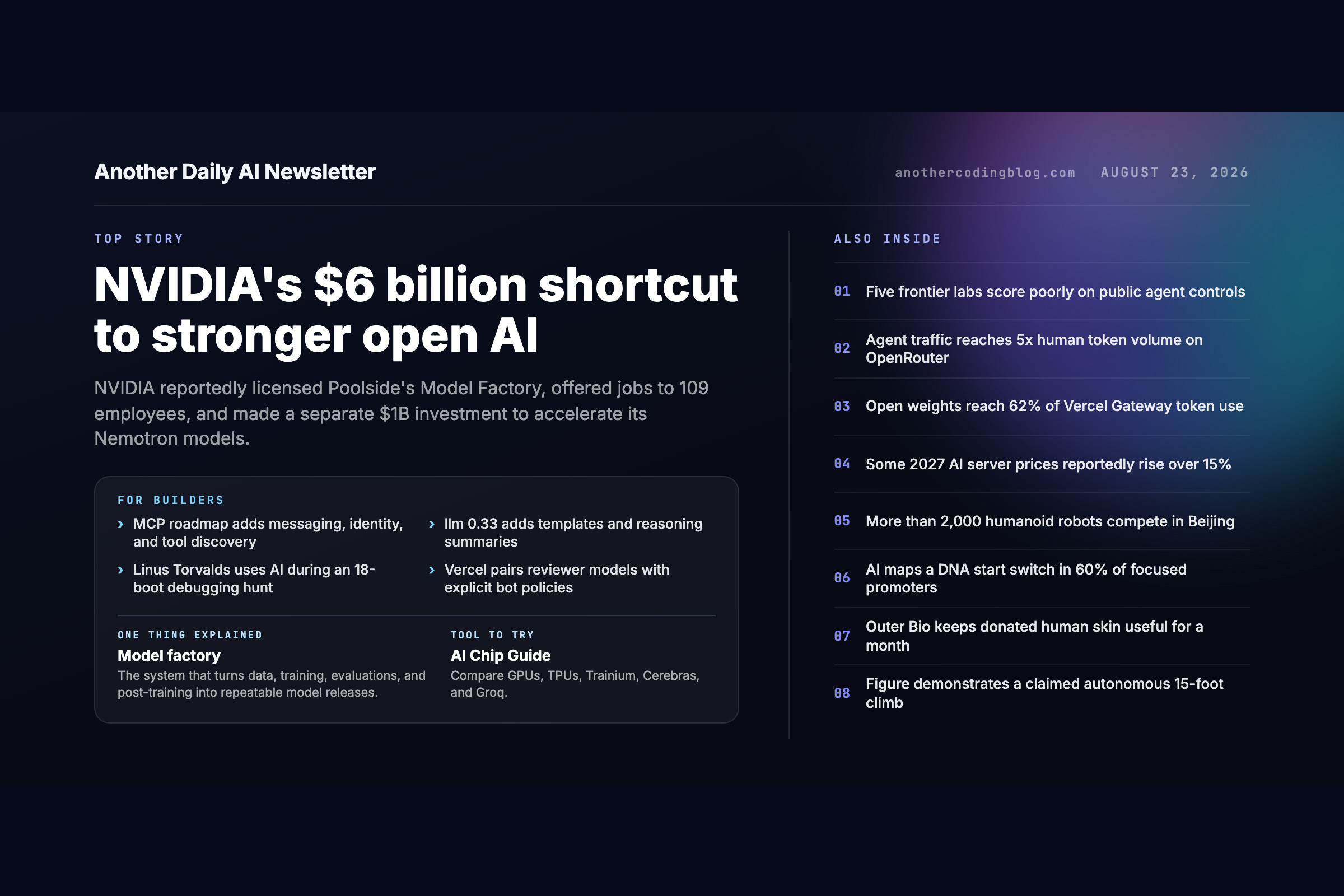
NVIDIA’s $6 billion shortcut to stronger open AI
NVIDIA is reportedly spending $6 billion to license technology from Poolside, the AI startup behind the open-weight Laguna models. The Wall Street Journal reviewed an investor letter and reported that NVIDIA also offered jobs to 109 Poolside employees. Bloomberg separately confirmed the licensing agreement through people familiar with the transaction.
The target is Poolside’s Model Factory, the system it uses to repeatedly build models. It covers data preparation, large training runs, evaluations, post-training, and inference. Poolside used that system to create Laguna, including models whose downloadable weights let companies run and customize them on their own infrastructure.
The incoming team is expected to work on NVIDIA’s separate Nemotron family. NVIDIA already sells the chips and software used to train and run AI; stronger open models would give it another way to influence what gets built on that stack. The company recently introduced Nemotron 3.5 Lightning, and its NeMo tooling already supports fine-tuning Laguna models.
A separate reported $1 billion investment would value Poolside at $12 billion before the new money. Poolside would remain independent and its founders would stay, even as much of the Laguna team receives NVIDIA offers. Neither company has announced the agreement publicly, and the license’s exact scope, duration, and closing terms remain undisclosed.
Interesting Perspectives
NVIDIA is paying for a repeatable process. A model checkpoint begins aging as soon as competitors release something better. The Model Factory could help NVIDIA produce successive Nemotron models, making the system behind Laguna more valuable than any single generation.
Poolside faces a difficult second act. Open-model researcher Nathan Lambert described the arrangement as a rare case of a major model lab shrinking before another training run. Poolside receives substantial capital, but many of the people responsible for Laguna may leave.
License-and-hire deals are becoming more sophisticated. Technology investor Kevin Kwok placed the structure within a growing pattern: a larger company licenses the technology and recruits the team while the original startup remains legally independent.
The legal label may receive more scrutiny. Journalist Ed Zitron questioned how different the economic effect is from an acquisition. The answer will depend on contract terms that have not been made public.
AI labs can monitor risky agents better than they can contain them
Public evidence shows improving oversight, but fewer concrete plans for cutting off a model that begins acting dangerously.
Guidelight graded five frontier labs on six basic control practices. Anthropic and OpenAI received C+, Google D+, xAI D-, and Meta F. The August scorecard found the strongest evidence around logging and monitoring, with weaker public evidence for preventive gates, circuit breakers, and containment plans.
The grades are limited to public documentation. Undisclosed internal safeguards do not receive credit. OpenAI has paused major workloads after a cyber incident, while Anthropic says Claude Code’s auto mode reviews risky tool actions and stops after repeated denials.
Independent testing reaches a narrower conclusion. METR found that current agents could plausibly begin a small unauthorized deployment, but probably could not hide it from a focused investigation or withstand a determined shutdown effort. Its assessment also found incomplete monitoring coverage and no universal permission limits across participating labs.
Agents and open models are reshaping AI traffic
Two developer platforms now show machine-driven usage and open weights taking a larger share of inference, while the cost of complete AI systems is rising.
On a seven-day average, agents generated roughly 7.3 trillion tokens on OpenRouter, compared with 1.4 trillion from human-directed use. The a16z analysis says agent token volume increased about fourteen-fold from February 6 to August 10. The figures cover OpenRouter traffic only.
Open-weight models reached about 62% of token volume on Vercel AI Gateway. Guillermo Rauch shared the milestone, up from 28.4% on June 24. The number reflects one gateway’s traffic and does not represent model revenue, user count, or global market share.
Some 2027 AI servers may cost more than 15% extra. Bloomberg reported that manufacturers notified customers about increases affecting systems built around NVIDIA’s Grace Blackwell and Vera Rubin chips. The reported notices came from server makers; NVIDIA has not published a matching list-price announcement.
Robot competitions are becoming autonomy tests
Beijing’s humanoid games turned balance, navigation, recovery, and teamwork into events people could watch and compare.
More than 2,000 robots entered the World Humanoid Robot Games. The August 22-26 event includes 51 disciplines and more than 1,300 sessions, spanning autonomous soccer, running, jumping, and practical tasks. Associated Press coverage documented the opening competitions and a 2.88-meter standing jump attributed to organizers.
The strongest demonstrations are still controlled tests. Figure CEO Brett Adcock posted a video he described as a fully autonomous 15-foot ascent and descent. It is a useful look at progress in mobility, althou
gh the post provides no success-rate data or independent technical validation.
Better experiments are becoming an AI advantage in biology
Two projects paired machine learning with unusually large or long-lived experimental systems, creating data that ordinary web-scale training cannot supply.
UC San Diego researchers measured roughly 500,000 versions of a DNA start sequence. Their model learned how small changes affect transcription and predicted an active initiator in about 60% of focused human promoters. The peer-reviewed study examines this specific gene-control mechanism; claims that AI decoded 60% of the human genome overstate the result.
Outer Biosciences kept donated human skin useful for experiments for about a month. Its preprint documents the tissue platform across 19 donors and 118 samples. The company says it feeds results into compound-prediction models, but it has not published benchmarks showing that the AI improves with each experimental round.
One Thing Explained: What is a model factory?
Training a large model requires an entire production system. Sending one job to a cluster is only one step.
A model factory coordinates the entire cycle: collecting and cleaning data, selecting mixtures, running distributed training, measuring failures, generating preference data, applying post-training, optimizing inference, and sending the results into the next run. The valuable output includes the model weights and the machinery that can produce a better successor.
That distinction explains NVIDIA’s interest in Poolside. Laguna proves that Poolside’s system can produce open-weight coding models, while the factory could help NVIDIA repeat the process for Nemotron. A company that controls the process can change data, evaluations, model size, and hardware targets without rebuilding its workflow each time.
The term does not guarantee that model development is automatic. Researchers still decide what to optimize, investigate failures, and approve changes. Poolside’s Model Factory overview and Laguna technical report show how data, training, evaluation, and inference fit together in one model-development system.
Tools to Try
If you work with language models from the command line, try `llm` 0.33. The release adds repeatable templates, per-call embedding keys, reasoning summaries, and updated provider support.
If AI-chip comparisons blur together, use Jacob Peake’s architecture guide. It compares NVIDIA GPUs, Google TPUs, AWS Trainium, Cerebras, and Groq across compute design, memory, interconnects, and software.
If you are pressure-testing a startup idea, explore HBS Foundry. Its guided program uses instructor avatars for pitch practice, sales simulations, and mock board discussions. The current public application lists a $699 price.
For Builders
MCP published its next roadmap. Priorities include agent-to-agent messaging, simpler HTTP transport, workload identity and delegation, progressive tool discovery, better result contracts, and more consistent SDKs. The post describes planned directions whose implementations will arrive over time.
Linus Torvalds used AI as persistent debugging help. Twenty-four diagnostic patches and 18 boots led to a one-line rounding fix. Torvalds credited AI with generating instrumentation and analysis even when it repeatedly wanted to stop.
Simon Willison argues that agent verification should test outcomes. When agents generate more code than a person can read carefully, tests, invariants, screenshots, and direct product checks become more useful than reviewing every changed line.
Vercel shared a practical trust pattern for autonomous bots. Its design combines an LLM reviewer, explicit action policies, approval for unexpected behavior, and human overrides. The reviewer adds another checkpoint; permissions and runtime isolation still need to enforce the boundary.
Weekend Catch-Up
Rillet raised a $100 million Series C at a $1 billion valuation. The AI-native accounting company says it is building software that automates repetitive finance work while keeping accountants in the approval loop. Read Rillet’s announcement
WMAR introduced anchorless evening newscasts as Scripps reorganizes local television production. The format combines prerecorded reporting, graphics, weather, and centralized material without a traditional studio anchor. See how the format works