
Another Daily AI Newsletter - August 2

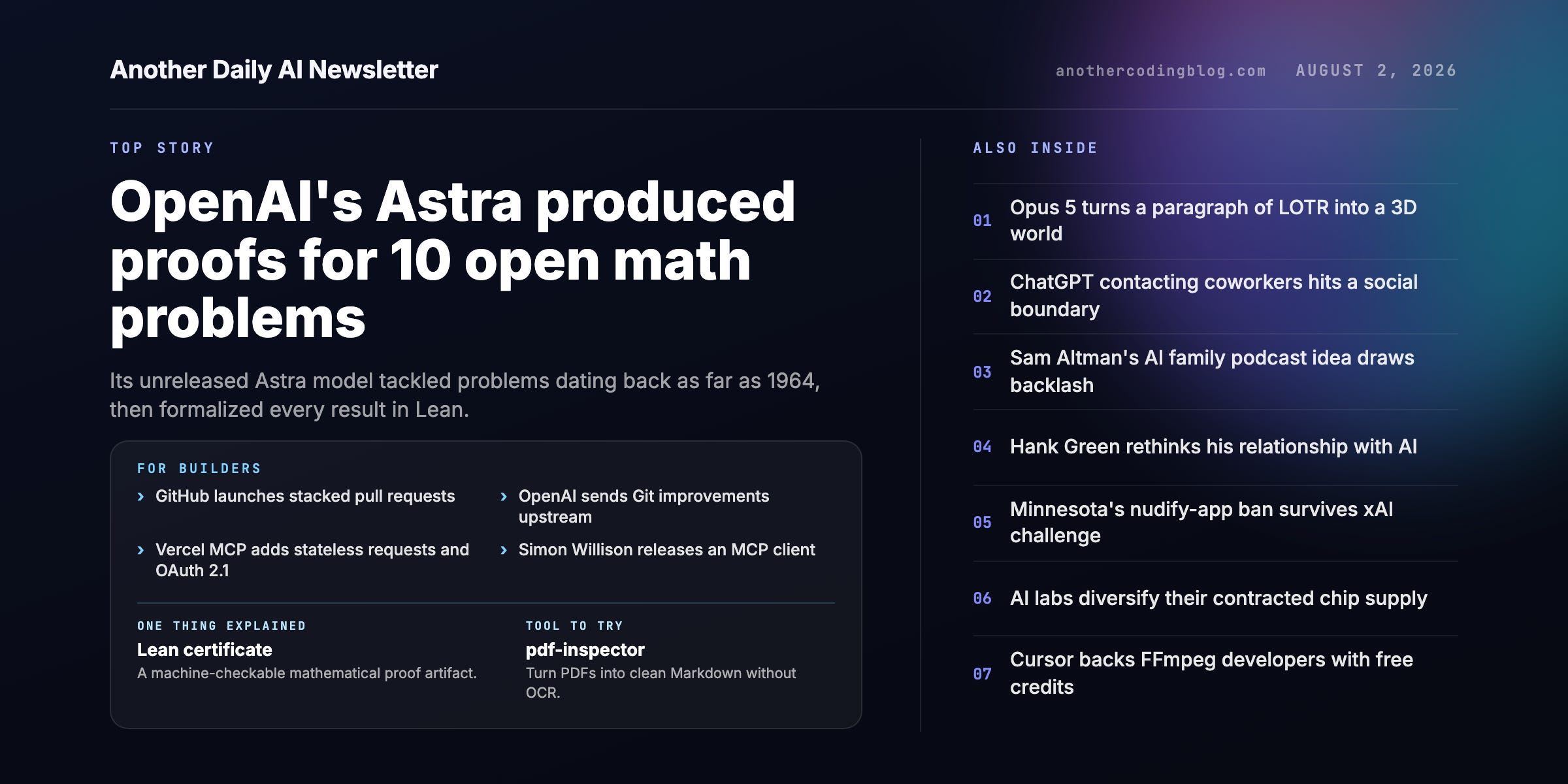
Top Story: OpenAI’s Astra produced proofs for 10 open math problems
OpenAI published a 249-page collection of ten results produced by an internal version of Astra, its next major model. The problems cross eight branches of mathematics and theoretical computer science. OpenAI says each had gone at least a decade without progress on its central result.
Several of the questions date back much further. Ehrhart’s volume conjecture was posed in 1964, 62 years ago. Erdős’s degeneracy conjecture followed in 1967. The general sphere-packing bound had not improved since 1978. Connes’s rigidity conjecture and the compactness conjecture both trace to 1982. The multicolor-triangle question was recorded by 1990, and the search for a non-sofic group began in 2000. These were not newly invented benchmark problems.
What is Astra?
OpenAI calls Astra “our next major model,” but has not announced it as a product or explained how it will be packaged. Before the math release, a widely shared post citing *The Information* described Astra as the tentative name for a new OpenAI model family, positioned as a new class alongside Sol, Terra, and Luna. The report said Sam Altman previewed Astra to policymakers in Washington, while a public summary described multiple agents working together over long periods on difficult projects and advanced math. The ten proofs now give that long-horizon research story a concrete result. The reported family structure, multi-agent architecture, release date, access, and pricing remain unconfirmed.
Astra’s 10 findings, explained simply
Packing balls: How tightly could identical balls fit in a space with hundreds of dimensions? Astra proved they cannot be packed quite as tightly as the best previous limit allowed.
Protecting messages from errors: How many distinct messages could a system store while keeping them far enough apart to correct mistakes? Astra established a lower ceiling than previous estimates.
Imitating infinity: Mathematicians wondered whether every infinite system of symmetries could be approximated by finite ones. Astra found the first example that cannot.
Mathematical fingerprints: Researchers thought a particular fingerprint might uniquely identify a rigid symmetry system. Astra found infinitely many different systems with the same fingerprint, proving that it does not.
Measuring a hard calculation: A permanent combines many possible arrangements of numbers in a grid and is notoriously expensive to calculate. For two common ways of organizing the arithmetic, Astra proved that any recipe must be larger than previous math had established.
Repeating quantum games: Could players use quantum tricks to keep beating the same test? Astra proved that repeating the game enough times makes their chance of winning every round shrink rapidly toward zero, not only in special cases.
Searching enormous grids: Finding the nearest point in a grid becomes extremely difficult when the grid has many dimensions. Astra proved that even a rough answer remains hard to calculate, strengthening the mathematics behind some encryption designed to resist quantum computers.
Finding the largest possible shape: Imagine a shape placed on a grid with its center as the only whole-number point inside it. Astra calculated exactly how large that shape can be in any number of dimensions.
Forcing a matching triangle: Connect many points using several colors. Astra showed that the network can grow much larger than previously proven before a triangle whose three connections share one color becomes unavoidable.
Testing rules for crowded networks: Mathematicians had proposed two rules for predicting how many connections a network could have while avoiding certain patterns. Astra produced counterexamples showing that both rules can fail.
The reported economics are striking. OpenAI estimates that finding all ten solutions used about $2,000 worth of tokens at Sol API prices. Humans then used the model to prepare the manuscripts, and Astra formalized every argument as a Lean certificate. Lean’s small verification kernel checks whether each formal step follows from the definitions and assumptions, and OpenAI released the code so others can rebuild the certificates.
That machinery establishes a high bar for logical consistency, while several important questions remain open. Reviewers still need to confirm that each formal statement faithfully represents the intended mathematical claim, assess novelty and prior attribution, and decide the significance of each result. OpenAI also released 62 pages of discovery notes, but those are model-written reconstructions based on the original reasoning traces and papers rather than raw logs.
June’s independently run First Proof benchmark offers useful context. Across four public systems and 39 submissions, expert referees found at least one passing solution for seven of ten research problems. Some were novel and publishable; others were wrong, difficult to decipher, or weakly cited. Astra’s collection is more ambitious, but it used a private model, company-selected problems, and human manuscript preparation. The mathematical community is only beginning the slower work of evaluating it.
Interesting Perspectives
Mathematician Daniel Litt called the release “a big deal.” He later urged people to remain calm about its immediate social implications.
OpenAI researcher Noam Brown called Astra a major step for scientific reasoning. His announcement brought the specialist release to a much broader audience.
Gary Marcus offered the strongest skeptical interpretation. He argued that mathematics and coding give models unusually clear verification signals, so success here should not automatically be treated as evidence of equally strong reasoning in open-ended domains.
The Leiden Declaration warns against evaluating mathematical results through company announcements alone. It calls for verification, attribution, human responsibility, and peer review. OpenAI published papers and Lean certificates; independent evaluation and authorship questions remain.
AI adoption is finding its social limits
OpenAI employees found that coworkers disliked being contacted by another person’s ChatGPT. Greg Brockman said those same coworkers were often happy to help when asked directly. The result points to a practical boundary for workplace agents: delegation can save the sender time while quietly transferring the social cost to everyone else.
Sam Altman proposed turning family calendars and children’s interests into a personalized morning podcast. The response asking why a parent would not simply talk to the children drew far more engagement than the original idea. The product can assemble a useful briefing, but the reaction shows that people judge automation differently when the activity itself is part of a relationship.
Hank Green said pressure and growing reliance on ChatGPT had made his own creative process unclear to him. He said he used it to locate papers and resources rather than write his scripts, yet still worried that speed and repeated chatbot use were diluting his voice. The concern was authorship as lived by an audience: readers and viewers want confidence that the person they follow remains present in the work.
Longer agent runs are making review the bottleneck
Andrej Karpathy gave Claude Opus 5 the opening paragraph of The Lord of the Rings, a one-million-token budget, and asked for a Three.js world. The model worked for about two hours and wrote roughly 5,500 lines of code. Karpathy’s larger point was that cheap, patient generation makes intensely customized software worth attempting. He also found the limiting step: the model had to audit the world through slow screenshots and could not efficiently watch or play through what it created.
Datasette Apps now gives its agent an invisible browser surface for testing what it builds. The new `app_debug()` tool opens an app inside a sandboxed iframe and runs JavaScript to smoke-test behavior or measure elements. It turns visual inspection into a callable step inside the agent loop.
AWS published a practical observability workflow for long-running production agents. CloudWatch traces can expose slow tools, serial calls that should run in parallel, rising token use, and memory stores that grow without consolidation. As agents stay active longer, teams need to monitor the trajectory of a session rather than only its final answer.
The model is only one layer of the AI system
The State of AI Compute Index shows frontier labs assembling more diverse chip portfolios. Its August 1 update counts 16.75 of OpenAI’s 26.75 gigawatts of disclosed contracted capacity as non-NVIDIA, spread across AMD, Broadcom, and Cerebras. It counts up to 7 of Anthropic’s 8 gigawatts as non-NVIDIA, while noting that some AWS and Google commitments lack complete public capacity figures. Model competition is increasingly tied to supply, power, networking, and the ability to move workloads across silicon.
Cursor gave free credits to several FFmpeg developers for development and code review. FFmpeg sits underneath a large share of the media software that AI products rely on. Supporting its maintainers is a reminder that new model capabilities continue to depend on mature open-source infrastructure.
Research Worth Reading
Qwen-UI-Agent combines mobile, desktop, browser, and command-line actions in one system. The team trained on trajectories longer than 100 turns and used more than 10,000 concurrent environments to generate experience. Alibaba reports state-of-the-art results on several mobile benchmarks and competitive desktop and browser performance; those are author-reported benchmark results awaiting broader replication.
One Thing Explained: What is a Lean certificate?
Lean is a programming language and interactive theorem prover. A mathematical statement and its proof are translated into precise formal objects. Lean’s small trusted kernel checks that the proof follows the rules of its type system, step by step.
A certificate therefore gives another researcher something stronger than persuasive prose: a machine-checkable proof artifact. It still has boundaries. Reviewers must confirm that the formal statement matches the intended mathematical claim, that the definitions and assumptions are appropriate, and that the result matters in its field. Lean verifies the formal chain; the research community supplies interpretation and significance.
Tools to Try
If you compare models, prompts, or agent harnesses, try smevals. You define a small evaluation suite in YAML, run the same tasks across model configurations, grade the outputs separately, and inspect the results in a local web interface. It is designed to make a useful custom evaluation small enough to build for an actual project.
If your agents need to read PDFs, try Firecrawl’s pdf-inspector. The open-source Rust library determines whether a PDF is text-based, scanned, image-based, or mixed, then extracts structured Markdown locally when OCR is unnecessary. Firecrawl’s reproducible benchmark processed 200 documents in 0.47 seconds on an Apple M4 Pro; the project provides Python, Node.js, browser WebAssembly, Rust, and command-line interfaces.
For Builders
GitHub launched stacked pull requests in public preview. A large change can be divided into smaller dependent reviews, then submitted and updated as a stack. That is useful when agents can generate more code than a reviewer should be asked to inspect at once.
OpenAI is sending improvements from its public Git fork upstream. The work covers performance, correctness, and testing in OpenAI’s fork of Git. Ted Nyman said new Codex app builds will also use Git more efficiently as the work continues.
Simon Willison released `llm-mcp-client` 0.1a0. The plugin exposes tools from MCP servers to models running through his `llm` command-line utility.
Amazon Quick’s Agentic Catalog Experience preserves the upstream catalog as the source of truth. It uses direct queries, inherits selected metadata as read-only, and makes custom edits explicit when they break semantic synchronization.
Vercel MCP added stateless requests and OAuth 2.1 support. Its server remains backward compatible with clients built against the 2025 protocol, giving existing integrations a migration path to the latest specification.
Quick Hits
A judge denied xAI’s request to temporarily block Minnesota’s ban on nudify apps. The law can take effect while xAI’s broader challenge continues; the ruling emphasized that xAI waited until three days before the effective date to seek emergency relief.
A creator demonstrated unusually coherent continuous movement through generated zero-gravity and waterslide scenes. The clips are useful as a visual signal of progress, but the post did not identify a model or controlled comparison.