
Another Daily AI Newsletter - August 3
Top Story: Alibaba launches Qwen3.8-Max; open weights arrive next week

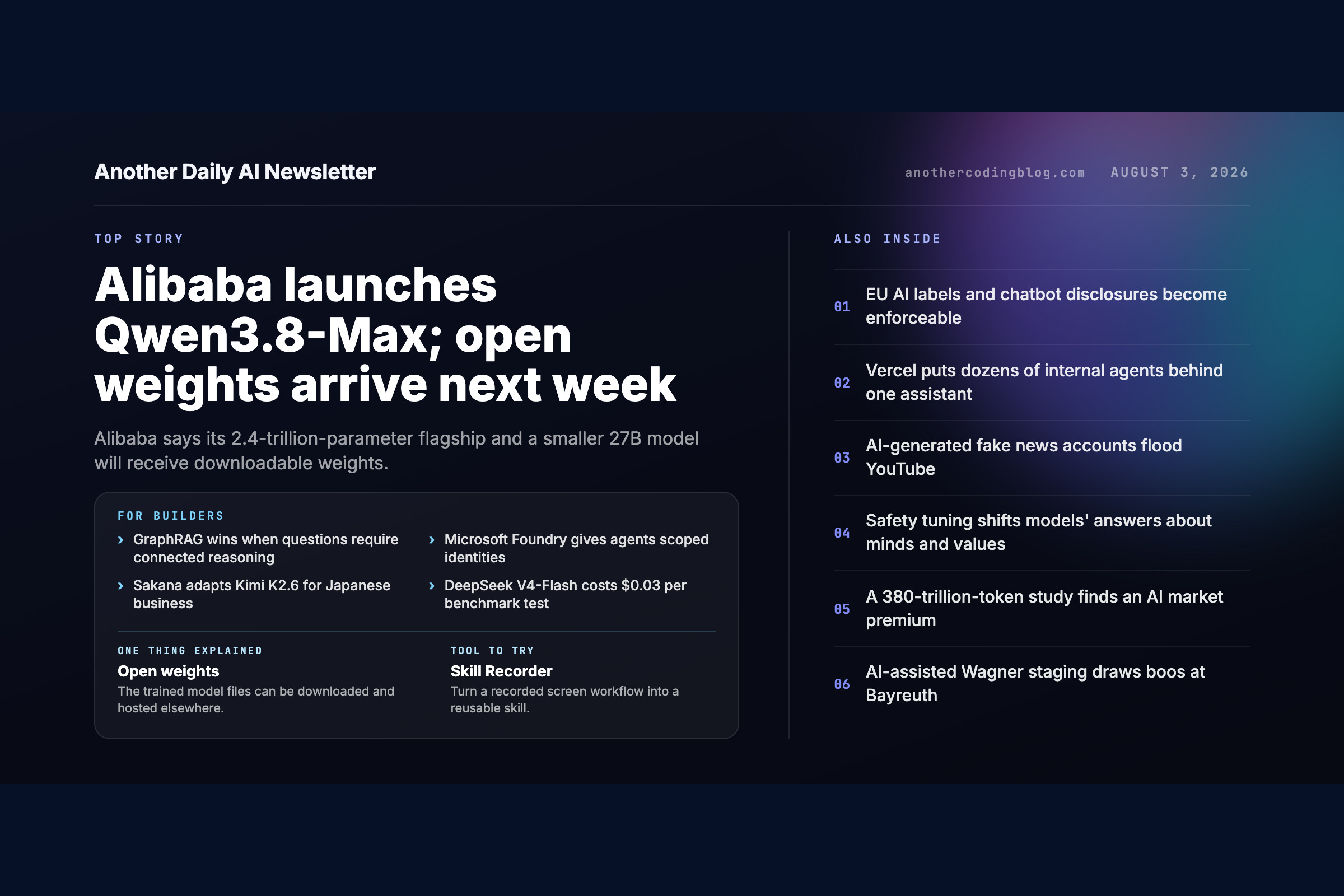
Top Story: Alibaba launches Qwen3.8-Max; open weights arrive next week
Alibaba says it will release downloadable weights for Qwen3.8-Max and a new 27-billion-parameter version next week. The commitment turns last month’s preview into a dated release plan. Qwen3.8-Max is already available through Qwen’s chat product and API; the weights and their license have not been published yet. Reuters independently described the announcement as Alibaba’s largest and most capable model unveiling to date.
Qwen describes Max as its most capable model so far, with 2.4 trillion total parameters. Reuters reports that its mixture-of-experts design activates 95 billion parameters at a time and accepts as many as one million tokens of context. Qwen says the model can sustain coding projects for more than ten days and work through hundreds of design iterations. Those are company claims, although Qwen published one continuing software project as a public trace.
The API also makes the economics unusually easy to inspect. QwenCloud lists Qwen3.8-Max at $2 per million input tokens, $6 per million output tokens, and $0.25 per million cached input tokens. The smaller 27B release may be the more practical part for individuals and smaller teams: a model of that size is far easier to host, modify, and study than a 2.4-trillion-parameter flagship.
Arena’s August 1 leaderboard places Alibaba second among labs, behind Anthropic, with Qwen3.8-Max marked preliminary. That is independent evidence that people prefer its answers in blind comparisons. The early result does not fully evaluate reasoning, reliability, or long-running work.
Next week’s artifacts will answer the remaining questions: which license Alibaba chooses, what hardware the models require, and whether independent testing supports the launch claims. The significance is already clear. A frontier model is moving from a metered service toward software that outside researchers and companies can inspect, host, and adapt.
Interesting Perspectives
AI researcher Nathan Lambert placed the announcement in a rapid new cadence for frontier open-weight models. Credible downloadable alternatives are arriving more frequently.
Qwen emphasized its second-place lab ranking on Arena. The leaderboard itself labels the result preliminary, which makes next week’s independent evaluations more important than the launch-day position.
The 27B model could have wider day-to-day impact than Max. Max is the headline, while the smaller model is the version more developers will be able to run and adapt without frontier-lab infrastructure. That is an inference from model size; Alibaba has not yet published hardware requirements.
AI transparency is becoming an audience expectation
The EU AI Act’s Article 50 transparency rules began applying on August 2. Providers must make it clear when people are interacting with AI, add machine-readable markings to synthetic media, and disclose certain uses of emotion recognition and biometric categorization. Deepfakes must be labeled, as must AI-generated text published to inform the public when it has not received human editorial review.
The European Commission’s implementation guidance makes disclosure part of product design and the synthetic-media pipeline. Violations can bring penalties of up to EUR15 million or 3% of worldwide annual revenue. Generative systems already on the market receive a transition period for marking outputs until December 2026.
Semafor found AI-generated videos presenting fabricated stories about companies abandoning California and New York. California officials said YouTube removed more than 700 accounts they identified since January. More than 100 carried false or highly misleading AI-generated material about Gov. Gavin Newsom and California. Some individual videos collected hundreds of thousands of views before removal.
An AI-assisted production at Germany’s Bayreuth Festival received boos after its image projections left parts of the audience confused. Organizers described AI as an image-generating force that would make every performance unique. The audience warmly applauded the performers and conductor while rejecting the staging. Labels can disclose AI involvement; creators still have to make the result coherent and worthwhile.
Companies want one agent layer, with permissions attached
Vercel CEO Guillermo Rauch says the company consolidated dozens of internal agents behind one assistant called V. Employees use the same interface across engineering, finance, communications, marketing, analytics, and documentation. V has per-user memory, workflows, and schedules, giving the company a shared agent layer instead of a separate bot for every department. These are Vercel’s own descriptions of an internal system.
Microsoft Foundry is addressing the permission problem that appears once agents reach that many systems. An agent can receive its own Entra identity, scoped role-based access, and traceable tool calls. OAuth passthrough can also preserve the human user’s permissions instead of giving every request the agent’s broadest access. The two announcements point toward the same operating model: one familiar interface for workers, with identity and policy enforced underneath it.
Research is tracing AI’s second-order effects
Safety tuning can shift more than the behavior it targets. Researchers trained models to stop describing themselves as conscious, then observed changes in their answers about animal minds, nature, spirituality, and human values. Activation steering and ablations reversed some of those changes without reducing theory-of-mind performance. The work does not show that models are conscious. It shows that a narrow safety intervention can become entangled with a broader set of model responses.
A new NBER working paper uses 380 trillion realized OpenRouter tokens to look for an “AI premium” in markets and work. Across more than 400 models, the researchers connect token demand with publicly traded companies and job skills. Firms with higher measured exposure subsequently earned higher returns in their sample, while labor exposure looked more positive for interactive work and more negative for analytical and operations-control skills. The observational relationships do not establish causation.
One Thing Explained: What are open weights?
A trained model stores what it learned in billions or trillions of numerical values called weights. When a company releases those files, other people can download the model, run it on their own infrastructure, study its behavior, and sometimes fine-tune it for a narrower task.
Open weights do not automatically include the training data, training code, or unrestricted permission to use the model. Those details come from the accompanying license and documentation. That is why Qwen’s promise matters, and why the release is not complete yet: Alibaba has set the date, while the actual files, license, and hardware requirements are still pending.
Tools to Try
If you repeat a computer workflow, try Microsoft Skill Recorder. It records clicks, app changes, URLs, and optional narration, then uses GitHub Copilot to create a reusable `SKILL.md` file or scheduled automation. It supports macOS and Windows 11. Analysis sends the event timeline, screenshots, and narration to GitHub’s cloud, so recordings should not contain secrets.
If your application stores large JSON logs with repeated text, try condense-json. The utility replaces repeated strings and substrings with compact references, then reverses the process with `uncondense_json`. Simon Willison built it to reduce duplicated content in SQLite logs from LLM calls. Its narrow job is compacting repetitive stored JSON.
For Builders
Use GraphRAG when a question depends on relationships across documents. The reviewed benchmarks show graphs helping most with multi-hop reasoning, global summaries, and connected facts. Plain vector retrieval remained competitive for simple factual lookup. A practical system can classify the question, then route it to vector, graph, or hybrid retrieval.
Sakana AI released Namazu, a Japanese-specialized agent API built from Kimi K2.6. Sakana adapted the open model for Japanese language and business contexts, with built-in web search and code execution behind an OpenAI-compatible API. The company reports stronger Japanese political-bias and business-task results than the base model; those benchmarks are internal and still need independent replication.
DeepSeek V4-Flash may be the cheapest prominent model to operate. Artificial Analysis estimated an average cost of $0.03 per benchmark test, compared with $0.86 for Kimi K3, $1.86 for GPT-5.6 Sol, and $3.15 for Claude Fable 5. Its Intelligence Index score of 50 matched Gemini 3.6 Flash while trailing the leading OpenAI and Anthropic models.