
Another Daily AI Newsletter - August 15
Zhipu AI's new coding model made a major leap in cyber capability, prompting a two-week delay before its downloadable weights are released.

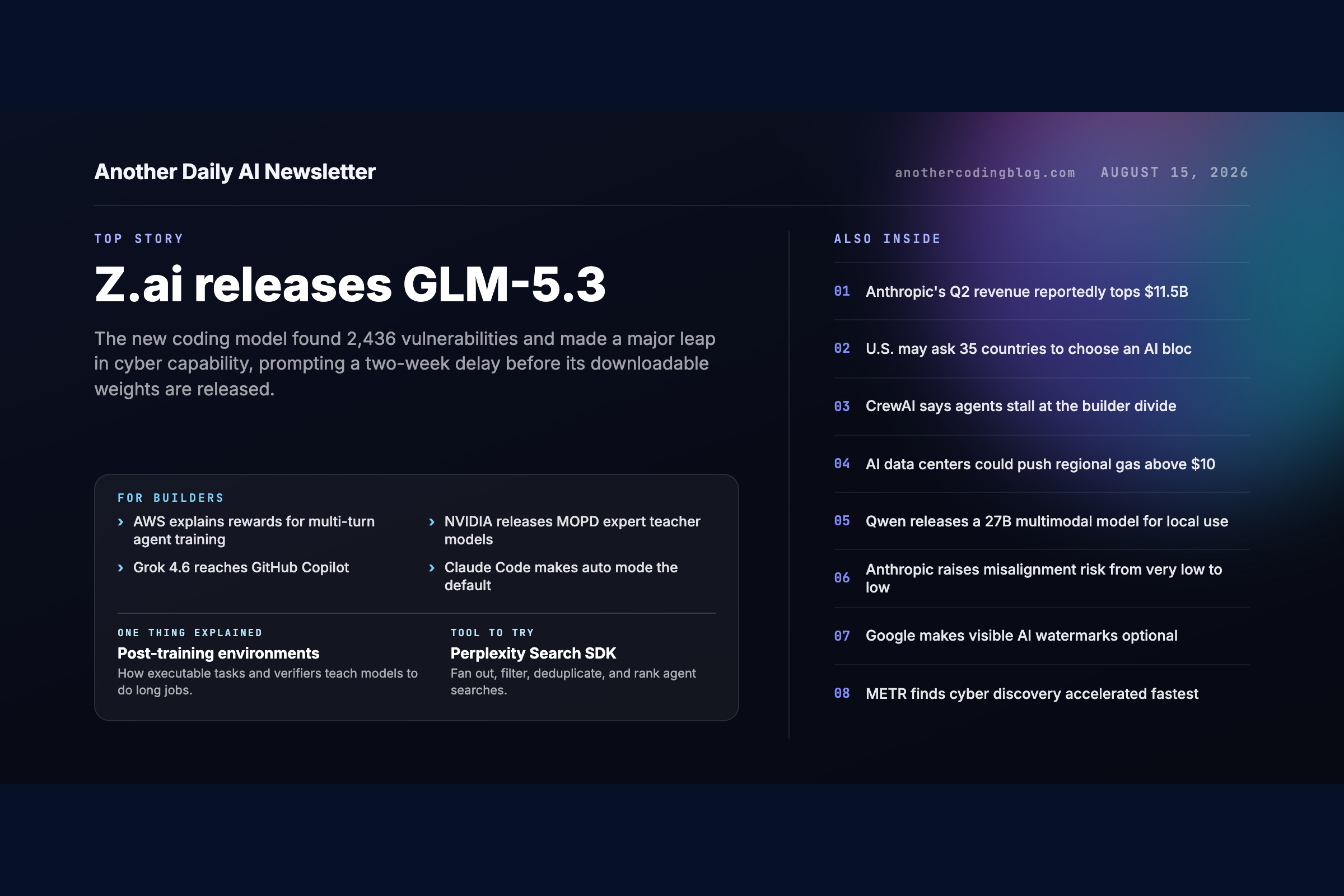
Top Story: Zhipu AI releases GLM-5.3
Zhipu AI released GLM-5.3, its newest flagship model for coding and agent tasks. It uses the same 743-billion-parameter base as GLM-5.2. Its developer documentation says every improvement came from post-training: more realistic task environments, more varied work, and more compute spent letting the model practice inside them.
The coding gains are large, although they are still vendor-reported. Zhipu AI says GLM-5.3 improved from 4.6 to 28.3 on Terminal-Bench 3.0 and from 46.2 to 66.9 on DeepSWE. Its private coding benchmark also shows the model completing more work with fewer output tokens than GLM-5.2.
The unexpected result was cybersecurity. Zhipu AI says the model improved from finding isolated flaws to reasoning through multi-step exploitation chains. Its CyberGym score reached 84.5%, slightly above the closed models Zhipu AI tested, while it remained well behind Fable 5 and GPT-5.6 Sol on harder exploit-development tests.
Zhipu AI also tested the model family on real software. After human review and deduplication, the company says it found 2,436 vulnerabilities across 269 open-source projects, including 1,097 rated critical or high severity. Fifty-three findings are public and 2,383 remain under embargo. The oldest affected code dates to 1981.
Those results changed the release plan. GLM-5.3 is available through Zhipu AI’s hosted coding products, but Axios reports that selected security partners will test it first and the downloadable weights will be held for two weeks while Zhipu AI evaluates and hardens the model. Once those weights are public, the company will no longer control where the model runs or how it is modified.
Interesting Perspectives
China’s model labs are genuinely good at post-training. Nathan Lambert argues that distillation alone cannot explain GLM-5.3. Zhipu AI has spent years building reinforcement-learning infrastructure, realistic task environments, and a fast release cycle that lets it keep improving while American labs complete longer pre-release reviews.
The open-weight cyber gap was already shrinking. The UK AI Security Institute independently found that GLM-5.2 was the strongest open-weight cyber model it had tested, trailing the closed frontier by four to seven months. That was down from a six-to-ten-month gap through most of 2025. If GLM-5.3’s vendor-reported gains survive independent testing, defenders may have even less time before advanced cyber capabilities become downloadable without the controls of a hosted service.
The release separates open access from immediate access. Lillian Ma noted that Zhipu AI is publishing the research and hosted product now while delaying the weights. The model is being presented as open, but its most transferable form is temporarily gated because of the very capability the launch is highlighting.
The capability may already be moving beyond benchmarks. Lou, a developer working with GLM, says the model found a potentially serious vulnerability in Cursor during a complex reverse-engineering task. The issue was disclosed privately and Cursor is working on a fix, so the flaw and the model’s role cannot yet be independently examined.
Enterprise AI is producing enterprise-sized numbers
Anthropic’s quarterly revenue reportedly passed $11.5 billion. Documents reviewed by Bloomberg show revenue rising at least fourteen-fold from $787 million a year earlier and more than doubling from the first quarter. The documents also show positive adjusted operating income ahead of a possible IPO.
OpenAI now makes more from organizations than consumers. CFO Sarah Friar told investors that enterprise revenue has surpassed consumer revenue. That changes how to read the competition: the most consequential customers increasingly buy models as operating infrastructure rather than chatbot subscriptions.
Cursor’s $60 billion acquisition is officially closed. Cursor says it is now part of SpaceX and will join SpaceXAI to work across Cursor, Grok Build, Grok Bot, and the Grok API. The coding-agent market has moved from an app category into the center of frontier-model strategy.
Agent adoption keeps breaking at the handoff
CrewAI calls it the translation tax. The people who understand a business process often cannot build the agent, while the engineers who can build it do not know every exception in the work. CrewAI’s argument is that business experts need a low-floor way to assemble agents while engineers retain code, governance, and a high ceiling for production.
The skills gap is broader than learning to prompt. Andrew Ng’s AI Engineering Skills Map, based on more than 10,000 job postings plus interviews and surveys, identifies four priorities: building and deploying AI applications, software fundamentals, using coding agents, and shaping the build through specs, context, and evaluation.
Production systems increasingly mix models by job. AWS published an AgentCore architecture that routes work among Claude models on Bedrock and a self-hosted Qwen model on SageMaker. The practical value is control over cost, data residency, and specialization without rebuilding the agent framework around every model.
Arts schools are treating AI literacy as curriculum infrastructure. Carnegie Mellon will lead a national study tracking how colleges teach creative AI and developing benchmarks for policy and practice. The project reflects a wider shift from isolated classroom experiments toward shared standards for using AI well.
AI infrastructure is becoming an energy and efficiency problem
Kog wants standard GPUs to decode large models much faster. The French startup demonstrated 3,000 tokens per second on a purpose-built 2-billion-parameter model and is now adapting the approach to larger systems. TechCrunch reports that Kog expects to demonstrate its first major model at 10x speed in September. Until then, the headline promise remains unproven at frontier scale.
Natural gas could turn into a hidden AI cost. A Noreva forecast says regional gas prices could rise above $10 per million BTUs as new data-center demand meets slower supply growth and more exports. Current futures do not predict that spike, but Meta, Microsoft, Google, and Amazon are making unusually large gas commitments that expose AI economics to fuel prices.
Indonesia opened its first university AI technology center. Universitas Gadjah Mada, Indosat, NVIDIA, and the Indonesian government are combining sovereign GPU infrastructure with research and training. Initial projects focus on tuberculosis screening, agriculture, and disaster response.
Capability gains are forcing more explicit controls
Anthropic raised its own estimate of high-stakes misalignment risk. Its 186-page August Risk Report moves the assessment from “very low” to “low,” describes an unreleased internal model somewhat beyond Mythos 5, and documents safety-process failures that Anthropic says it remediated. It found faster internal AI research, but not a doubling of research speed.
The U.S. may ask 35 partners to choose an AI bloc. Reuters reviewed a draft letter warning that countries joining China’s framework could be excluded from the U.S.-led Pax Silica initiative covering models, chips, and critical minerals. The letter is undated and could still change.
Google is making visible AI watermarks optional. Users will be able to remove the mark from generated images, video, and music while SynthID and C2PA metadata remain. Google is also open-sourcing Credentio so developers can validate provenance locally.
One Thing Explained: Post-training environments
Pretraining gives a model broad knowledge by asking it to predict text across a huge dataset. Post-training shapes what the finished model can actually do.
An environment is a practice world for that second stage. A coding environment might contain a repository, terminal, tests, documentation, and a hidden bug. The model tries the task, uses tools, makes mistakes, and produces a complete trajectory. A verifier then checks an outcome such as whether the tests pass or a vulnerability was reproduced.
Reinforcement learning uses those scores to make successful behavior more likely. The model is learning from attempts and results instead of memorizing one ideal answer. NVIDIA’s NeMo Gym guide explains how verifiable rewards move much of the work from the optimization algorithm into the quality of the environment and its checks.
GLM-5.3 shows why that matters. Zhipu AI kept the same base model and changed the practice: more realistic environments, longer jobs, synthesized verifiers, and more reinforcement-learning compute. The result was a large capability jump without training a new foundation model from scratch.
Tools to Try
If you want a capable local multimodal model, try Qwen3.8-27B. It is Apache 2.0 licensed, understands text, images, and video, supports a 262K native context window, and can be served with common local inference frameworks.
If an agent needs to search broadly, try Perplexity’s Search SDK. The Python toolkit lets an agent fan out searches, then filter, deduplicate, and rank the results in code.
If you have too many labels to pass into a prompt, try generating a likely label first. Simon Willison highlights a technique that lets the model invent the best description, then uses embeddings to map it onto the nearest label in the real vocabulary.
For Builders
AWS published a practical guide to multi-turn reward functions. The failure mode to watch is a reward component that looks healthy in aggregate while contributing no useful learning signal.
NVIDIA released expert teacher models for MOPD research. The weights make multi-teacher on-policy distillation easier to study, although the model size still puts the work beyond many independent labs.
Grok 4.6 now costs provider list price inside GitHub Copilot. Business and Enterprise administrators must explicitly enable it before teams can select it.
Claude Code’s auto mode is rolling out as the default. Teams should review which actions it can approve automatically before accepting the new permission behavior.
Research to Read
Public vulnerability discovery accelerated sharply in 2026. METR’s new research note finds a clear increase across several software projects and vulnerability databases. Mathematics shows weaker evidence of acceleration, while the optimization datasets METR examined do not show a dramatic change.