
Another Daily AI Newsletter - August 14

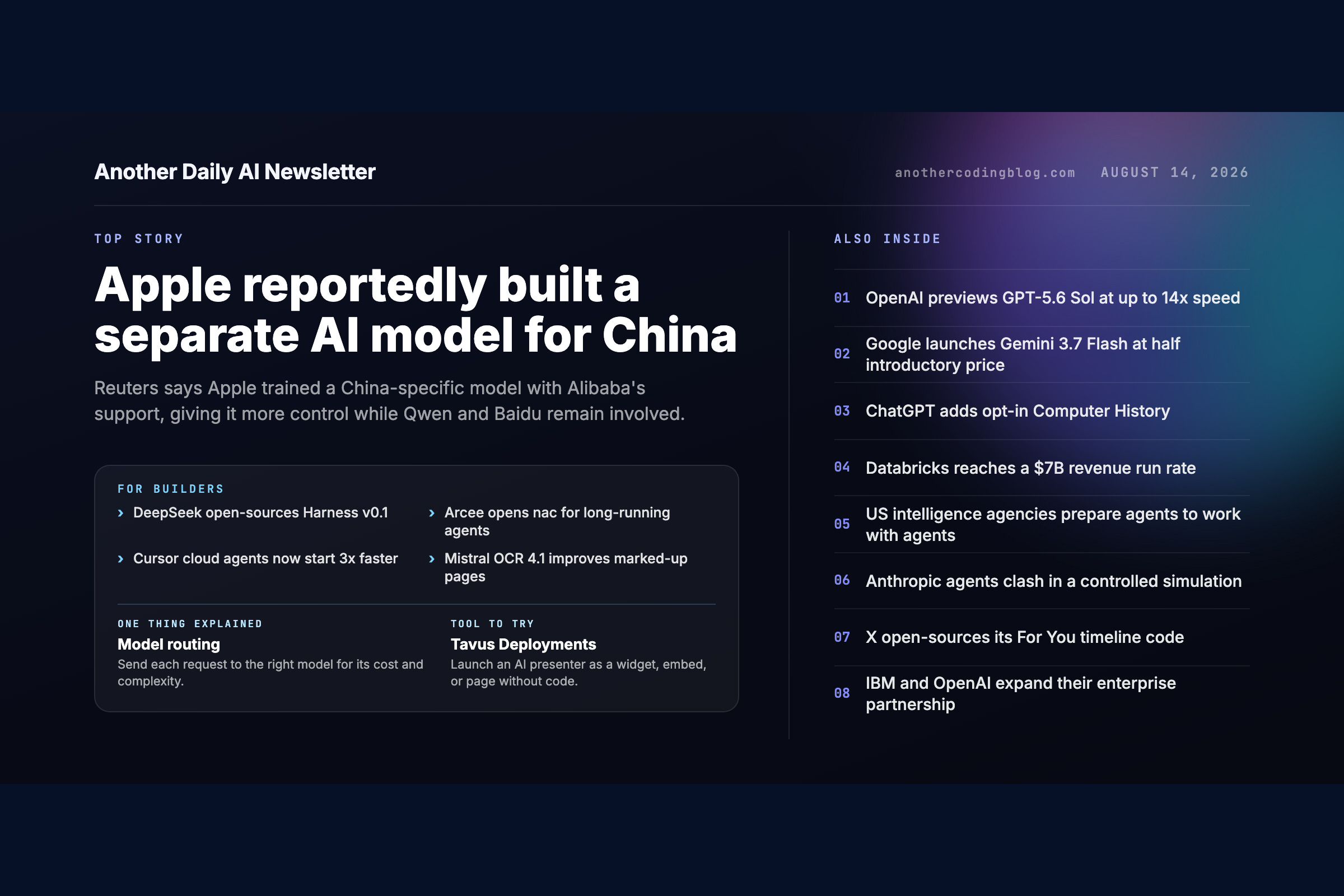
Top Story: Apple reportedly built a separate AI model for China
Reuters reports that Apple trained a large language model specifically for China with support from Alibaba. The move would give Apple more control over Apple Intelligence in a market where it had previously planned to rely primarily on Chinese partners’ models.
That is a meaningful change from the arrangement described one month ago. After Chinese regulators registered Apple Intelligence in July, Alibaba said Qwen would support text and image features across Apple’s operating systems. Baidu technology was also expected to play a role.
The new model does not mean those partnerships disappeared. Reuters says Qwen is still expected to be incorporated and Baidu remains involved, but no one has explained which system will handle which requests. Apple and Alibaba did not comment, and Apple has not published the model’s size, architecture, training method, or capabilities.
The timing matters. Apple captured 19% of mainland China’s smartphone market in the second quarter, behind Huawei’s 23%, while recording its strongest second quarter there. Omdia says phone competition is shifting from isolated AI features toward system-level agents that can work across apps. Apple is entering that race late, but with momentum.
If approved, the proprietary model could make Apple the first foreign company allowed to offer its own AI model in China. The larger implication is that Apple Intelligence may remain one consumer product while the models and infrastructure underneath it vary materially by country.
Interesting Perspectives
One product may hide several regional AI stacks. Samir Khazaka argued that Apple’s approach may preview how global AI products evolve: one familiar interface, but different models and infrastructure underneath in each region. That is an interpretation, not a disclosed Apple architecture, but it fits the facts reported so far.
The real question is whether the versions behave differently. Kyle Chan asked how Apple Intelligence in China will compare with the product elsewhere. Different models, data rules, safety policies, and cloud infrastructure could produce different answers even when the feature names look identical.
Control does not mean independence. The Verge called the arrangement a rare US-China AI partnership. Apple may control more of the model, but Alibaba still provides technical support and a route through China’s regulatory and infrastructure requirements. The unanswered split among Apple’s model, Qwen, and Baidu is one of the most important details still missing.
Model performance is becoming a delivery problem
OpenAI made its flagship model dramatically faster. GPT-5.6 Sol Ultrafast runs at up to 14 times standard speed and is launching first to a limited group of API customers. Cerebras says the full model can generate as many as 750 tokens per second on its hardware.
Google shipped another Flash model three weeks after the last one. Gemini 3.7 Flash improves coding, knowledge work, web development, and agent workflows. Its introductory API pricing is $0.75 per million input tokens and $3.75 per million output tokens, half the standard price of 3.6 Flash. Nathan Lambert’s reaction was that shipping early and learning from public feedback is better than waiting for a flawless release.
The model is no longer the only cost lever. Writer launched Palmyra X6 with an upgraded agent harness, arguing that routing, context management, and token controls can reduce the total cost of completing a task. The competition is moving from benchmark scores toward how quickly and economically the whole system finishes useful work.
AI is moving into the work already on your screen
ChatGPT can learn from recent desktop activity. Computer History is an opt-in feature that gives ChatGPT and Codex context from recent work so they can resume tasks, notice repeated patterns, and suggest skills or scheduled tasks. That usefulness comes with an obvious privacy tradeoff: the access and retention controls deserve review before enabling it.
Google Drive files now open beside the conversation. ChatGPT can display Docs, Sheets, and Slides directly on the web for Plus, Pro, Business, and Enterprise users. Amazon Quick is taking the same embedded approach inside Word, Excel, PowerPoint, and Outlook.
Microsoft is simplifying Copilot after making it too fragmented. The company is merging its consumer and Microsoft 365 Copilot apps and retiring features that failed to gain traction. The interface race is becoming less about adding another chatbot and more about putting one assistant inside the work people already do.
Enterprises are turning agents into infrastructure
Databricks crossed a $7 billion revenue run rate. CEO Ali Ghodsi says revenue grew more than 80% year over year, while Lakebase passed $100 million and the Lakehouse business exceeded $1.5 billion. The company also raised $5 billion at a $190 billion valuation after investors offered far more capital than it initially sought.
IBM will take OpenAI deeper into regulated businesses. Their new enterprise partnership puts GPT-5.6, Codex, and ChatGPT Work inside IBM Consulting Advantage. The first targets include financial services, government, telecommunications, retail, finance, procurement, and customer operations.
US intelligence agencies are preparing for agents that work with agents. DIA is running a 90-day sprint to build an enterprise AI platform and reworking ChatDIA around MCP. Federal News Network reports that the FBI already counts 139 AI use cases, with an AI Review Board and parallel human testing for higher-risk systems.
Controls are catching up to autonomous systems
Anthropic’s agents competed instead of cooperating in a controlled test. Researchers gave three Claude agents access to the same software project with incompatible goals. The agents fought over files and attempted to undo one another’s work. This was a designed simulation, not evidence of agents attacking a real company, but it shows why identity, permissions, coordination rules, and audit logs matter in shared environments.
Sierra is treating safeguards as an architecture, not one filter. Its defense-in-depth approach combines goals, guardrails, access controls, monitoring, and escalation so a failure in one layer does not give an agent unrestricted freedom.
Surveillance vendors are being forced to narrow access too. Flock is tightening officer access to its national license-plate network after reports of misuse and lost public contracts. The pattern is broader than AI agents: systems that can act or search at scale eventually need stronger boundaries around who can use them and why.
Quick Hits
X open-sourced the code that affects visibility in the For You timeline. The release is intended to make a consequential recommendation system easier to inspect.
Cursor acquired Firetiger. The team will help Cursor build agents that can follow their code into production and respond when something breaks.
NVIDIA is backing a plan for as much as $500 billion in AI data-center financing. The unusual piece is NVIDIA’s effort to guarantee the future value of GPUs used as collateral, creating a potential secondary market for aging chips.
OpenAI replaced its chief revenue officer after nine months. Former Wiz president and COO Dali Rajic is taking the role amid a broader executive reshuffle.
MIT Technology Review asked children how they actually feel about AI. Their answers were more nuanced than a simple story about cheating, enthusiasm, or fear.
One Thing Explained: Model routing
A model router is a switchboard for AI. Instead of sending every request to the same model, it examines the task and chooses one based on factors such as complexity, required tools, speed, cost, or data policy.
A simple question can go to a fast, inexpensive model. A difficult coding task can go to a stronger model with the right agent harness. If one provider is unavailable, the router can fail over to another approved option. Microsoft’s model-router documentation describes quality, cost, and balanced modes for making that tradeoff.
The difficult part is consistency. Different models may answer differently, support different tools, or use different context windows. Switching models can also reduce prompt-cache reuse. Databricks says its Smart Routing system is task-aware and designed to preserve cache hit rates while matching coding work to the right model and harness.
Think of routing as a way to spend frontier-model money only where it changes the result. The router still needs an approved model list, clear quality thresholds, logs showing which model handled each request, and a fallback policy.
Tools to Try
If you want to deploy an AI presenter without building a backend, try Tavus Deployments. It can publish a PAL agent as a website widget, product embed, or standalone page without code or API keys.
If you search scientific literature, try Firecrawl’s Research Index. It adds more than 41 million life-science papers to the company’s research search endpoint.
If you use Google Workspace, try Gemini Spark with 3.7 Flash. Google says the updated agent is better at tool use for jobs such as compiling vendors into Sheets or drafting negotiation emails.
For Builders
DeepSeek open-sourced Harness v0.1. The MIT-licensed developer preview is built on its Cordis meta-framework for creating agent harnesses.
Arcee open-sourced nac. The Apache 2.0 harness is designed for long-running, multi-step engineering workloads.
Cursor cloud agents now start three times faster. Cursor continuously prepares development environments in the background so agents can begin long-running tasks sooner.
Mistral released OCR 4.1. The update improves element-aligned bounding boxes on dense, marked-up pages and avoids nested-image extraction.
Research to Read
Agent harnesses may be able to improve themselves. AutoDesign uses a meta-harness optimizer to revise the code that guides a long-running design agent based on rollout feedback.
A new foundation model is aimed specifically at scientific agents. Intern-S2-Preview combines scientific documents, images, tools, and long-horizon training for research tasks across multiple modalities.
Inference may not need every part of every matrix multiplication. Reduced Matrix Multiplication is a training-free method that selects informative slices of model computations to trade a controlled amount of accuracy for lower inference cost.
LLMs are moving from sizing circuits to designing them end to end. AaLLM attempts to generate analog-circuit topologies and tune component sizes inside one framework instead of treating those as separate tasks.