

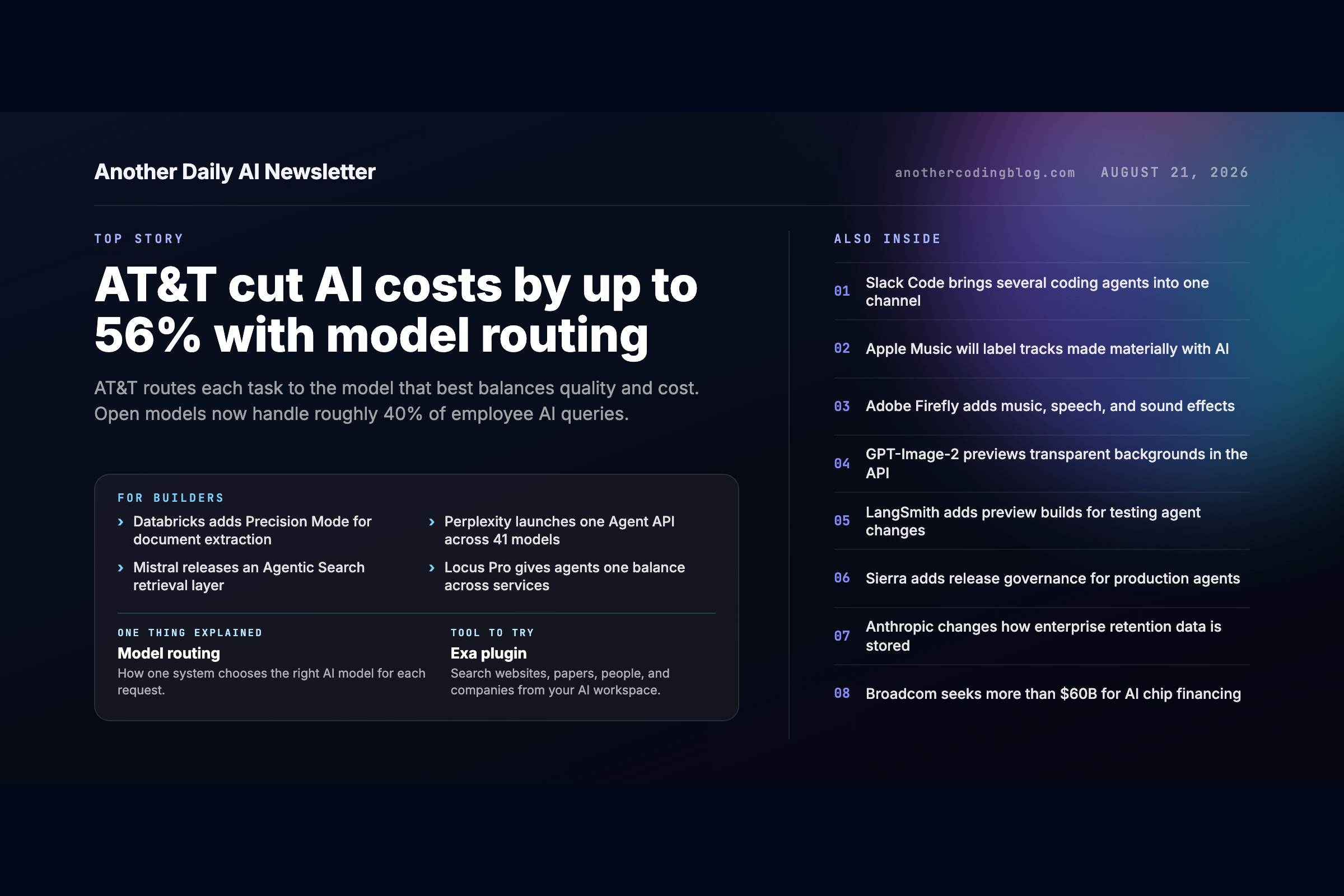
AT&T cut AI costs by up to 56% with model routing
AT&T is treating AI models less like one permanent vendor and more like a portfolio. Fresh reporting says the company reduced costs by as much as 56% on coding and other advanced tasks by using a router to choose between premium and lower-cost models. AT&T reported only a 2% decline in output quality for those workloads.
Open models now handle roughly 40% of employee AI queries, with AT&T aiming for 60% to 70%. The company is using models including NVIDIA’s Nemotron, Meta’s Llama, and Google’s Gemma, while reserving leading closed models for work that still needs their stronger capabilities. AT&T says open models generally trail the frontier by six to ten months, but many are already good enough for routine enterprise work.
This is operating at substantial internal scale. AT&T told VentureBeat in February that Ask AT&T Workflows had reached more than 100,000 employees, with more than half reporting daily use. AT&T’s reported volume increased from 27 billion tokens per day in that interview to 45 billion per day by July.
At every turn, AT&T’s broader AI Gateway weighs expected quality against speed and cost, and can change models during a conversation. The company says that system has reduced costs by as much as 90% on some workloads and is already saving millions.
The 56% and 90% figures describe different measurements. The first covers coding and other advanced tasks routed through LiteLLM; the second is AT&T’s broader maximum for its proprietary gateway. Both are company-reported results rather than independently audited fleetwide averages. The architecture still matters: an enterprise does not need every prompt to run through the most capable and expensive model. It needs a reliable way to recognize which prompts actually require one.
Interesting Perspectives
Open models are leverage, not a complete break from frontier labs. AT&T wants to keep employee spending with Anthropic and OpenAI flat while increasing the open-model share. It is not currently using DeepSeek or Moonshot models and says it is still evaluating their risks, showing that a larger model pool still needs an approved boundary. Read the current reporting
The savings depend on knowing when to escalate. In NVIDIA’s own Switchyard tests, a router sent only 7% of calls to a frontier model and cut costs 74%, but accepted an approximately six-point accuracy decline. That comparison makes AT&T’s reported 2% quality loss important, while reinforcing why each company must evaluate routing on its own work. Read NVIDIA’s results
Specialization changes what “good enough” means. AT&T has also trained telecom-specific OTel models using industry data from GSMA. The goal is a smaller model that understands telecom terminology and workflows well enough to replace a general-purpose model for narrow tasks. Read the Google Cloud case study
AI work is moving into shared team surfaces
The newest workplace agents are being designed around collaboration, handoffs, and reusable context instead of a private chat window.
Slack Code brings several coding agents into one channel. Teams can guide Claude Code, Devin, GitHub Copilot, ChatGPT, and Vercel agents together, keeping the people and agents working on a project in the same conversation. See Slack’s announcement
ChatGPT Sites now supports collaborative editing. OpenAI says teams can add editors to the same site project while Codex manages git and continuous integration behind the scenes. See the update
Notion is making successful agent work reusable. Teams can share Skills, ask Notion’s agent to turn a proven workflow into a Skill, and load those instructions into local agents. See how shared Skills work
Codex and ChatGPT Work can now share read-only build threads. The links preserve the context behind pull requests, technical deep dives, and handoffs without giving recipients editing control. See the announcement
Creative AI is becoming more capable and more visible
Creation tools are expanding into complete production suites while distribution platforms begin telling audiences when AI materially shaped the result.
Apple Music will add a “Made With AI” label later this year. Labels and distributors will identify tracks materially created with AI, although the system relies on self-reporting. Read Variety’s report
Adobe Firefly can now generate music, speech, and sound effects. Its generally available tools include controls for mood, pacing, voice, and timing. See the Firefly update
GPT-Image-2 is previewing transparent backgrounds in the API. It removes a production step for product assets, icons, and composited graphics. See the API preview
Agent teams are adding change control before production
As agents gain access to browsers, files, and business systems, teams are building deployment practices that look more like software release management.
LangSmith Preview Builds test agent changes before they reach users. Teams can evaluate an isolated version against production before promoting it. Read the announcement
Sierra added release governance for agents at scale. Organizations can set approvals, assign ownership, and control which versions reach each environment or customer. See Sierra’s release controls
AWS can translate written business rules into enforceable agent policies. Bedrock AgentCore converts natural language into controls for tool arguments, required steps, rate limits, and cumulative actions. Read the technical walkthrough
One Thing Explained: Model routing
A model router is a traffic controller for AI requests. It estimates what each task needs and chooses from several models.
A routine summary might go to a small, inexpensive model. A difficult coding problem can escalate to a frontier model. Routers can also consider quality, latency, budgets, availability, and conversation context.
The hard part is knowing when a cheaper answer could cause an expensive mistake. Teams need evaluations, confidence thresholds, monitoring, and clear escalation rules. Go deeper with LiteLLM’s routing documentation and the independent RouteLLM research.
Tools to Try
If you research in Codex or ChatGPT, try Exa’s new plugin. It searches websites, documents, papers, people, and company records inside the conversation.
If your conversations live in Apple Messages, try the ChatGPT Messages plugin. On Mac, it can search and summarize chats, draft replies, and send after approval.
If you want a structured introduction to Claude, try Claude Academy. Its free courses cover Claude, prompting, APIs, and responsible use.
If you want to test a mystery model, try Ox Alpha in OpenCode while it is free this week. Its maker is undisclosed, so treat OpenCode’s capability and privacy claims as unverified.
For Builders
Databricks added Precision Mode for difficult document extraction. AI Extract handles long documents, nested outputs, and details spread across pages.
Claude’s computer use, browser, Skills, and Files APIs are generally available. Builders can combine application control, reusable instructions, and persistent files without beta interfaces.
Perplexity launched an Agent API across 41 models and nine providers. One interface combines model choice with web, finance, fetch, and sandboxed-code tools.
Mistral released an Agentic Search retrieval layer. It decides when to search, gathers evidence, and returns grounded results to an agent.
Liquid AI accelerated LFM2.5 with speculative decoding. A smaller model drafts likely tokens for the main model to verify, increasing throughput without changing the output.
Vercel documented how v0 connects to Snowflake without exposing OAuth tokens. A proxy injects credentials only into approved authentication fields outside the generated-code sandbox.
Locus Pro gives agents one balance and API key across hundreds of services. It adds per-user ledgers, spending controls, and usage-based billing; access is currently limited.
Research Radar
LLMs and embedding models nearly tied, but the price gap was enormous. Across 37 tasks, the best scores were 77.6 and 77.2 while an LLM could cost up to 1,431 times more. Read The Embedder’s Dilemma
Meta is testing a broader way to judge generated media. WildArtifactBench combines human preferences, agent judges, win rates, and Elo-style scoring for finished creative work. See the research preview
Quick Hits
Anthropic plans to let enterprises keep required retention data in their own clouds. Its 30-day policy would still apply to covered frontier-model traffic. Read the report
Broadcom is seeking more than $60 billion for AI chip financing. Discussions involving Anthropic and other customers could push the total to $100 billion. Read the report
GPT-5.6 can now use cross-region capacity on Amazon Bedrock. Sol, Terra, and Luna can route requests across approved regions for more throughput. Read the AWS announcement
Wayve and Uber started early-access autonomous rides in London ahead of a broader public launch. See the update
Harvey and Fireworks post-trained Kimi K3 for legal work. Harvey reports that Tenet nearly doubled task completion over the base model in its testing. See the release
Chroma previewed a self-improving memory system for agents. Foundation turns prior sessions into reusable strategies and preferences. See the research preview
OpenAI introduced AI Futures to study AI’s effects on jobs, institutions, competitiveness, and public policy. Read the announcement
ChatGPT Search is using site-specific queries at scale. Simon Willison found it targeting individual domains with the `site:` operator. Read the analysis
Muse Spark 1.2 topped Design Arena’s video-to-website leaderboard and ranked second for image-to-HTML. See the results