
Another Daily AI Newsletter - August 1

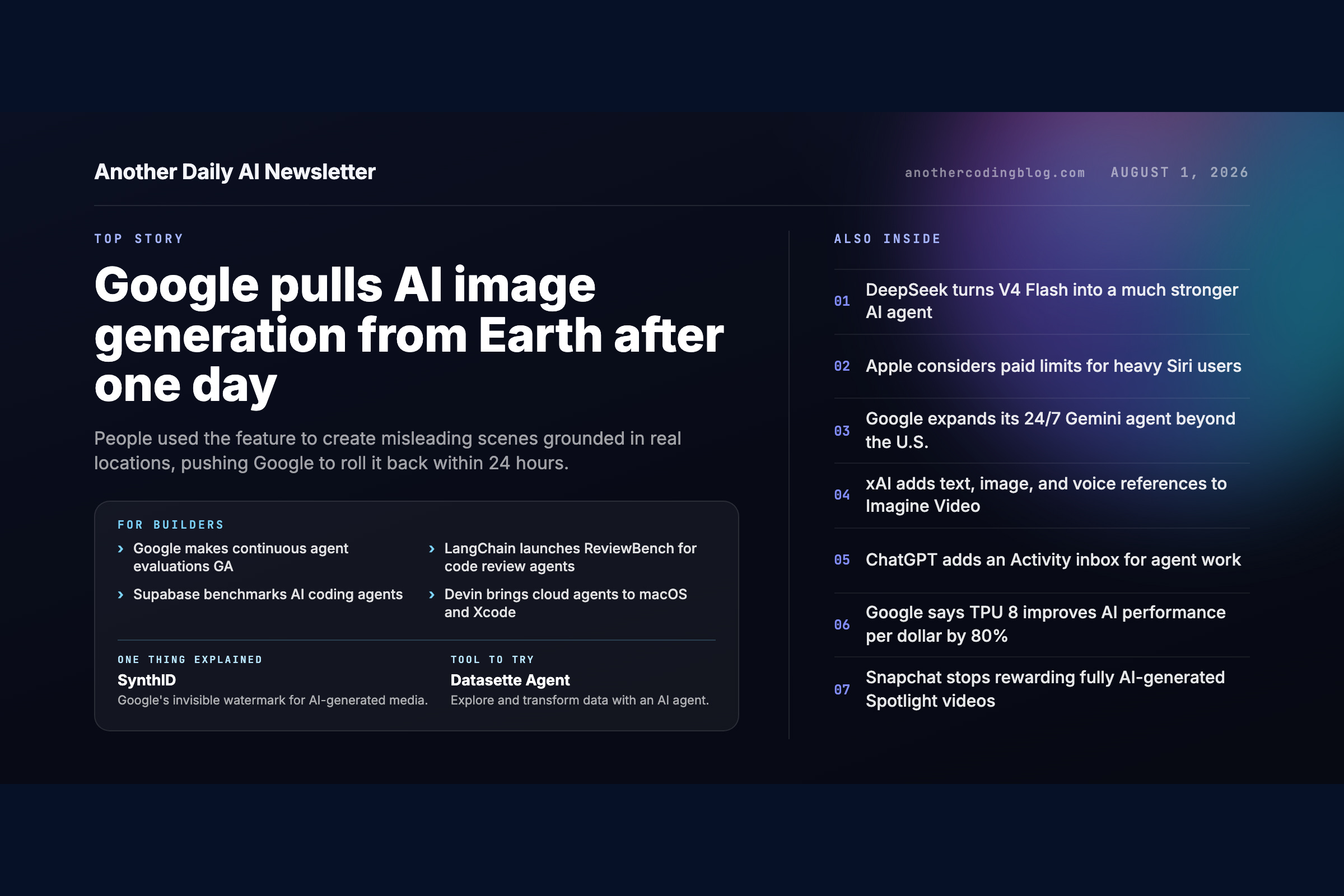
Top Story: Google pulls AI image generation from Earth after one day
Google added Nano Banana 2 image generation to Google Earth on July 30, allowing anyone to transform real satellite, aerial, and 3D scenes with a prompt. Google’s examples included reconstructing Pompeii, redesigning an empty lot, and previewing a house. The feature launched globally on the web.
Within hours, people were using it to create misleading scenes grounded in recognizable locations. Open-source investigator Henk van Ess demonstrated how quickly fabricated events could be placed inside real-world geography. The images inherited Google Earth’s perspective and familiar interface, giving a generated scene more credibility when it traveled as a screenshot.
Google said generated images were separate from the shared Google Earth imagery and carried its invisible SynthID watermark. That protected the underlying map, but it did not solve the screenshot problem. Images shared through screen recordings, crops, and reposts can lose the context that tells a viewer they came from a generator. Van Ess also showed an external detector failing to flag one reposted example.
Google rolled the feature back on July 31, saying people had shared generated imagery that appeared to violate its policies and that stronger guardrails were needed. The one-day release exposed a product-design risk: when generative media is placed inside a service people already use as visual evidence, the surrounding product becomes part of how believable the output appears.
Interesting Perspectives
Van Ess focused on inherited trust. Google Earth remains an intact archive, but a fabricated export can circulate without showing whether it came from the historical record or the image generator.
WITNESS researchers called Google Earth part of the world’s verification infrastructure. Journalists, courts, and human-rights investigators use it to test claims, which made outside review especially important before launch.
TechCrunch framed the rollback as a problem of friction. Fabricating geospatial imagery was already possible; embedding the generator in Earth reduced the work to a prompt and a screenshot.
Model performance is becoming a systems problem
DeepSeek turned V4 Flash into a much stronger agent through post-training. The MIT-licensed release keeps the preview’s architecture but adds major vendor-reported gains: Terminal Bench 2.1 rose from 61.8 to 82.7 and DeepSWE from 7.3 to 54.4. Those results used an unreleased DeepSeek harness at maximum reasoning effort, and two listed evaluations are internal, so independent reruns still matter.
Google says TPU 8 improves low-latency serving performance per dollar by as much as 80%. The new 8i and 8t systems can scale across more than one million chips. The claim is Google’s, but it shows where model competition is heading: capability gains increasingly depend on the chips, serving software, and routing beneath the model.
Kimi K3 is now available in Microsoft Foundry through Fireworks AI. Microsoft describes it as a 2.8-trillion-parameter open-weight model with a one-million-token context window. Distribution through a major enterprise platform makes a large Chinese open model easier for companies to evaluate without operating the infrastructure themselves.
The agent stack is building a measurement layer
Google made continuous agent and model evaluations generally available. Teams can use one evaluation engine across development and production, with more than 20 built-in or custom metrics and adaptive rubrics. That brings testing closer to the live environment where an agent’s tools, data, and permissions affect its behavior.
Supabase launched Evals for AI coding agents. It runs Claude Code, Codex, OpenCode, and other agents against real Supabase tasks, then scores the work. The useful shift is toward product-specific tests that measure whether an agent can navigate the actual stack a team uses.
LangChain released ReviewBench for code-review agents. Its tasks come from issues that human reviewers caught in real pull requests. That grounds the benchmark in whether an agent finds useful review comments rather than whether it passes another synthetic coding problem.
Composio found that changing the agent harness changed both cost and success. On the same model and tasks, its self-reported experiment produced a 3.8-times difference in cost per task and moved success from 17 to 21 of 26 tasks. Model choice is only one variable in agent performance.
Personal agents are becoming background workers
Google is expanding Gemini Spark beyond the United States. The persistent agent works in the background under a user’s direction and is rolling out to Google AI Pro subscribers in additional countries. Its usefulness will depend on which services it can access and how clearly it reports what happened while the user was away.
ChatGPT added an Activity inbox for agent work. The desktop view collects conversations that need attention and recent project updates. As tasks become asynchronous, products need a place to show approvals, failures, questions, and finished work without forcing users to reopen every chat.
Notion meeting notes can now trigger Custom Agents. Once a summary is ready, an agent can create tasks, update a project tracker or CRM, and send next steps to Slack. The meeting becomes an automated starting event for the rest of the workflow.
AI is widening the boundaries of individual jobs
OpenAI analyzed more than 800,000 work-related ChatGPT messages and found that 43.5% of occupation-specific use involved tasks associated with another occupation. Marketers troubleshoot software, salespeople analyze data, and small-business owners draft contracts or financial work. Ethan Mollick connected the result to similar findings from a Procter & Gamble study: the division of labor may change before job titles do.
Dutch insurer Unive reports broad internal ChatGPT adoption. OpenAI’s customer case says 97% of enterprise licenses were activated, 85% of employees use the product weekly, and staff created roughly 1,500 custom GPTs. One workflow reduced preparation of pet-insurance claims from hours to minutes. The figures are self-reported, but they show what adoption looks like when employees build tools for their own work.
Media tools add control while platforms rewrite incentives
xAI added text, image, and voice references to Imagine Video 1.5. The model can generate native 1080p video and use multiple references to preserve a character, look, or voice. References move video generation closer to repeatable production instead of starting every clip from a fresh prompt.
Qwen released Audio 3.0 ASR Flash. The transcription model adds custom hotwords, domain-term recognition, context consistency, and automatic polishing into structured transcripts. Those features target the names, jargon, and formatting errors that make general speech-to-text frustrating in specialized work.
Smallest.ai raised $13 million for low-latency voice agents. The company is building smaller, specialized models that listen, reason, and speak with less conversational delay. Its bet is that natural timing and interruption handling matter as much as raw language-model intelligence in a phone call.
Snapchat stopped rewarding fully AI-generated Spotlight videos. AI-assisted edits remain allowed, but only videos made by real people will qualify for Spotlight recommendations and rewards. The policy draws an economic line between AI as a creative tool and AI as the entire piece of content.
Research Worth Reading
Echoverse trains computer-use agents in environments that evolve with them. Microsoft created twelve simulated worlds in which the tasks and environments become harder as the agent improves. The team reports that a 9-billion-parameter model rose from 36.5% to 67.1% across its evaluation, offering a way to train long-running computer use without repeatedly exhausting a fixed benchmark.
Spatial-IQ exposes how poorly multimodal models reason about hidden 3D objects. NVIDIA reports 82.1% accuracy for humans and 17.7% for the best off-the-shelf model on a benchmark that separates object counting into nine perceptual and reasoning tasks.
Value Leakage tests whether a model’s own learned preferences quietly shape its advice. The researchers found answers can favor values expressed by the model in another context without disclosing that influence in the reasoning. The work matters for advice systems expected to separate factual judgment from hidden preference.
One Thing Explained: SynthID
SynthID is Google’s invisible watermark for AI-generated images, audio, video, and text. It changes the generated media in ways people should not notice but Google’s detector can recognize. The image watermark is designed to survive common changes such as cropping, filters, and lossy compression.
Google also says SynthID is not foolproof against extreme manipulation. The Earth incident shows the practical gap: people often encounter a screenshot, recording, or repost rather than the original file. Watermarking can support verification, but the viewing context and an accessible detection path still determine whether anyone checks.
Tools to Try
If you work with CSV or SQLite data, try Datasette Agent. The latest release lets agent plugins execute JavaScript in the user’s browser, making it possible to inspect, transform, and visualize data inside the Datasette interface.
If an AI gives you an HTML prototype that is awkward to edit, try Artifactor. It turns generated HTML into a directly editable artifact so you can adjust the result without returning to a long prompt-and-regenerate loop.
For Builders
Devin Cloud Agents can now run macOS, Xcode, and the iOS simulator. That gives the remote agent a real Apple development environment for building, signing, playing, and testing native iOS apps.
NVIDIA published a guide to designing attention for responsive long-context inference. It connects head grouping, head dimensions, and sequence length to the different bottlenecks in prompt processing and token generation.
Fireworks suggests three checks before replacing LoRA with full fine-tuning. Test data coverage, optimization, and rank first. Its experiments found that inexpensive adjustments sometimes closed the gap and sometimes revealed when full fine-tuning was justified.
GitHub added team-level Copilot model policies in public preview. Enterprise administrators can set a company baseline, then grant additional models to specific teams for role-based access or early testing.
Quick Hits
Apple is considering paid compute limits for heavy Siri users. Tim Cook said power users may eventually buy more capacity through iCloud+, though the plan is not final.
OpenAI will remove GPT-5.4 and GPT-5.4 mini from ChatGPT on August 31. Both models will remain available through the API and API-key-authenticated Codex sessions.
GitHub Copilot deprecated Gemini 2.5 Pro and Gemini 3 Flash. GitHub recommends Gemini 3.1 Pro Preview and Gemini 3.6 Flash as replacements.
Google DeepMind published a new conversation about Gemini Robotics 2. The 39-minute discussion covers the model, the arc of robotics progress, and where the team expects the field to move next.
The Google AI Studio mobile project changed direction after more than 800,000 preorders across 168 countries. The team says it is pursuing an approach that avoids asking users to download another standalone app.